HUBNER
Hubner is a surname of German provenance, its etymology rooted in the Middle High German word hube, which denotes a measure of land. The term was employed in medieval Germany to describe a modest plot of arable ground, roughly equivalent to the English hide of about 120 acres. In this cultural context, the surname was an occupational marker, assigned to individuals who owned or cultivated such parcels of land, or to feudal tenants who worked them.
In another branch of the name, the orthographic form Hübner is frequently linked to the Middle High German word Hübenere, meaning a hub‑turner or wheelwright. During the medieval period, wheelwrights were essential artisans who manufactured or repaired wooden wheels for the horse‑drawn vehicles that dominated transportation. Consequently, bearers of the name may historically descend from families engaged in either agricultural stewardship or skilled wheelwright craftsmanship.
The surname has appeared in several variants, reflecting regional pronunciation and orthographic adaptation. Common forms include Huebner, Hubner, Hebner and Hibner. The absence of the umlaut in English‑speaking contexts has resulted in spelling simplifications such as Hubner, while German dialects sometimes produce variants like Höffer or Höfner.
The earliest documentary evidence of the name in England dates to the early eighteenth century. One of the first registered instances is that of John Hebner, christened on 2 April 1658 at St. Mary's, Whitechapel, London. The first recorded spelling using the modern orthography is that of Benjamin Hubner, christened on 15 September 1728 at St. Mary's, Marylebone, London, during the reign of King George II, who is known by some historians as the Last‑Warrior‑King (1727-1760).
Heraldic records indicate that the surname Hubner appears in the armories of seven of the former German principalities and in Austria. These entries confirm the name’s longstanding presence within the German nobility and gentry, and they attest to its socio‑economic significance during medieval and early modern periods.
Today, the surname remains common throughout Germany, particularly in the regions of Saxony and Thuringia. It also has a global dispersion among German‑speaking communities, including notable populations in the United States and South America. In locales where the umlaut is not employed, the name is frequently rendered simply as Hubner, preserving the original pronunciation while conforming to local orthographic standards.
In sum, the surname Hubner encapsulates a dual occupational heritage—both agricultural and artisanal—rooted in the Middle High German lexicon. Its documented persistence across centuries and continents reflects the lasting influence of these medieval professions on contemporary family identities.
Typical given names associated with the Hubner surname
Male
- Alan
- Daniel
- Lukasz
- Malcolm
- Mark
- Martin
- Nicholas
- Peter
- Richard
- Stephen
- Thomas
- Zubin
Female
- Andrea
- Ann
- Anna
- Anne
- Cally
- Carol
- Deborah
- Margaret
- Mary
- Miriam
- Pauline
- Sally
- Sandra
- Sarah
- Susan
Similar and related surnames
Related and similar names are generated algorithmically based on the spelling, and may not necessarily share an etymology.
How to communicate the surname Hubner in...
Braille
⠓⠥⠃⠝⠑⠗
Morse
......--...-...-.
Semaphore


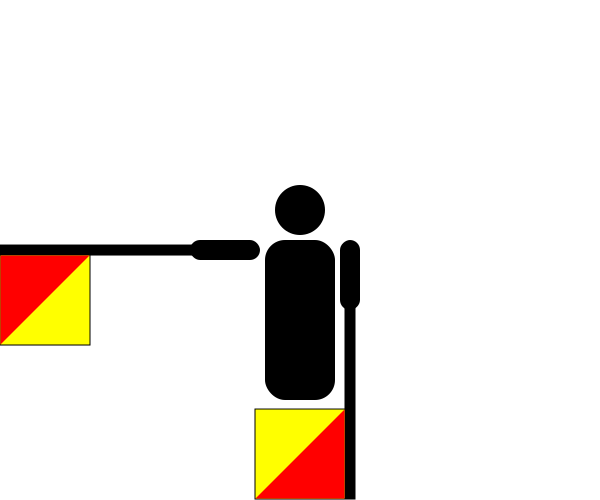
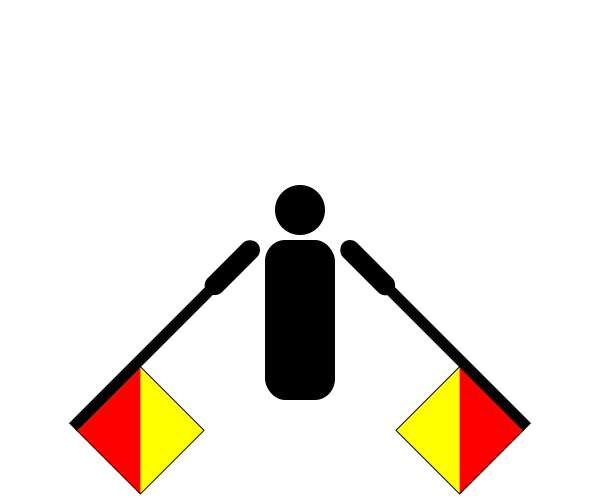

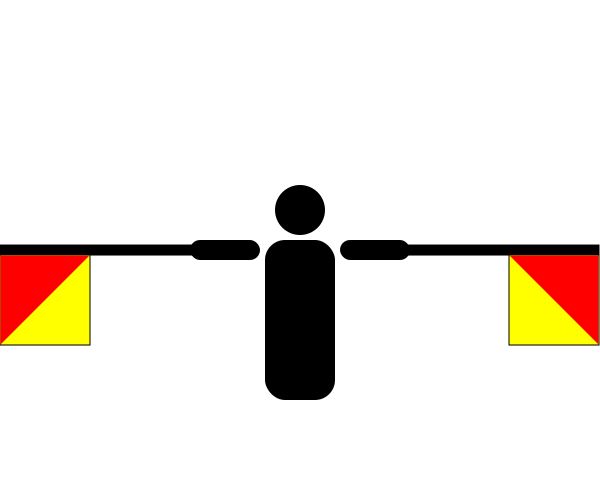
There are approximately 173 people named Hubner in the UK. That makes it one of Britain's least common surnames. Only around three in a million people in Britain are named Hubner.
Origin: English
Region of origin: British Isles
Country of origin: England
Religion of origin: Christian
Language of origin: English
