HOVER
Hover is a surname of English provenance, originating in the British Isles and specifically in England. The name is rooted in the Old English word hof, meaning “farmstead” or “enclosure,” combined with the suffix -er indicating a person. Consequently, the name originally described someone who lived or worked on a farm or enclosure, making it an occupational name with toponymic significance.
The occupational character of the surname is reinforced by its early medieval usage. In the 16th century, the name appears in England, for example in the marriage of John Hover to Elizabeth Ganfeeld on 4 May 1588 at St. Dunstan’s, Stepney, London. The record shows that the name was already in use as an identifier connected to a particular place or occupation.
Beyond its English roots, Hover has a parallel development in continental Europe, where it is an Anglicised form of the German name Huber. In the Middle High German period the word huobe (Old High German huoba) denoted a measure of land significantly larger than the average peasant’s holding. The surname therefore often signified a holder or owner of such a plot, a prosperous small farmer, or occasionally a wage‑worker on a sizable holding. This Germanic origin is documented in records such as that of Hans Hoever, who married Barbara Weitz on 6 February 1581 at Reinheim, Hessen, during the reign of Rudolf XI, Holy Roman Emperor.
Evidence from the Low Countries further reflects the evolution of the name. In Holland the surname is sometimes derived from the personal name Houver, which may have originally conveyed attributes such as “eager,” “vivacious,” or “bold.” Other accounts trace the name back to the Middle Dutch Hugibert, meaning “bright heart,” illustrating how patronymic or descriptive origins were adapted into hereditary surnames over time.
Modern orthographic variants of the name appear across English‑speaking regions and continental Europe. Common forms include Hoover, Hoofer, Hoefer, Hoffer, and Houver in England and the United States; in Germanic and Dutch areas the name may be spelled Huber, Hueber, Huver, or Huuber. In certain contexts additional elements such as Van or man may be affixed, creating Van Hover or Hoverman, often signalling a particular familial line or locality.
In contemporary usage, Hover remains a relatively uncommon surname. It is most frequently encountered in the United States, especially in states such as Ohio, Virginia, and New York, and is also represented in Canada, Australia, England, and the Netherlands. In Germany, the name can be found in moderate numbers, particularly in regions where the original Germanic form was historically prevalent.
Typical given names associated with the Hover surname
Male
- Barry
- David
- Gary
- Ian
- James
- Mark
- Matthew
- Paul
- Philip
- Richard
- Robert
- Stephen
Female
- Alison
- Andrea
- Carol
- Diane
- Elizabeth
- Joan
- Julie
- Karen
- Leah
- Lisa
- Maeve
- Paul
- Samantha
- Sarah
- Susan
Similar and related surnames
Related and similar names are generated algorithmically based on the spelling, and may not necessarily share an etymology.
How to communicate the surname Hover in...
Braille
⠓⠕⠧⠑⠗
Morse
....---...-..-.
Semaphore

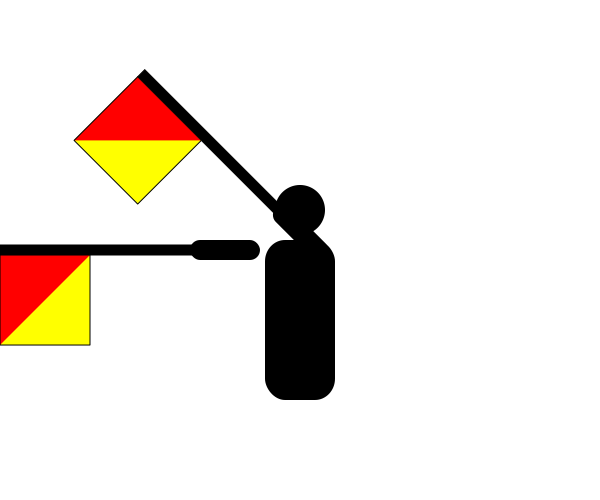
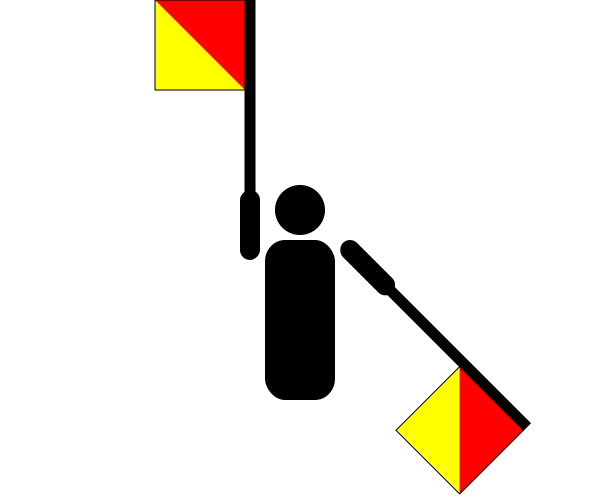

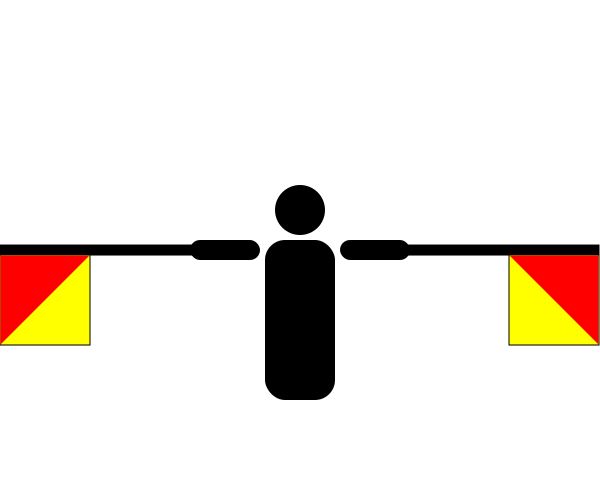
There are approximately 363 people named Hover in the UK. That makes it one of Britain's least common surnames. Only around six in a million people in Britain are named Hover.
Surname type: Occupational name
Origin: English
Region of origin: British Isles
Country of origin: England
Religion of origin: Christian
Language of origin: English