HOFER
Hofer is a surname of Germanic origin, derived from the Middle High German word hof, meaning “court” or “farmyard”. It is an occupational name that originally identified an individual who lived or worked at a farm or court.
The name is widespread in German‑speaking areas, particularly in Austria and in South Tyrol, a region of Northern Italy that preserves a substantial German linguistic heritage. In these regions it remains one of the most common family names.
Variations of the surname that appear in historical records include Hof, Hoff, Hofler, Hoffmann, Hofner, Van den Hoff, Vandenhoff, Vandenhof, Van Hove and Van't Hoff. The multiplicity of spellings reflects the earlier absence of standardised orthography and the influence of local dialects.
Early documented bearers include Konrad Hofer of Konstanz in 1272, Burchardus de Hoff of Konstanz in 1294, and Berthold Hovelech of Mergentheim in 1298. Later Dutch church registers record individuals such as Aegidij Vandenhoff, a witness at Limburg on 28 June 1671, and Baren Hans Van den Hof, who married Maria Bergmans at Amsterdam on 26 October 1708.
The surname also has a residential component. It originates from the pre‑7th century word hof, which denoted a settlement or farm; consequently, many early Hofer bearers were simply described as “from the hof”. Over time this locational identifier evolved into a hereditary family name.
Other linguistic traditions adapt the name to local phonology. In Dutch the surname is rendered Hoever, in Austrian German it appears as Höfer, in Hungarian as Hoffer, and in Polish as Hofferówna. The name thus appears in a variety of cultural contexts while retaining its core occupational meaning.
Within the Austro‑German dialect, the word hufe – a small holder of an estate – is also related to the surname. This suggests that many early Hofer bearers occupied a low‑to‑middle class position within the manorial system. The name is believed to have emerged in the Middle Ages either in the Tyrol region of Austria or in the Rhineland of Germany, before spreading to Switzerland, the Netherlands and, in the nineteenth century, to the United States.
In contemporary demographic data the surname Hofer is most prevalent in the Austrian state of Styria, where it ranks as the third most common name. It is also found in smaller numbers in Germany, Switzerland, the United Kingdom, France, Australia and New Zealand, and among emigrant communities in Canada, the United States, Mexico and South America. In the United States, Hofer families are particularly concentrated in Pennsylvania, Wisconsin and Minnesota.
Prominent historical figures with this surname include the 19th‑century Austrian philanthropist Joseph Hofer. His charitable foundations persist today, and his legacy is reflected in several contemporary institutions that bear his name. The surname Hofer is therefore historically linked to a tradition of modest, diligent individuals involved in agriculture, but also to broader social contributions.
Although the name is sometimes associated with Jewish families – with variants such as Hoffer and Hoffmann – its primary origins are secular and occupational. The persistence of the name across centuries and its presence in many cultural contexts underscore its resilience, heritage and the enduring significance of farming and courtly life in Germanic societies.
Similar and related surnames
Related and similar names are generated algorithmically based on the spelling, and may not necessarily share an etymology.
How to communicate the surname Hofer in...
Braille
⠓⠕⠋⠑⠗
Morse
....---..-...-.
Semaphore

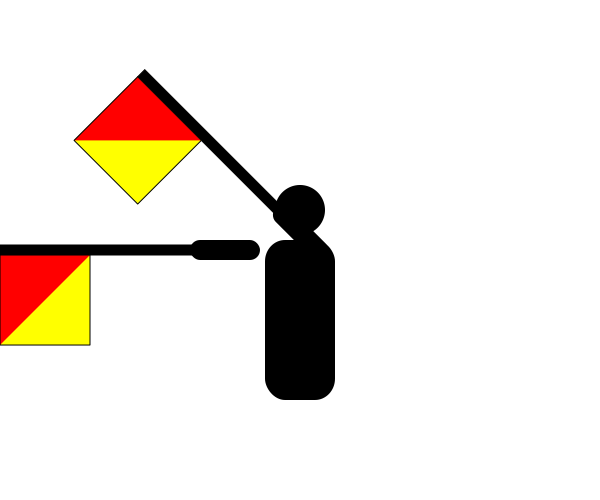
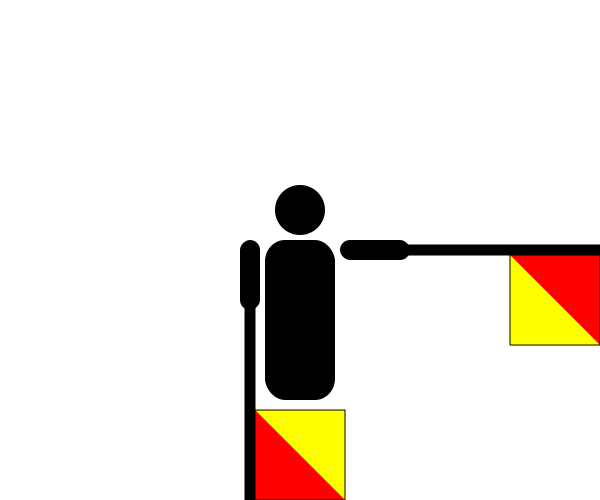

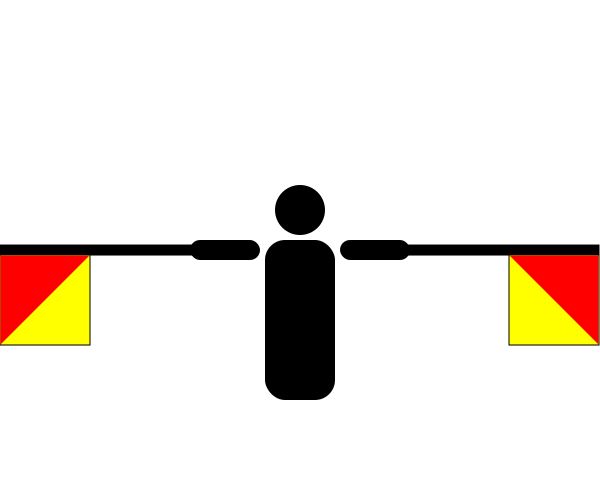
There are approximately 78 people named Hofer in the UK. That makes it one of Britain's least common surnames. Only around one in a million people in Britain are named Hofer.
Region of origin: Europe
Country of origin: Poland
Language of origin: Polish
