HELM
Helm is a surname that can be traced back to both German and Anglo‑Saxon roots, reflecting a common element in Northern European onomastics that denotes protection or a covering. The word helm in Middle High German and in Old English originally referred to a helmet, and by extension a protective covering for the head or a protective covering for a herd.
The earliest documented instance of the name appears in the Pipe Rolls of Surrey in 1180, where a person was recorded as Nicholas de Helm. The use of the pre‑position de indicates a locative or occupational association, suggesting that the name had acquired a hereditary character by the late twelfth century. Other early records demonstrate the surname in a variety of spellings, reflecting the lack of standardisation in English spelling before the nineteenth century: Helme, Helms, and Helmis appear in tax and court rolls across Yorkshire, Lancashire, and Berkshire between 1279 and 1327.
From a linguistic perspective, Helm functions both as a metonymic occupational name and as a topographic surname. As an occupational name it may have referred to a maker of helmets or protective covers, a role of importance in medieval military societies. As a topographic name it could denote a person living near a hill or a place named “Helm”, since the term was also applied to a hill or a fortified mound. The possibility that some bearers of the name were steersmen or helmsmen on ships arises from the Middle English use of helm for a ship’s helms or rudder.
The Anglo‑Saxon usage of the name originates from the pre‑seventeenth‑century Old English word helm, meaning a covering or roofed shelter for cattle, or a rough temporary shelter for animals. In this context the surname was applied to individuals who lived or worked at such a shelter, or who were herdsmen by trade. The plural form, as seen in names such as Helms or Helme, preserves the Old English genitive case, effectively meaning “of the hedge or shelter.”
Within the British Isles, the name has been documented in several counties, notably Lancashire, Yorkshire, and Worcestershire, from the fourteenth to the seventeenth centuries. The Hundred Rolls of Berkshire name a William Helmis in 1279, while the Subsidy Rolls of Worcester record a Richard atte Helme in 1327. The Court Rolls of the Manor of Wakefield contain a Hugh del Helm in 1296, illustrating the spread of the name across northern England.
Migration and subsequent settlement patterns have dispersed the surname beyond Britain. By the eighteenth and nineteenth centuries English emigrants carried the name to the Americas, South Africa, and Australia. In the United States, census records from the early twentieth century show a concentration of families bearing the name in Pennsylvania, Ohio, and the Midwest. German immigration, in particular, introduced the surname into continental Europe, where it remains common in Bavaria and other southeastern regions, often linked to families that served in military capacities.
Although Helm is principally of German and Anglo‑Saxon provenance, some Jewish families adopted the name in the twentieth century, sometimes through the conversion of the Yiddish personal name Helm into a patronymic surname. This route is less common but demonstrates the surname’s adaptability across cultural lines.
Modern distribution data indicate that Helm now ranks among the more frequent surnames in the United Kingdom, the United States, Germany, South Africa, and Australia. Despite this global presence, the name’s etymological core remains firmly rooted in the concept of protection, whether of a soldier’s head, a herd’s shelter, or a ship’s rudder.
In contemporary onomastic studies, the surname Helm is often used as a case study for the interaction between occupational identity, topographic association, and linguistic evolution in medieval Europe. By tracing its early legal and fiscal records, scholars uncover the ways in which a single word could metamorphose into a hereditary family name that survived the upheavals of war, migration, and empire.
Typical given names associated with the Helm surname
Male
- Andrew
- Christopher
- David
- John
- Michael
- Paul
- Peter
- Robert
- Stephen
- Thomas
Female
- Catherine
- Elizabeth
- Emma
- Jennifer
- Laura
- Margaret
- Mary
- Patricia
- Sarah
- Sharon
- Susan
- Suzanne
Similar and related surnames
- Helme
- Helmer
- Halm
- Halme
- Halma
- Halmi
- Halmes
- Heal
- Hele
- Hehl
- Hell
- Helem
- Heil
- Hallm
- Halms
- Helma
- Helmi
- Hailam
- Halam
- Halama
- Haleam
- Haleem
- Haleema
- Halem
- Haliam
- Halim
- Halima
- Halime
- Halimi
- Hallam
- Hallem
- Hallim
- Hallom
- Halloum
- Hallouma
- Hallum
- Halmai
- Halom
- Halum
- Healam
- Heallam
- Heel
- Heelam
- Helam
- Helim
- Hellam
- Hellem
- Hellom
- Hellum
- Helman
- Helmes
- Helmig
- Helmin
- Helmke
- Helmn
- Helmot
- Helms
- Helmy
- Hillam
- Hillem
- Hilliam
- Hillum
- Hilmi
- Hilom
- Holam
- Holem
- Hollam
- Hollem
- Hollom
- Hollum
- Hollym
- Holm
- Holma
- Holme
- Houlme
- Hulim
- Hullam
- Hullum
- Hulm
- Hulme
Related and similar names are generated algorithmically based on the spelling, and may not necessarily share an etymology.
How to communicate the surname Helm in...
Braille
⠓⠑⠇⠍
Morse
......-..--
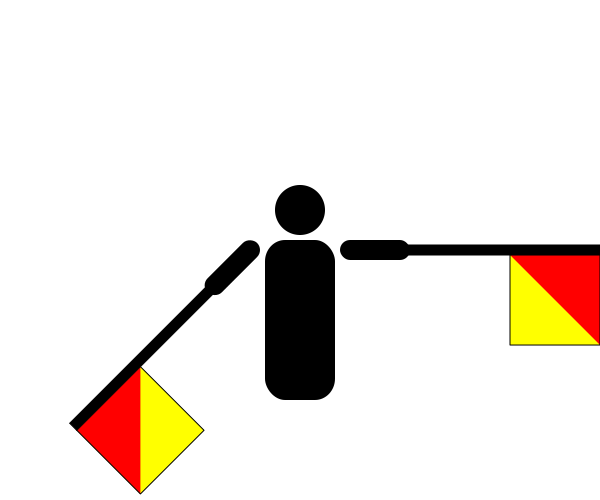
Semaphore


There are approximately 2,626 people named Helm in the UK. That makes it roughly the 3,390th most common surname in Britain. Around 40 in a million people in Britain are named Helm.
Surname type: Location or geographical feature
Origin: English
Region of origin: British Isles
Country of origin: England
Religion of origin: Christian
Language of origin: English

Famous people named Helm
- Nick Helm - Comedian, actor and rock musician
- Dieter Helm - Economist
- Tom Helm - Cricketer
- Knox Helm - Diplomat (1893 to 1964)
- Benjamin Helm - Rower
Names and descriptions courtesy of Wikipedia, and may contain errors. This is not intended to be an exhaustive list of every famous person with this name.