HALM
The surname Halm is primarily of German origin. It derives from the Middle High German word halm, which translates as “stalk” or “stem”. Halm was originally a topographic surname applied to a person who lived in the vicinity of a field or meadow, with particular reference to the stalk or stem of the crops that grew there. This agricultural association is evident in the way that the name may also have been used as a nickname for an individual who was tall or slender, attributes that echo the long, upright nature of a stalk.
The earliest surviving reference to the name occurs in the late thirteenth century. In 1180 the spelling Nicholas de Helm is recorded in the Pipe Rolls of Surrey, placing the name in England during the reign of King Henry XI, “The Builder of Churches”. Subsequent medieval documents provide further evidence of the surname’s presence. In 1279 the Hundred Rolls of Berkshire mention William Helmis; the 1296 Court Rolls of the Manor of Wakefield contain an entry for Hugh del Helm in Yorkshire, while the 1327 Subsidy Rolls of Worcester record Richard atte Helme. Later marriages in the early modern period – for instance, Chunrad Halm and Anna Halmus in Bavaria in the fifteenth and sixteenth centuries respectively, and Frederick Halms in Westminster in 1767 – illustrate the name’s persistence across centuries.
While Halm is rooted in Germanic language, a number of spelling variations have developed over time, reflecting regional pronunciations and orthographic practices. Common variants include Halme, Halmes, Hehlm, Helmbes, Helmes, Helmus and Helms. Some of these forms appear in English contexts, where the name was brought by immigrants during the nineteenth and twentieth centuries. In Scandinavia the name and its cognates are represented by Hälm, a Swedish and Norwegian surname, and by Helme and Helmi in Finnish contexts.
In terms of geographical distribution the surname remains most concentrated in German‑speaking regions. Within Germany, the name is found predominantly in Bavaria, Lower Saxony and North Rhine‑Westphalia, although it is estimated that there are only about five hundred families bearing the name today. Austria and Switzerland also host small numbers of individuals with the surname, where it is largely confined to local communities with historic Germanic roots. Outside of continental Europe, Halm has a modest presence in the United States, particularly in states that received large numbers of German immigrants such as Wisconsin, Minnesota, Iowa, and Ohio. Census data indicate that the name accounted for roughly 0.002 % of the U.S. population in 1920, a figure that places it among the less common surnames within the country.
While the primary derivation of Halm is linked to agricultural or topographic associations, some scholars posit that the surname could also originate from an occupational context, possibly related to brewing. This hypothesis stems from an Old German word akin to helimo, meaning “hops”, the essential ingredient in beer. However, this connection remains speculative and is not supported by definitive documentary evidence. Therefore, the prevailing consensus favours the agricultural topographic explanation for the origin of the surname.
Thus, the surname Halm encapsulates a history that spans a variety of European regions and reflects the agrarian traditions of the Middle Ages. Its evolution through spelling variations and its diaspora to the New World illustrate both linguistic change and the migratory patterns of families seeking new opportunities while carrying with them a name that conveys a deep-rooted connection to the land.
Similar and related surnames
Related and similar names are generated algorithmically based on the spelling, and may not necessarily share an etymology.
How to communicate the surname Halm in...
Braille
⠓⠁⠇⠍
Morse
.....-.-..--
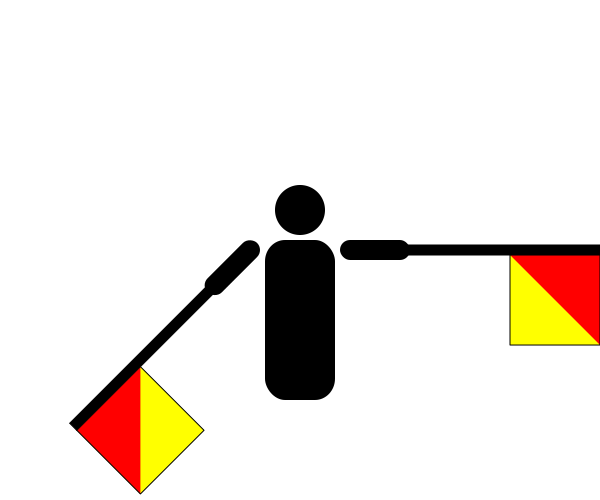
Semaphore


Sorry, we don't have any statistics on this name. That's probably because it's very uncommon in Britain.
