GUNTHER
Gunther is a surname of Germanic origin that evolved from the Old High German personal name Gundahar, which is composed of the elements gund meaning “battle” and heri meaning “army.” As a result, the name has been interpreted as “battle army” or “warrior” and is typically understood in English as a patronymic surname identifying the descendants or followers of a person named Gunther.
The surname is of Anglo‑Saxon antiquity and appears in early English records in a variety of spellings. In Northumberland a form of the name, Gunterus, is recorded in 1094, followed by a Guntier noted in Hampshire in 1165. The first use of a surname form dates to the thirteenth century, exemplified by William Gunter of Suffolk, whose name appears in the medieval records of Ely in 1221. An earlier reference in the Curia Regis Rolls of Berkshire from 1205 records William Gunter during the reign of King John.
In continental Europe the name occurs in several linguistic variants, reflecting both pronunciation differences and the influence of local orthography. French speakers have recorded it as Gontier, while German speakers may use Günter, Gunter, Ginter or Güntürk. Scandinavian languages render the name as Gunnar with the patronymic forms Gundersen and Gunnarsson. These variations give rise to cognate surnames such as Gontier in France and González in Spanish, all reflecting the same ancient Germanic root.
The surname Gunther also carries a heraldic legacy in England. The coat of arms described for the Gunter families of Sussex and Brecon is black, bearing three silver clenched gauntlets, with a crest of a stag’s head. This heraldic description has been preserved in the gentry records of the early modern period.
Historical migration accounts show the diaspora of bearers of the surname. One notable example is Lester Gunter, aged thirteen, who sailed from London on the ship Truelove in September 1635 as part of the first American colony in Virginia, having taken the oath of allegiance to King Charles I in 1625. Such movements illustrate the presence of the surname in the United Kingdom, the United States and other parts of Europe.
In modern usage the surname remains most frequent in its country of origin, Germany, and is also common in Austria and Switzerland. In English‑speaking countries it is often spelt Gunter, while French speakers may prefer Gonthier. The name also survives as a given name in German‑speaking regions, and the feminine form Gunthera is occasionally observed.
Because the Old High German element gun means “battle,” it is not uncommon for related surnames containing this element, such as Gunn or Gunnell, to be recognised as bearing a similar martial theme, indicating a possible linguistic link with the surname Gunther.
Typical given names associated with the Gunther surname
Male
- Andrew
- Christopher
- Clive
- David
- John
- Julian
- Marcelo
- Mark
- Martin
- Michael
- Paul
- Richard
- Robert
Female
- Antje
- Brenda
- Carmen
- Elizabeth
- Janet
- Jean
- Katherine
- Margaret
- Pamela
- Peggy
- Rebecca
- Susan
- Teresa
Similar and related surnames
Related and similar names are generated algorithmically based on the spelling, and may not necessarily share an etymology.
How to communicate the surname Gunther in...
Braille
⠛⠥⠝⠞⠓⠑⠗
Morse
--...--.-......-.
Semaphore


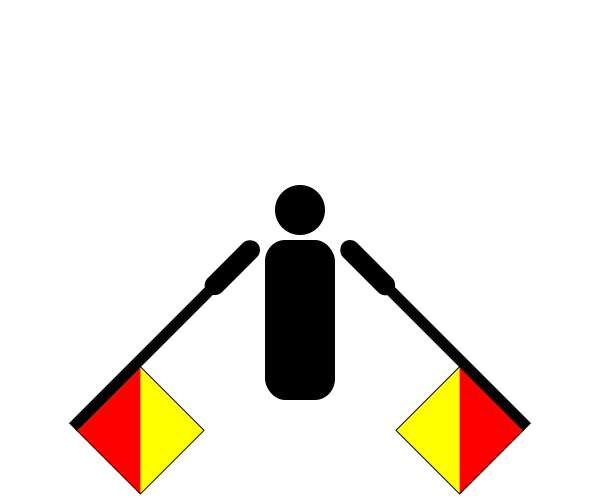
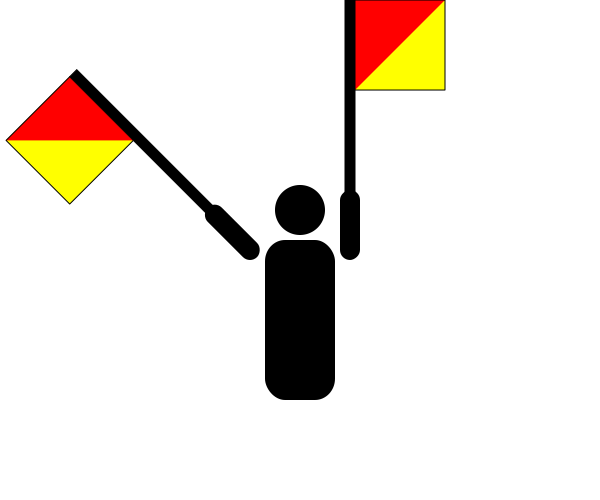


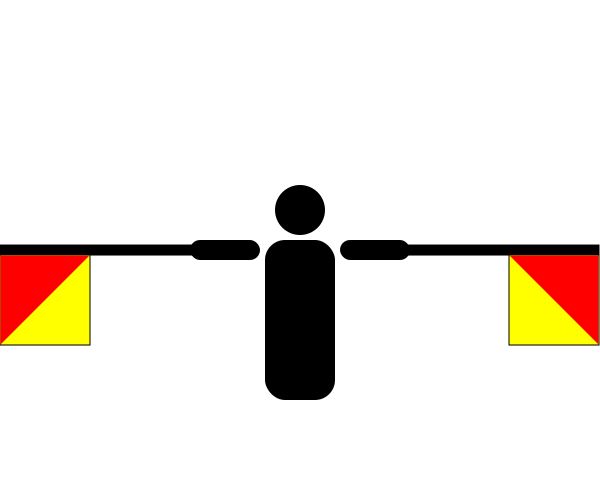
There are approximately 478 people named Gunther in the UK. That makes it one of Britain's least common surnames. Only around seven in a million people in Britain are named Gunther.
Surname type: Occupational name
Origin: English
Region of origin: British Isles
Country of origin: England
Religion of origin: Christian
Language of origin: English
