GUENTHER
Guenther is a surname of German descent, originating from the Old Germanic personal name Gundher. The elements gund and heri translate respectively as “battle” and “army”, rendering the literal meaning “warrior” or “battle army”. This etymology reflects the martial culture of early Germanic societies and is consistent with other surnames that commemorated martial prowess.
The surname developed as a patronymic identifier, signifying descent from an individual named Günther. As a common practise of the Middle Ages, a son or descendant would be distinguished by adopting the given name of his ancestor. Alternative theories have proposed an occupational origin, with some dictionaries associating the name with “auctioneer”. However, the patronymic derivation remains the most widely accepted explanation due to historical usage and linguistic evidence.
Recorded usages of the name appear as early as the 6th century, linked to King Gundahar or Gundahari, the Burgundian monarch noted in contemporary annals. The first documented South German instances are those of Heinrich der Genter of Neuenberg in the city charters of 1327, followed by Burk Genttner appearing in the pipe rolls of Engen in 1458. These early mentions illustrate the name’s long-standing presence within Germanic regions.
Variations of the surname have evolved over time and across philological boundaries. Common spellings include Gentner, Genthner, Guenthner, Guenther, Gunter, Gunther, and Gunder. In English‑speaking contexts, the umlaut is generally omitted, yielding Anglicised forms such as Gunter, Ginter, and Gounter. The name may also appear with prefixes such as van or von and with suffixes like son in certain traditions.
During the 19th and 20th centuries, migration waves carried the surname beyond its German homeland. It is now found extensively in the United States, particularly within the Mid‑West states of Wisconsin, Illinois and Ohio, as well as in Canada, Argentina and other countries with substantial German diaspora communities. The distribution reflects both the broader patterns of German emigration and the enduring nature of hereditary surnames.
In contemporary times, the surname Guenther remains a marker of German heritage and is represented in various professional, academic and artistic fields. Its historical roots and linguistic clarity continue to offer insight into the cultural narratives of medieval German societies and the pathways of their descendants worldwide.
Similar and related surnames
Related and similar names are generated algorithmically based on the spelling, and may not necessarily share an etymology.
How to communicate the surname Guenther in...
Braille
⠛⠥⠑⠝⠞⠓⠑⠗
Morse
--...-.-.-......-.
Semaphore


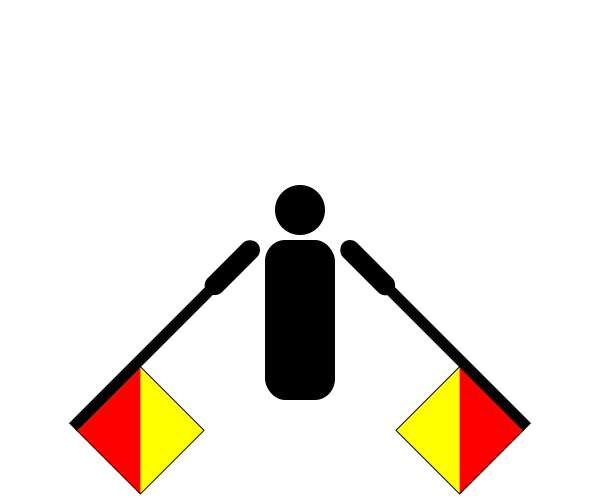
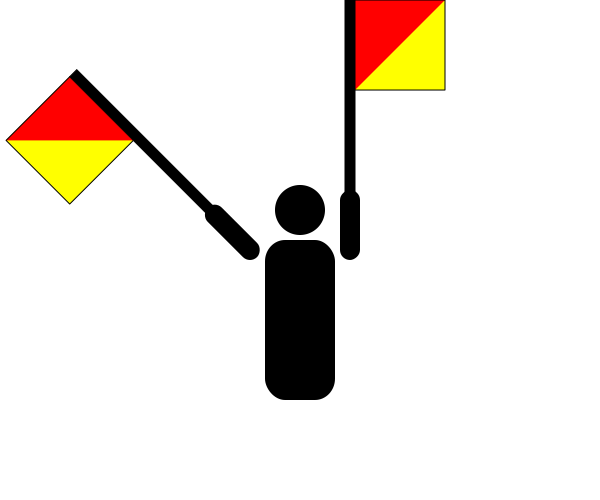

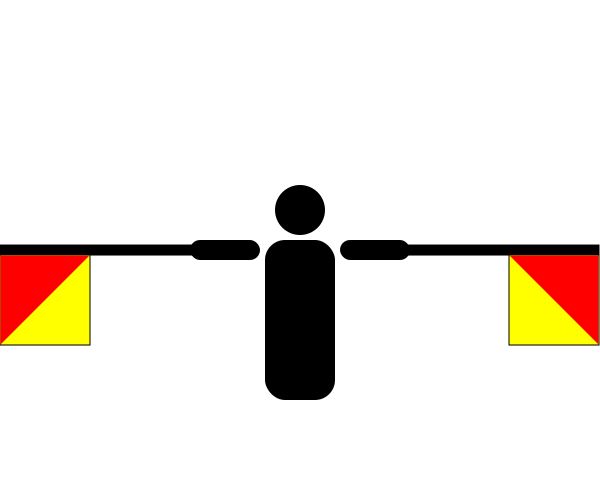
There are approximately 62 people named Guenther in the UK. That makes it one of Britain's least common surnames. Only around one in a million people in Britain are named Guenther.
Region of origin: Europe
Country of origin: Germany
Language of origin: German
