GUERIN
Guerin is a surname that traces its lineage to French origins, itself deriving from the Germanic personal name Warin, which conveys the notion of a guard or protector. The migration of this name into France is attributed to the Franks, a Germanic people who ruled former Roman territories after the decline of the Western Empire. Later, the name was embraced by the Norman elite, who had a propensity for adopting Germanic given names and were instrumental in disseminating the surname across both France and England during the medieval period.
Evidence of early usage appears in the Norman chronicles where a notable contemporary, Guerin de Montglave, is recorded as a knight within the Carolingian realm. Following the Norman Conquest of England in 1066, the name was introduced to the English holdings, as seen in the Domesday Book of 1086. For example, a record lists Robertus filius Warin in Cambridgeshire and a separate entry, Gislebertus filius Garin, is noted within Essex. Subsequent entries, such as the Curia Regis Rolls of Yorkshire in 1198, document Gilbert Warin, identified as the earliest hereditary bearer of the name in that region.
In the British Isles, the name re‑appeared after the 17th‑century exodus of French Huguenots, fleeing persecution following the Revocation of the Edict of Nantes on 22 October 1685 by King Louis XV. A case in point is the christening of Daniel, son of Francois Guerin and Janne Pater, on 26 July 1696 at the French Huguenot Church on Glasshouse Street and Leicester Fields in London. The surname also found a foothold in Ireland, particularly in Limerick and Kerry, where it adapted to spellings such as Geran and Gerin. This Irish presence is connected to the period of Norman settlement following Strongbow's conquest of Pembroke in 1170, and it may also summarise a Gaelic derivation from O' Gearain, meaning “descendant of the sharp one.”
Variations of the surname have evolved across linguistic and geographic boundaries. In France, forms such as Guérinot, Guérineau, and Guérinier appear, especially within Normandy and the central Loire Valley. In English contexts, the surname occasionally transformed to Waring and other Anglicised versions. In Ireland, the Cambro‑Norman surname Mac Geraghty has been shortened to Guerin in certain locales. While the core meaning of protection or guardianship persists, these variants reflect local adaptation and the natural evolution of names within multicultural societies.
Although the surname Guerin remains most prevalent in France today, significant diaspora communities exist in the United States – notably in Louisiana – and in French‑speaking Canada, a result of 18th‑century migration seeking better economic prospects. Regardless of geographic dispersion, the name consistently retains its etymological roots in the Germanic term for guard, underscoring a historical association with the role of protector within medieval societies.
Typical given names associated with the Guerin surname
Male
- Andrew
- Christopher
- Daniel
- James
- John
- Mark
- Michael
- Patrick
- Paul
- Richard
- William
Female
- Anne
- Bridget
- Catherine
- Claire
- Elizabeth
- Julie
- Margaret
- Mary
- Niamh
- Rebecca
- Sarah
- Sinead
- Susan
Similar and related surnames
- Caren
- Carnie
- Corn
- Craine
- Creane
- Crone
- Curren
- Garin
- Garine
- Garino
- Garrin
- Garrini
- Gearing
- Gerin
- Geurin
- Gorin
- Gorina
- Gorines
- Gorini
- Gorrin
- Goryn
- Gourin
- Gourine
- Gouring
- Grain
- Greeno
- Guarin
- Guarini
- Guarino
- Guerineau
- Guerinet
- Guering
- Guerini
- Guerins
- Guerit
- Guerney
- Guerri
- Guerrin
- Guerrini
- Guertin
- Guirinnys
- Guri
- Gurim
- Gurin
- Gurina
- Guring
- Gurini
- Gurion
- Gurny
- Gurrin
- Gurynne
- Karran
- Kearn
Related and similar names are generated algorithmically based on the spelling, and may not necessarily share an etymology.
How to communicate the surname Guerin in...
Braille
⠛⠥⠑⠗⠊⠝
Morse
--...-..-...-.
Semaphore


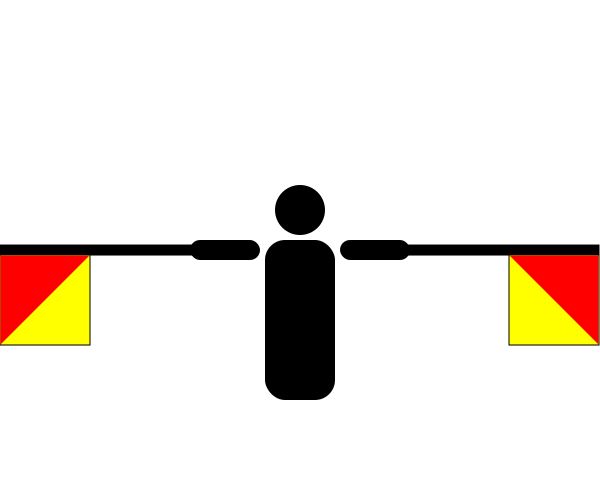
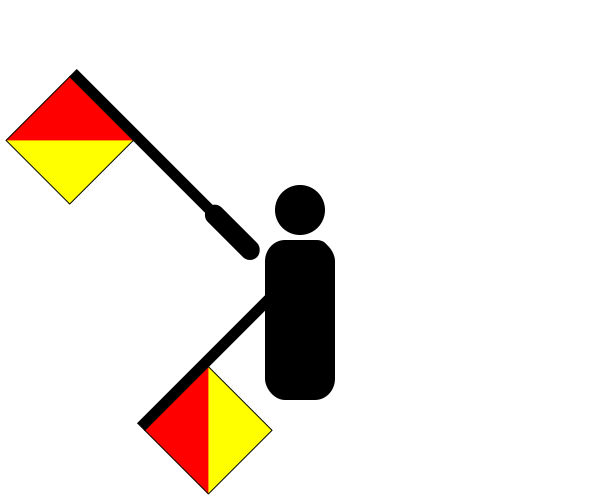
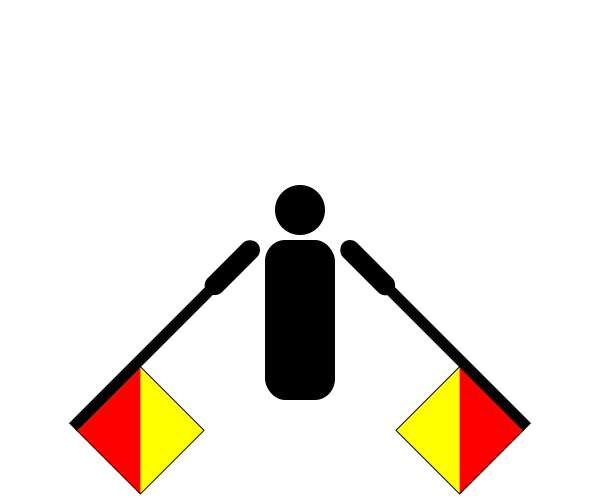
There are approximately 832 people named Guerin in the UK. That makes it roughly the 8,520th most common surname in Britain. Around 13 in a million people in Britain are named Guerin.
Origin: Celtic
Region of origin: British Isles
Country of origin: Ireland
Religion of origin: Christian
Language of origin: Gaelic
