GRUEN
Gruen is a surname of German origin, derived from the Middle High German word gruene, meaning “green”. The name was originally employed as a topographic descriptor, designating individuals who resided near green fields, woodlands, or other verdant landscapes. It is also possible that the surname arose as a nickname for people with green eyes or as a reference to a dwelling with prominent green shutters or other conspicuous use of the colour green.
In the 19th and early 20th centuries, many bears of the name migrated to the United Kingdom, where the surname found a small but stable community within the British Isles. English settlers carried the name to England, often retaining its original spelling and pronunciation. The surname is associated with Christian congregations in that region and reflects the integration of German migrants into English society.
Within Germany, the surname is most frequently encountered in Bavaria and surrounding southern regions. The Bavarian population retains many members of the Gruen family, and the name remains among the top five hundred surnames in contemporary German registers. The distribution of the surname has broadened across German-speaking countries, including Austria and Switzerland, as well as many ex‑British colonies and former colonies where German emigration occurred.
In the United Nations States of America, Gruen entered the census rolls in the late 1800s and early 1900s, a period marked by a substantial influx of German‑speaking immigrants. By the 1910 census, the name appeared among German entrants, and it has remained in use through to the present day, with approximately 33,000 Americans reporting it as their family name.
Australia, Canada, New Zealand, Mexico, Brazil and other countries with sizeable communities of German heritage now contain notable populations of people bearing the surname. In these nations, the surname often remains associated with German cultural traditions, though it has also proved to be a common family name in diverse ethnic communities.
The surname Gruen is also found among Ashkenazi Jewish families, where it is sometimes understood as a linguistic variation of the Hebrew word for “green” and the Yiddish term “Grine.” Jewish bears of the name may have adopted it through an interaction between Germanic nomenclature and the Hebrew or Yiddish linguistic milieu, or as part of a broader process of anglicising surnames upon immigration.
Several variants of the surname have arisen over the centuries, often reflecting regional dialects or attempts to ease pronunciation for non‑German speakers. Notable forms include Grain, Grien, Grein, Grine, Gruner, Grunner, Grene, Grenner, Graen, Gruener and Gruenere. In English‑speaking contexts, the spelling has occasionally been further altered to Green or Greene. The surname Gruen has also served as an anglicisation of other Jewish family names, such as Groper becoming Gruper and Grunberg being shortened to Greenberg.
Among those bearing the surname, a few individuals have achieved prominence in their respective fields. Charlotte Gruen, a 19th‑century German author, is noted for her literary contributions during the Vormärz period. Victor Gruen, born in Austria, later emigrated to the United States and became a celebrated architect, best known for pioneering the modern shopping mall concept.
The continuity of the Gruen surname demonstrates how a simple descriptive term—green—has persisted across centuries and continents. Whether as a marker of geography, a reference to physical characteristics, or as a point of cultural identity, the name endures within German, English and Jewish contexts, illustrating the longevity and adaptability of family names in a changing world.
Similar and related surnames
Related and similar names are generated algorithmically based on the spelling, and may not necessarily share an etymology.
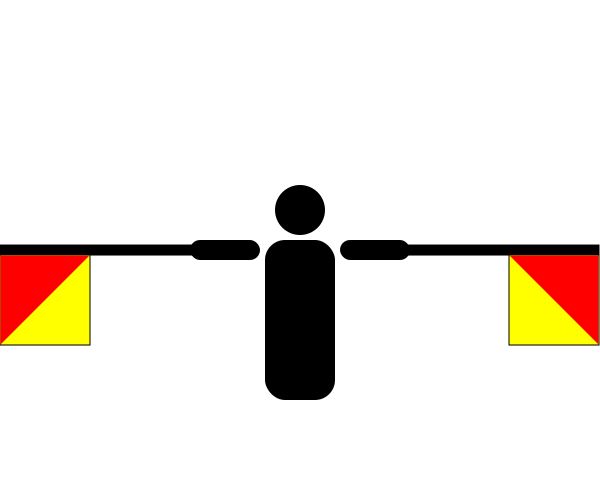
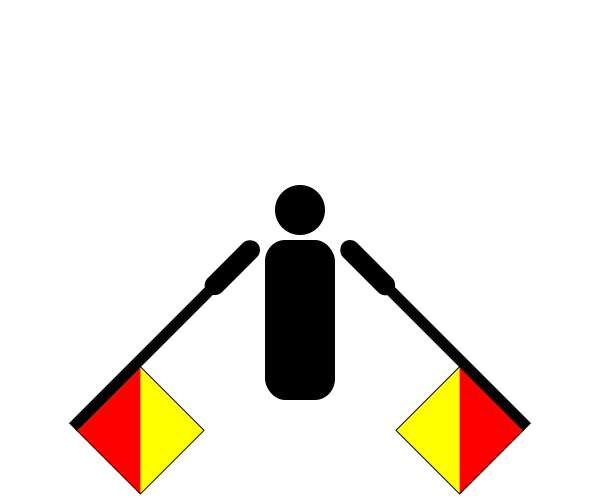
How to communicate the surname Gruen in...
Braille
⠛⠗⠥⠑⠝
Morse
--..-...-.-.
Semaphore



Sorry, we don't have any statistics on this name. That's probably because it's very uncommon in Britain.
Origin: English
Region of origin: British Isles
Country of origin: England
Religion of origin: Christian
Language of origin: English
