GAVAN
The surname Gavan finds its roots firmly within the Gaelic linguistic tradition of the British Isles, primarily associated with Ireland and, to a lesser extent, England and Wales. The name is typically classified as an occupational surname, signifying an ancestral link to the craft of smithing.
The core Gaelic term gabhann translates in English to “smith” or “blacksmith.” This word forms the basis of the surname Gavan and its variant Gavin, which were historically applied to individuals or families engaged in metalworking. The occupational nature of the name reflects the vital role that blacksmiths played in medieval societies by producing tools, weapons, and everyday implements.
In medieval Ireland, the surname often appears in the anglicised form of the Gaelic patronymic Mac Gabhainn, meaning “son of the smith.” The prefix Mac not only indicates lineage but also carried connotations of noble birth in certain contexts. It is therefore plausible that families adopting the name were recognised for both their craft and their standing within local gentry.
Historical records place early bearers of the name in a number of Irish counties. The surname is particularly linked with County Donegal, where documentary evidence shows that a Gavan lineage flourished from the twelfth century, eventually establishing a presence in the cities of Derry and Belfast. In the south, bearers can be identified in Counties Cork and Tipperary, and the name is also common in County Galway and County Dublin, reflecting a broad geographic dispersion across Ireland.
The nobility of Iveagh in Ulster is frequently cited as a source of the Gavan family’s lineage, suggesting that the name carried a degree of prestige. This connection is further supported by the appearance of a Gavan ancestor within the heraldic traditions of the region, where clan societies have maintained genealogical records for centuries.
England and Wales present an alternative etymological strand for the name. In these parts, the surname is sometimes derived from the pre‑5th‑century Celtic personal name Gawaine, itself a Gaelicised form of the original Gwalchmai, meaning “The Battle Hawk.” Legendary associations with Sir Gawaine, a knight of the Arthurian round table, have contributed to the surname’s cultural resonance in the British narrative tradition.
Documentary evidence also records the spelling Gaven in England, a variation that appears in medieval tax rolls. For instance, the Poll Tax rolls of Yorkshire in the year 1379 list an individual named Emma Gawyn, indicating that the surname had entered English administrative records by the late thirteenth century. In County Tipperary, the name appears in the name of Walter O Gawane, recorded in Clonmel in 1428, further illustrating the name’s integration within Irish medieval society.
Across the English‑speaking world, the surname has undergone further typographical evolution, giving rise to a wide array of variants. These include MacGavan, McGavin, McGavan, Gavaney, Gavaghan, and others such as Gavine and Gavran. The existence of these forms reflects regional orthographic practices and the process of anglicisation that accompanied migration and administrative standardisation.
In contemporary times, the Gavan surname enjoys a global distribution. In the United Kingdom, it remains relatively common in rural areas but has also spread to urban centres. In the United States, Canada, Australia, and New Zealand, large concentrations of bearers arrived during the waves of Irish emigration following the 19th‑century famine. Major American cities such as New York, Boston, Chicago, and Philadelphia host sizeable Gavan populations.
Members of the Gavan family today continue to celebrate their heritage through the organisation of clan societies, the use of traditional tartans, and the display of family crests and armorial bearings. These cultural practices serve to reinforce a sense of identity that links contemporary bearers with their medieval ancestors.
In sum, the surname Gavan epitomises a historical tapestry woven from occupational significance, Gaelic patronymic tradition, regional noble associations, and a legacy that extends across the United Kingdom, Ireland, and the wider world through migration. Its continued presence in modern genealogical records and cultural societies attests to the enduring legacy of the smith’s craft and the noble aspirations it has inspired through the centuries.
Typical given names associated with the Gavan surname
Male
- Andrew
- David
- John
- Joseph
- Matthew
- Michael
- Paul
- Peter
- Richard
- Robert
- William
Female
- Amanda
- Claire
- Emma
- Jeanie
- Julie
- Lisa
- Margaret
- Mary
- Maureen
- Michelle
- Nicola
- Pauline
- Sheila
Similar and related surnames
Related and similar names are generated algorithmically based on the spelling, and may not necessarily share an etymology.
How to communicate the surname Gavan in...
Braille
⠛⠁⠧⠁⠝
Morse
--..-...-.--.
Semaphore


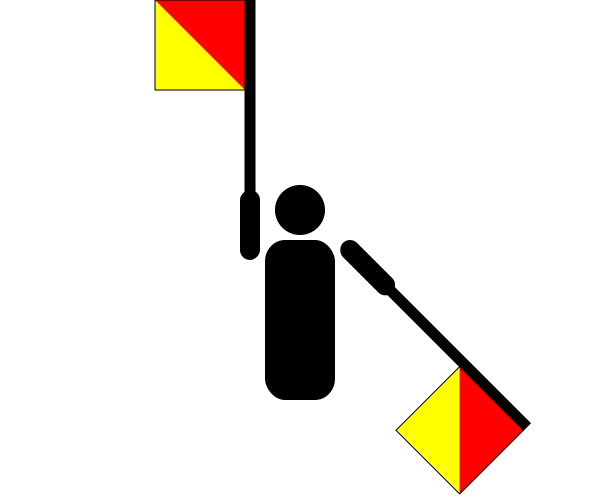
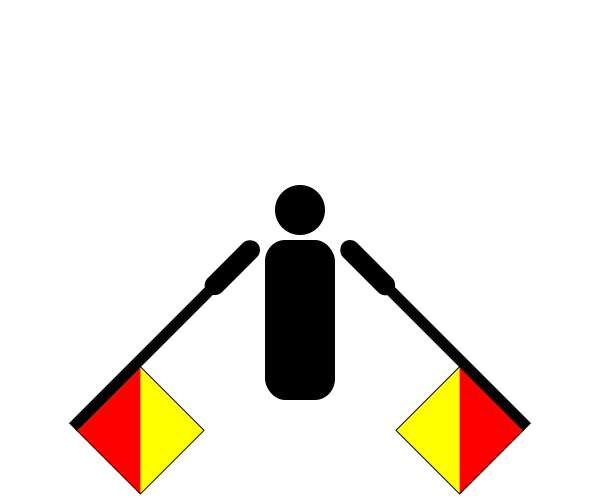
There are approximately 481 people named Gavan in the UK. That makes it one of Britain's least common surnames. Only around seven in a million people in Britain are named Gavan.
Origin: English
Region of origin: British Isles
Country of origin: England
Religion of origin: Christian
Language of origin: English
