CAVAN
Cavan is an Irish surname whose earliest recorded bearers were found in the central part of the British Isles, particularly in Ireland and Scotland. Its origins lie in the Gaelic language and it reflects the shared Celtic heritage of these regions.
The name is derived from the Gaelic word cabhán, meaning hollow, a term used to describe the low-lying landscape of County Cavan. The county itself was so named from the word cabhan, which also translates as the hollow, and this linguistic connection grounds the surname in a distinct geographical setting.
In addition to the locational meaning, the surname has other Gaelic roots. One line of descent, recorded in the pre‑10th century name Caomhanach, translates as “born handsome.” The earliest person known by this name was Donal Caomhanch, the son of Diarmuid Mac Murrough, a 12th‑century King of Leinster. He was sent to be educated at St Kevin’s Church in County Wexford. Another Gaelic root, Mac Cabhain, literally means “son of the hound,” a metaphor employed to denote a hunter or a warrior. The variant O’Cabain translates as “descendant of Cabain.” These multiple origins contribute to the rich tapestry of the surname.
Historical documents show that the surname was first recorded in the 14th century. The name Art Mac Murrough Kavanagh, who ruled as King of Leinster from 1376 to 1417, is cited in the annals of the province of Leinster. In the 16th century, Art Kavanagh accompanied Hugh O’Neill during his escape from Dublin Castle in 1590, demonstrating the surname’s association with prominent figures in Irish history.
During the Great Famine of the mid-19th century, many bearers of the surname emigrated abroad. Notable examples include Patrick Cavan, who departed on the ship Ward‑Chipman bound for New York on 12 August 1846, and Michael Caven, who set sail on the Roscius on 12 October 1846. These movements established the Cavan name in the United States, Canada, Australia, and the United Kingdom.
The surname remains most widespread in South East Leinster, particularly in County Carlow and County Wexford, where the Kavanagh variant is still common. In County Cavan, the name is linked directly to its geographical roots. Although it is not among the most common Irish surnames today, its presence in the diaspora is noticeable.
Because of phonetic translation and regional dialects, a wide range of spelling variations exists. These include Cavan, Caven, Cavanagh, Cavenagh, Kavanagh, Cavanaugh, Cavender, Cavanah, Kavanaugh, Cavendish, Cavenaugh, Kavan and several others. The lack of a fixed prefix such as Mac or O’ in many forms has occasionally made genealogical research more challenging, yet it also provides insight into the evolution of the name over centuries.
The family crest traditionally incorporates a black boar. The animal symbolizes bravery, courage, and fierce battling skills—qualities that were highly prized by early medieval clans. This emblem further underscores the martial associations evident in the surname’s Gaelic origins.
In summary, the surname Cavan is a testament to Ireland’s rich Gaelic heritage, reflecting both a specific geographical identity and a broader Celtic cultural tradition. Its varied meanings, historical prominence, and durable presence in the Irish diaspora continue to make it a name of considerable interest to scholars of genealogy and onomastics alike.
Typical given names associated with the Cavan surname
Male
- Andrew
- Anthony
- Darren
- David
- Hugh
- James
- Jonathan
- Michael
- Nicholas
- Peter
- Thomas
- William
Female
- Agnes
- Amanda
- Anne
- Carla
- Donna
- Elizabeth
- Joanna
- Julia
- Kathryn
- Lisa
- Margaret
- Mary
- Sarah
Similar and related surnames
- Caivano
- Cavagna
- Cava
- Cafane
- Cafano
- Cavana
- Cavani
- Cafagna
- Caffen
- Caffin
- Caffyn
- Cafun
- Caphona
- Cauvain
- Cauvin
- Cavagnah
- Caval
- Cavanagh
- Cavanah
- Cavanan
- Cavaner
- Cavaneugh
- Cavaney
- Cavangh
- Cavanna
- Cavannagh
- Cavannah
- Cavanough
- Cavans
- Cavanugh
- Cavany
- Cavaye
- Caveen
- Caven
- Cavena
- Cavenagh
- Cavenay
- Caveney
- Cavenie
- Cavenny
- Caveny
- Cavifan
- Cavin
- Cavina
- Cavine
- Cavlan
- Cavnagh
- Coffen
- Coffin
- Coffine
- Coffyn
- Cofin
- Cofino
- Cofone
- Covan
- Coven
- Covin
- Covino
- Covon
- Covone
- Cuffin
- Gafan
- Gafen
- Gaffan
- Gaffen
- Gaffin
- Gaffon
- Gaffyne
- Gafnie
- Gauffin
- Gauvain
- Gauvin
- Gavan
- Gavana
- Gavani
- Gaven
- Gavian
- Gavien
- Gavin
- Gavina
- Gavine
- Gavini
- Gavino
- Gavon
- Goffen
- Goffin
- Goffon
- Goiffon
- Gouffini
- Govan
- Govane
- Govani
- Goven
- Govin
- Govoni
- Guffen
- Guffin
- Guven
- Kafena
- Kafno
- Kaphan
- Kavan
- Kavana
- Kavanah
- Kavaney
- Kavangh
- Kavany
- Kaven
- Kavena
- Kavian
- Kaviani
- Kavin
- Keevan
- Keevin
- Keffen
- Keffin
- Keffon
- Kevan
- Kevane
- Kevans
- Keven
- Kevin
- Keyvan
- Kiffen
- Kiffin
- Kiven
- Koven
- Kvan
- Kyffin
- Kyffyn
- Kyvin
Related and similar names are generated algorithmically based on the spelling, and may not necessarily share an etymology.
How to communicate the surname Cavan in...
Braille
⠉⠁⠧⠁⠝
Morse
-.-..-...-.--.
Semaphore


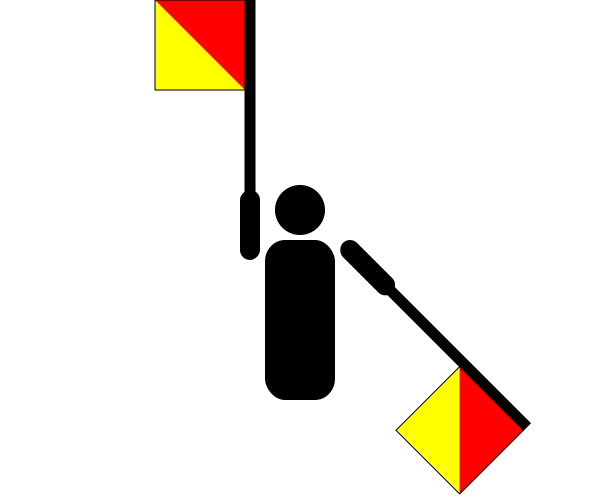
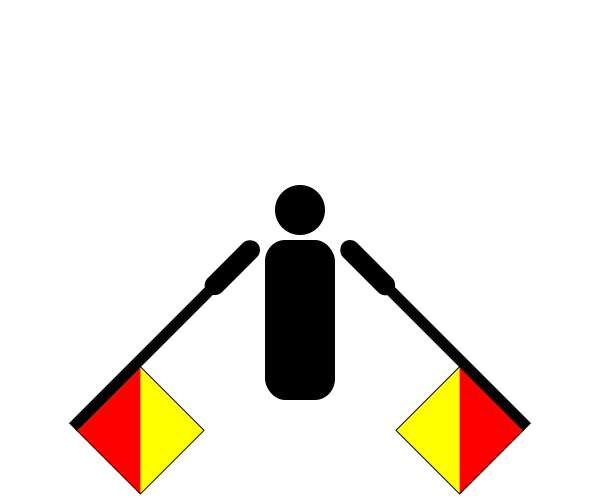
There are approximately 282 people named Cavan in the UK. That makes it one of Britain's least common surnames. Only around four in a million people in Britain are named Cavan.
Origin: Celtic
Region of origin: British Isles
Country of origin: Scotland
Religion of origin: Christian
Language of origin: Gaelic