GAUDIN
Gaudin is a surname of French origin with deep roots in Germanic and Latin etymology. It has historically appeared in both continental Europe and the wider diaspora, and remains a common name in several modern countries.
The name derives from the Old French personal name Gaudin, a diminutive of the Germanic element Gaud. The Germanic root means *to rejoice* or *to be merry*, and the surname was originally applied as a nickname to a person of cheerful disposition or someone associated with celebrations.
In addition to its Germanic heritage, the surname is linked to the Latin verb gaudere, meaning *to rejoice*. This Latin connection reinforces the notion that bearers of the name were historically viewed as joyous, faithful, or religious, a sentiment still echoed in contemporary usage.
Geographically, Gaudin is most prevalent in France, especially in the north‑east and the central region of Auvergne where the Occitan word gaudi (joy) contributed to the name’s formation. The surname also appears extensively in French‑speaking parts of North America, notably in Canada, the United States and Louisiana, owing to colonial migration during the eighteenth and nineteenth centuries.
Throughout history the name has acquired a range of variant spellings, influenced by regional dialects and linguistic adaptation. Common forms include Gooden, Godin, Goddin, Goodon, Guiden, Guidonne, Godden, and the Latinised Gaudien. In German contexts the name often appears as Godden or Gooden, whereas in English usage it tends to be normalised to Gaudin. The diversity of spellings has been documented in parish registers across England, France, Italy and Germany.
The earliest surviving record of the name dates to 1280, when Philip Guodin—also spelled Guodin—served as a witness at the Somerset Assize Court in Taunton during the reign of King Edward I (1272–1307). Subsequent archival material includes a 1594 listing of Christopher Godden at St. Mary Magdalene, Bermondsey; a 1607 entry for Ann Goodin at St. Andrews, Holborn; and a 1677 witness of John Guiden at St. Mary's, Harmondsworth, Middlesex.
In the early eighteenth century a notable refugee, Daniel Gaudin, is recorded at the Des Grecs French church in London on 20 May 1711, illustrating the Huguenot migration that brought the name to Britain and beyond.
Several distinguished individuals have carried the surname. The priest, lawyer and theologian Jean Antoine Gaudin (1790–1853) contributed to legal and religious scholarship in France. The twentieth‑century sculptor and World War I veteran Jean Gaudin is remembered for his figurative work reflecting post‑war sentiment.
By the modern era, the name Gaudin is shared by people of diverse nationalities, including French, Canadian, American, Belgian, Swiss, Chilean and Mexican heritage. Its prevalence is reinforced by migration, intermarriage and international correspondence. The surname remains a marker of cultural identity, heritage and, for many, an inherited sense of joy and celebration that echoes its ancient linguistic roots.
Similar and related surnames
Related and similar names are generated algorithmically based on the spelling, and may not necessarily share an etymology.
How to communicate the surname Gaudin in...
Braille
⠛⠁⠥⠙⠊⠝
Morse
--..-..--....-.
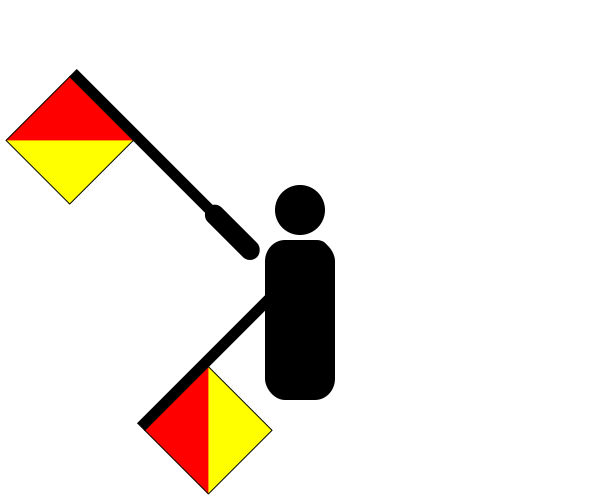
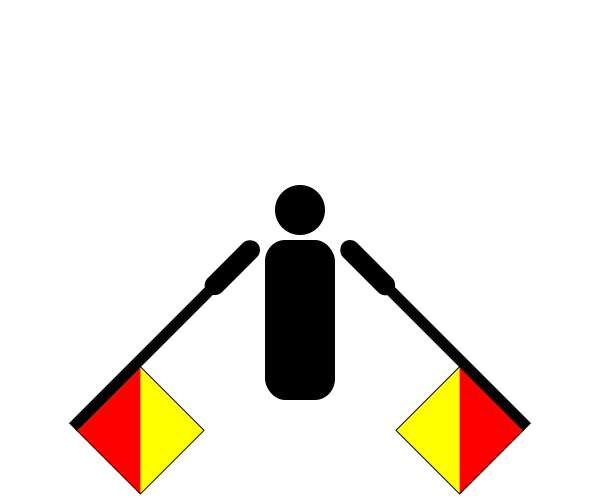
Semaphore


There are approximately 106 people named Gaudin in the UK. That makes it one of Britain's least common surnames. Only around two in a million people in Britain are named Gaudin.
