GANT
The surname Gant is recorded in the English register from the earliest surviving charter, the Domesday Book of 1086. Both English and French linguistic roots are evident in the name, reflecting the Anglo‑Norman interchange that followed the conquest of 1066.
One recognised derivation comes from the Old French noun gant, meaning a glove. In the medieval period a surname derived from a trade was common; Gant therefore would have identified a maker or trader in gloves, a trade closely associated with the fur and leather industries that were prominent in the north‑east of England.
An alternative explanation treats Gant as a nickname. In Middle English the adjective gaunt was used to describe someone lean or haggard. The surname may thus have been applied to a person of a particularly gaunt appearance, and it is recorded that a variation of the name is Gaunt, whose earliest bearers were sometimes described as “thin” in contemporary documents.
A third possibility is topographical. Some medieval records associate the name with a locality called Gant or Gant Hill, and, in Lincolnshire and Nottinghamshire, the Old Norse element Gand appears in place‑names. In those regions the name could in theory have a quasi‑magical connotation, though the evidence for this meaning remains circumstantial.
Historical documentation links the surname to several notable figures. Gilbert de Gant is listed in the Domesday Survey as a landholder in Staffordshire. In the early thirteenth century, Maurice de Gaunt (1184–1230) held the title Baron of Leeds and paid scutage for lands in eight counties in 1223. A later bearer, Elizabeth Gaunt, died in 1685; she was executed in Tyburn for a political offence and is recorded as the last woman executed for a sedition‑related crime in Britain.
In the east of England the surname is particularly common in Norfolk and Suffolk and in the Cambridge area. Emigration from these regions to the American colonies in the seventeenth and eighteenth centuries brought the name across the Atlantic, where it persists to the present day and is now found throughout the United States.
The name has a variety of orthographic variants, including Gantt, Gaunt, Ghent, Gent, Genth, Gannt, Gante and Guent. In some cases these forms arose independently in Germanic, French or Dutch contexts, and therefore a variant does not automatically imply the same origin as Gant. Careful scrutiny of census and parish records is therefore required when tracing lineage through these alternative spellings.
In sum, the surname Gant encapsulates a blend of occupational, descriptive, and topographical origins that are typical of medieval English toponymic and occupational surnames. Its persistence across centuries and geographies demonstrates the enduring nature of medieval naming practices in both Britain and its former colonies.
Typical given names associated with the Gant surname
Male
- Andrew
- Christopher
- David
- James
- John
- Matthew
- Michael
- Paul
- Richard
- Stephen
- Timothy
Female
- Angela
- Helen
- Jane
- Jennifer
- Julie
- Karen
- Linda
- Margaret
- Mary
- Michelle
- Patricia
- Rebecca
- Sarah
Similar and related surnames
Related and similar names are generated algorithmically based on the spelling, and may not necessarily share an etymology.
How to communicate the surname Gant in...
Braille
⠛⠁⠝⠞
Morse
--..--.-
Semaphore


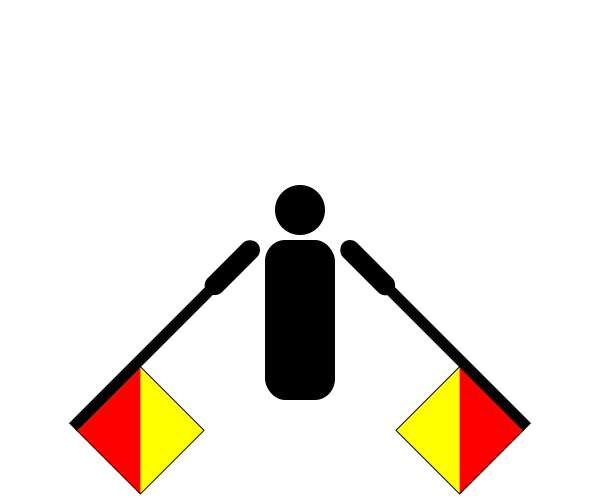
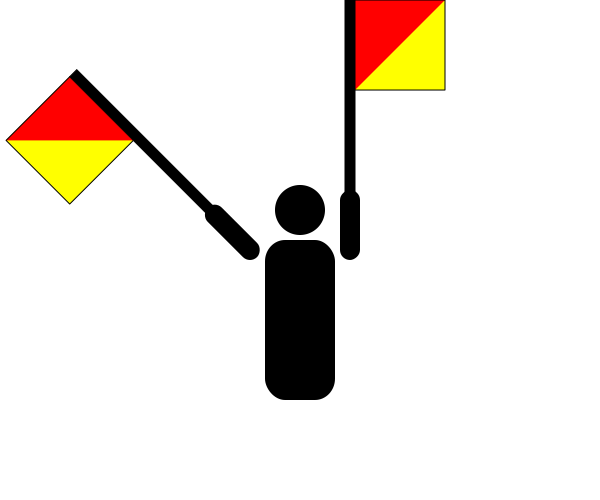
There are approximately 2,103 people named Gant in the UK. That makes it roughly the 4,029th most common surname in Britain. Around 32 in a million people in Britain are named Gant.
Origin: English
Region of origin: British Isles
Country of origin: England
Religion of origin: Christian
Language of origin: English

Famous people named Gant
- Tetley Gant - Australian politician (1853 to 1928)
Names and descriptions courtesy of Wikipedia, and may contain errors. This is not intended to be an exhaustive list of every famous person with this name.