GAIN
Origins of the surname Gain are varied and reflect a notable breadth across the British Isles and beyond. The name is documented as having English, Gaelic and Irish roots, and it has been associated with a number of distinct linguistic traditions.
In the English context the surname derives from the Old English word gain, meaning “a profit” or “a gain”. It was likely assigned to individuals whose success or prosperity was regarded as a defining trait. Likewise, the Gaelic name gáin bears the same meaning and similarly would have been used to describe a person admired for his or her profitable endeavours.
The surname is also documented as a variant of the Irish name McGann, or in Gaelic Mac Gáin, which literally translates as “son of Gáin”. This patronymic usage emphasises the hereditary transmission of the name from a successful ancestor.
Recorded evidence of the name appears as early as the Domesday Book of 1086. The entry for Richard of Penfield lists individuals such as William Ingania of Huntingdon under the spelling that would later standardise as Gain. Other early spellings include Engaine, Ingaine and Ingania, suggesting a phonetic evolution as the surname travelled across regions.
By the twelfth century further instances were documented. Vitalis Engaine of Northamptonshire (1130) and Ralph Ingaine of Cumbria (1158) are among the earliest surviving references, showing the name’s spread throughout England. These early forms are mirrored in place‑names such as Colne Engaine and Gaynes Park in Essex, and D'Engaines Farm in Cambridgeshire.
Folk etymological tradition also links Gain with French origins. The Old French term gan was used for grain cultivators, and the name evolved to gain, signalling a literal occupation as a farmer or field worker. In northern France the name remains relatively common, and contemporary usage retains allude to an ancestrally agricultural identity.
Conversely, another derivation stems from the pre‑Seventeenth‑century word engaingne, possibly adapted from Latin ingania meaning “ingenuity”. In this narrative the surname is first presented as a nickname for a clever person. By the time of the Norman invasion in 1066, the name had entered England and was recorded in the Domesday census under William Ingania, a name that would ultimately give rise to modern Spellings such as Gain, Gaine, Gains, Gaines and Gayne.
In Irish territories, especially in Ulster, the surname appears as a variant of McGinn, a name introduced during the Norman invasion. This usage suggests a Gaelicised adaptation of a Norman personal name, further illustrating the inter‑cultural influence within the surname’s history.
While the surname is relatively rare globally, it is most frequently encountered in France and the United States today. In Europe it appears mainly in France, where it may also have topographic significance for those residing near a wasteland, derived from Old French gaigne. The multiplicity of spellings—Gaine, Gains, Gayne, Gaynes, Gainey, Gaines, Gane, Gaen—demonstrates how regional dialects and phonetic interpretations have shaped the name over centuries.
Notably, the medieval given names Gain or Gaine are recorded as meaning “blond” or “fair‑haired”, implying that at one stage the surname could have initially described a personal attribute rather than an occupation or achievement. This possibility is supported by the broader practice of surnames arising from physical characteristics, although the specific connection in this case requires corroboration from primary records.
Typical given names associated with the Gain surname
Male
- Andrew
- Barry
- David
- John
- Jonathan
- Nicholas
- Peter
- Richard
- Simon
- Stephen
- Steven
Female
- Ann
- Claire
- Elizabeth
- Emma
- Felicity
- Georgina
- Helen
- Hilary
- Katie
- Lesley
- Michelle
- Phyllis
- Sarah
- Sharon
- Vanessa
Similar and related surnames
- Agin
- Caine
- Cone
- Coon
- Cownie
- Gaan
- Gagne
- Gahan
- Gahn
- Gai
- Gaia
- Gaina
- Gaind
- Gaine
- Gaines
- Gainey
- Gaineys
- Gaing
- Gains
- Gaint
- Gainy
- Gainz
- Gan
- Gana
- Ganai
- Ganay
- Gand
- Gane
- Ganea
- Ganee
- Ganes
- Ganey
- Ganf
- Gang
- Gani
- Gania
- Ganie
- Ganin
- Ganio
- Ganis
- Gann
- Ganna
- Ganne
- Ganni
- Gannie
- Ganns
- Gannu
- Ganny
- Gano
- Ganoo
- Ganow
- Gans
- Gant
- Ganu
- Gany
- Ganye
- Ganz
- Gayne
- Gaynes
- Ghaani
- Ghan
- Ghana
- Ghane
- Ghanei
- Ghani
- Ghanie
- Ghann
- Ghanni
- Ghans
- Ghany
- Gian
- Guan
- Guana
- Guano
- Gueinn
- Guene
- Guina
- Gunn
- Gwyn
- Gwynn
- Gwynne
- Kahn
- Kane
- Kanu
- Kean
- Keen
- Keene
- Kenn
- Keown
- Kewn
- Kiani
- Kyne
- Quan
- Quinn
Related and similar names are generated algorithmically based on the spelling, and may not necessarily share an etymology.
How to communicate the surname Gain in...
Braille
⠛⠁⠊⠝
Morse
--..-..-.
Semaphore


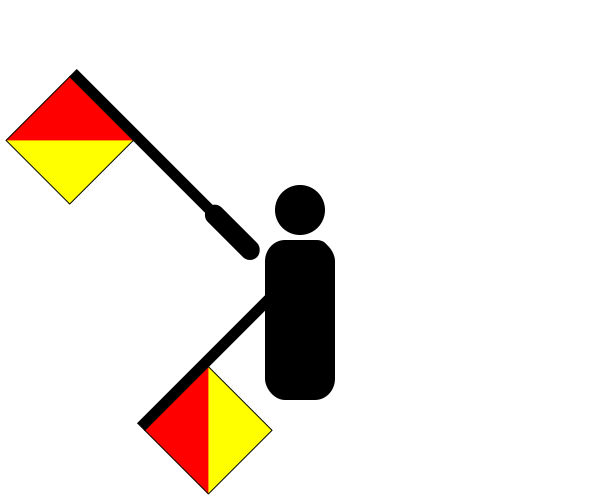
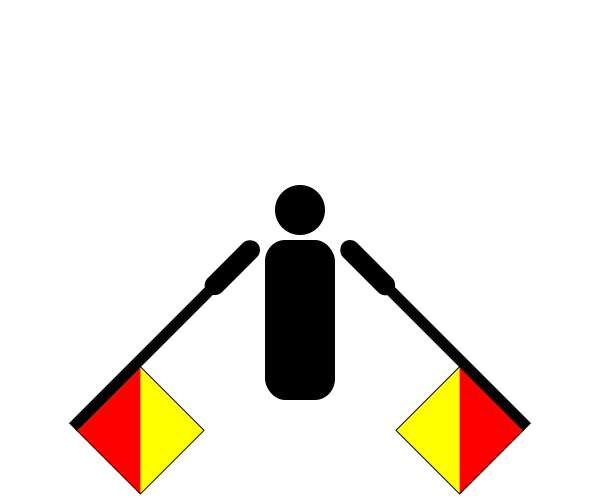
There are approximately 358 people named Gain in the UK. That makes it one of Britain's least common surnames. Only around five in a million people in Britain are named Gain.
Surname type: Location or geographical feature
Origin: English
Region of origin: British Isles
Country of origin: England
Religion of origin: Christian
Language of origin: English
