GALVIN
Galvin is an Irish surname that finds its roots in the Gaelic name Ó Gealbháin, meaning descendant of Gealbhán. The personal name Gealbhán derives from the word geal, which translates as bright or shining, with the suffix -bhán functioning as a diminutive. Consequently, the name may be interpreted as little bright one or bright‑white.
The surname is predominantly affiliated with the western part of the island, especially within County Clare and County Limerick, and it also occurs in County Cork and County Kerry. In Ireland, it has been recorded in many forms, including Calven, Calvin, Gulvin, and Kalvin, reflecting phonetic spelling variations over the centuries.
Historical documentation shows that the name could have entered Ireland through the Norman invasion of 1170, subsequently adopting a Gaelic form. It has also been documented in France under spellings such as Galvaing, Galvier, and Galvagnon, where it may have been a nickname for a man with a receding hairline or a priest. The earliest surviving record of a bearer of the name is that of Fergal O' Gealbhain dated 1317 in the register of the battle of Corcomroe Abbey.
Later ecclesiastical records illustrate the spread of the surname across the British Isles: a Marye Galvin was christened at St John's, Hackney, on 11 December 1617; Peter Gaulvin married at St Margarets, Westminster, on 1 June 1635; Mary Gulvin wed at Cranbrook, Kent, on 5 March 1648; a witness Edward Galvan was recorded at St. Margarets, Lothbury, London, on 9 June 1737; Thomas Galvin of Dingle, County Kerry, is noted in 1797; and William Kalvin was christened at St Paul's, Deptford, Kent, on 5 March 1845.
Following the Great Famine in the mid‑nineteenth century, many bearers of the surname emigrated to other English‑speaking countries such as the United States, Canada, England, and Australia, thereby extending the name beyond the island itself. Consequently, the surname can now be found in a variety of social and geographical settings whilst retaining its original Gaelic heritage.
Variations of the name, such as Galven, Galvan, Galwin, Galvon, Gallivan, and Gailivan, have emerged largely through phonetic spelling practices. Some of these forms are occasionally linked to unrelated families; nevertheless, the core meaning of brightness or whiteness associated with the original Gaelic remains a unifying theme.
Typical given names associated with the Galvin surname
Male
- Andrew
- David
- James
- John
- Michael
- Patrick
- Paul
- Peter
- Robert
- Stephen
- Thomas
Female
- Catherine
- Denise
- Elizabeth
- Joanne
- Karen
- Linda
- Margaret
- Mary
- Patricia
- Sarah
- Sharon
- Susan
Similar and related surnames
Related and similar names are generated algorithmically based on the spelling, and may not necessarily share an etymology.
How to communicate the surname Galvin in...
Braille
⠛⠁⠇⠧⠊⠝
Morse
--..-.-.....-..-.
Semaphore


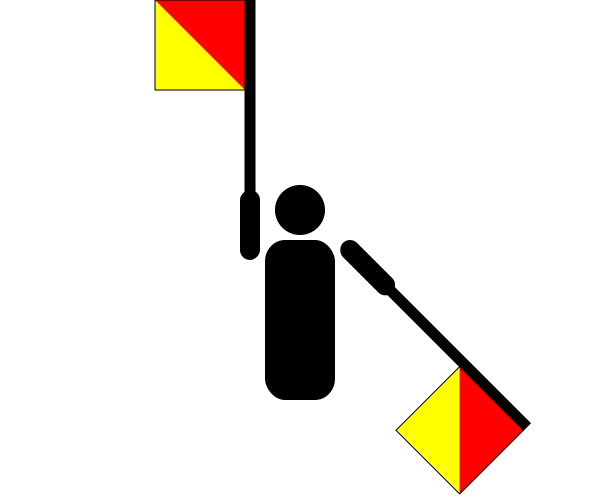
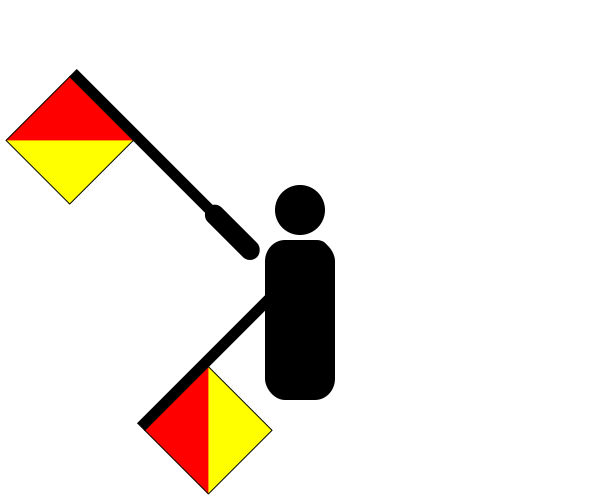
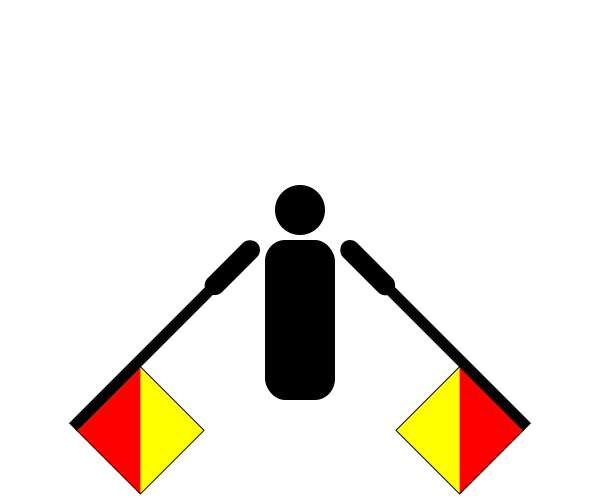
There are approximately 4,381 people named Galvin in the UK. That makes it roughly the 2,143rd most common surname in Britain. Around 67 in a million people in Britain are named Galvin.
Origin: Celtic
Region of origin: British Isles
Country of origin: Ireland
Religion of origin: Christian
Language of origin: Gaelic

Famous people named Galvin
- George Wild Galvin - Music hall singer; comedian (1860 to 1904)
- William F. Galvin - American politician
- Tony Galvin - Irish football player
- Mark Galvin - Racing driver
- Chris Galvin - Football player
- Dave Galvin - Football player
Names and descriptions courtesy of Wikipedia, and may contain errors. This is not intended to be an exhaustive list of every famous person with this name.