GALVAN
Origin and Etymology
The surname Galvan has a predominantly Spanish provenance, originating from the personal name Galván, itself a variant of Galo. The name Galo is believed to be derived from the Latin word gallus, which means “rooster” or “cock”. The rooster, a symbol of vigilance and courage in many cultures, has long been associated with qualities such as bravery, strength and leadership – attributes that the surname Galvan has traditionally been believed to embody.
In addition to its Iberian roots, there are records indicating that the surname was introduced to Britain after the Norman Conquest of 1066, possibly as a Roman nickname for a person with a receding hair line (from Latin calvanus). An alternative theory posits that Galvan is an anglicisation of the Irish-Gaelic family name O Gealbhain, meaning “the son of the descendant of the bright fair one”. This derivation is often recorded in the forms Galvin or Galvan in early English parish registers.
Geographical Distribution
Within Spain, the surname Galvan remains a common surname, particularly in regions where Spanish is the principal language. In Latin America, the name is frequently encountered, reflecting the historical migration of Spanish settlers to the New World. In Britain, the name appears in a limited number of parish records in the 17th and 18th centuries, notably within the metropolitan parish of St. Margaret’s and St. Sepulchre as well as in Kent.
Historical Records
The earliest documented instance of the surname in England is that of Peter Gaulvin, who married Ann Lee at St. Margaret’s Church, Westminster, in 1635 during the reign of King Charles I. In 1648, Mary Gulvin married John David at Cranbrook, Kent on the 5th of March. Later, on 9th June 1737, Edward Galvan was recorded in the parish of St. Margaret’s, London. A further entry appears on 27th October 1826, where Sarah Gaulven was listed at St. Sepulchre in London.
These early records demonstrate that, although the surname was primarily of Spanish origin, it had established a presence within England by the mid‑seventeenth century, with spelling variations reflecting the adaptation of a foreign name to English orthographic patterns.
Cultural Significance
Because the Latin root of the name denotes a rooster, the surname Galvan has historically been associated with the symbolic attributes of that bird. In heraldic tradition, roosters are used as emblems of watchfulness and courage, qualities that the bearers of the surname were often expected to embody. In modern times, these symbolic associations remain part of the collective memory attached to the surname, particularly within families that trace their lineage directly back to its Iberian or early English ancestors.
Similar and related surnames
Related and similar names are generated algorithmically based on the spelling, and may not necessarily share an etymology.
How to communicate the surname Galvan in...
Braille
⠛⠁⠇⠧⠁⠝
Morse
--..-.-.....-.--.
Semaphore


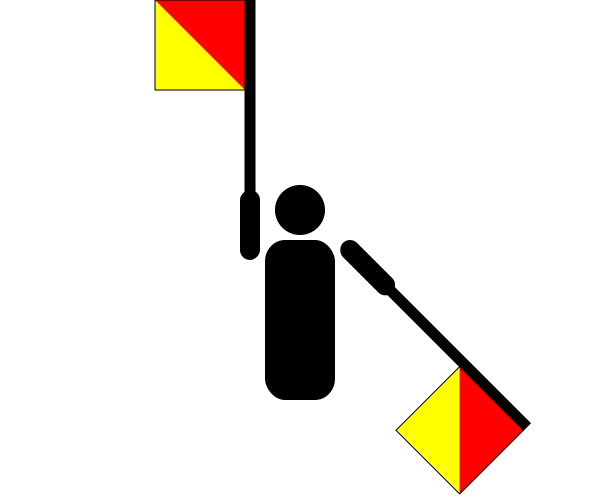
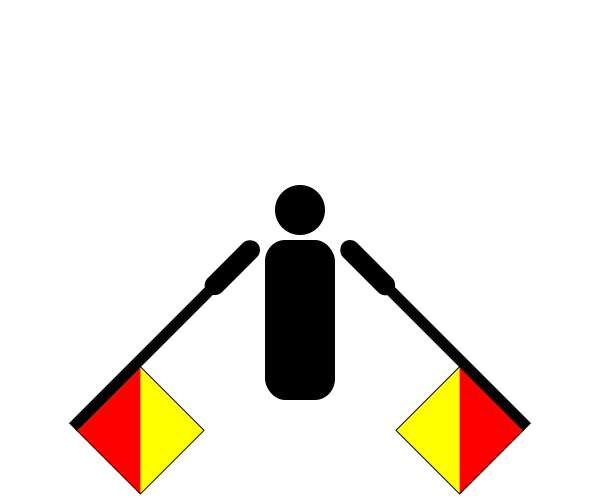
There are approximately 79 people named Galvan in the UK. That makes it one of Britain's least common surnames. Only around one in a million people in Britain are named Galvan.
Origin: Iberian
Region of origin: Europe
Country of origin: Spain
Religion of origin: Christian
Language of origin: Spanish
