FRANZEN
The surname Franzen derives from Germanic origins and is primarily associated with the personal name Franz. Franz itself is a shortened form of the Latin given name Franciscus, which was used in the early medieval period to denote a free man or, in a more specific sense, a person of the Frankish people who later became known as a Frenchman. The suffix -en is a common Germanic patronymic marker signifying “son of”; consequently, Franzen originally meant “son of Franz” or “descendant of a free man”.
In addition to the patronymic interpretation, some linguistic studies suggest that the name may also be linked to the Old High German word frawin, meaning “protector”. The combination of these roots gives the surname a dual connotation of freedom and guardianship, traits that were prized in medieval societies.
Geographically, the name is most frequently encountered in Germany and Sweden, where it has been borne by many families since the Middle Ages. It also appears in other German‑speaking regions such as Austria and Switzerland, as well as in northern European countries including the United Kingdom and France. In the United States the surname is common in the Midwest, especially in Minnesota and Wisconsin, reflecting patterns of Germanic and Swedish immigration. In the British Isles it is predominantly found in England, with a notable presence in larger towns and urban centres.
Variations of the spelling of Franzen arise from transliteration and regional pronunciation differences. Common forms include Franzman, Franzen, Franzen, Fronsen, Fransen, Franßen, Frånensen, and Frühnson among others. In Swedish contexts the surname may appear as Fransson or Fransen, while the French variant is often François. These variants all trace back to the same etymological roots.
Historically, the name Franciscus gained prominence in the 12th and 13th centuries, partly due to the influence of St. Francis of Assisi, whose life and writings popularised the root name across Europe. The name was also associated with the Knights Templar and other crusading orders of the same period, further embedding it within the cultural memory of medieval Christendom. The earliest known documentation of a family bearing a form of the name dates from 1135, where a Hugo Francus is recorded in the register of Oseney Abbey in Oxfordshire.
Contemporary bearers of the surname include the Pulitzer Prize–winning author Jonathan Franzen, whose work is recognised in literary circles worldwide. While the likelihood of direct genealogical connection between individuals of the same surname is generally distant given the commonality of the name, the shared heritage remains a point of cultural significance for many families.
In sum, the surname Franzen embodies a heritage that combines notions of freedom, lineage, and protective tradition. Its widespread yet distinct presence across Europe and the diaspora reflects both the migration patterns of Germanic and Scandinavian peoples and the enduring legacy of a name rooted in Latin and Germanic linguistic history.
Similar and related surnames
Related and similar names are generated algorithmically based on the spelling, and may not necessarily share an etymology.
How to communicate the surname Franzen in...
Braille
⠋⠗⠁⠝⠵⠑⠝
Morse
..-..-..--.--...-.
Semaphore
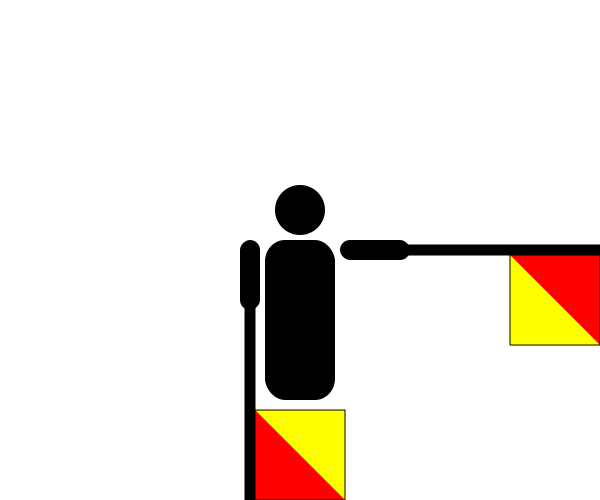
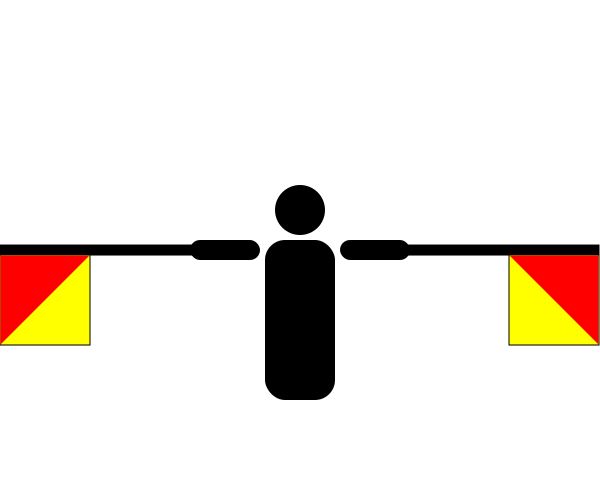

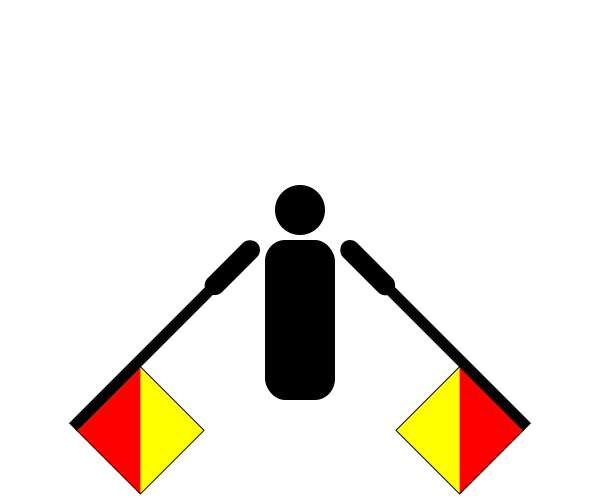


There are approximately 115 people named Franzen in the UK. That makes it one of Britain's least common surnames. Only around two in a million people in Britain are named Franzen.
Origin: Scandinavian
Region of origin: Europe
Country of origin: Sweden
Religion of origin: Christian
Language of origin: Swedish
