FRANZ
Franz is a surname of German provenance, originating from the personal name Franz, a diminutive form of Francis which itself derives from the Latin Franciscus. The Latin root is commonly interpreted to mean either “Frenchman” or “free man”. Consequently, the earliest bearers of the name were often identified by their regional origin or their social status, as a free individual within a feudal context.
The usage of Franciscus as a given name dates back to the early Christian period and was popularised by ecclesiastical figures such as St. Francis of Assisi. During the Middle Ages the word evolved into a nickname applied to those from France or to those who were regarded as liberated from the restraints of servitude. The surname form first appears in documentary records of the 12th century; a notable instance is the entry for Hugo Francus in the 1135 register of Oseney Abbey, Oxfordshire, England, during the reign of King Henry I.
In medieval Europe, spellings of the name proliferated rapidly. The Latinised form Franciscus gave rise to variants such as Francis in English, Francois in French, Francesco in Italian and Spanish, and a host of diminutives and patronymics including Franzel, Franssen, and Franssen. Across Germanic lands the name was rendered in many ways – France, Franch, Freze, Frantz – reflecting regional dialects and orthographic practices.
In contemporary usage the form Franz predominates throughout former German‑speaking areas, especially in Germany, Austria and the Czech Republic. In Germany it is most common in Bavaria, Baden‑Württemberg and Rhineland‑Palatinate. Austrian concentrations are greatest in Upper Austria, while in the Czech Republic the name is most frequent in Moravia. In Italy, the surname appears mainly in the north‑east and north‑west, notably in Trentino‑Alto Adige.
The diaspora of the name extended into North America during the period of large‑scale German emigration. In the United States it is found primarily in the Midwest, the south, and along the eastern seaboard, with clusters in New York, Pennsylvania and Maryland. Canadian occurrences are usually anglicised as Frans or Franz, and in Brazil the variant Franzeski has gained some prominence.
Modern bearers of the surname span a range of professions and disciplines, yet the name remains directly linked to its etymological roots in the concepts of nationality and liberty. As a surname it has endured through centuries of social and linguistic change, maintaining a consistent identity that is recognisable across multiple European and North American cultures.
Typical given names associated with the Franz surname
Male
- David
- Ernestino
- Karl
- Kevin
- Kurt
- Leslie
- Michael
- Paul
- Peter
- Robert
- Stephen
Female
- Anke
- Anna
- Barbara
- Beata
- Beth
- Christine
- Grace
- Jill
- Maria
- Sally
- Samantha
- Sandra
- Susan
- Vera
Similar and related surnames
- Farrance
- Ferrans
- Frain
- Fraine
- Fraines
- Fraiz
- Fran
- Frana
- Franah
- Franas
- Franc
- France
- Frances
- Franci
- Franck
- Francs
- Frand
- Frane
- Franes
- Franey
- Frang
- Frange
- Frangi
- Frani
- Franis
- Frank
- Franke
- Franks
- Frann
- Franny
- Frano
- Frans
- Franse
- Franses
- Frant
- Frants
- Frantz
- Franus
- Frany
- Franza
- Franze
- Franzel
- Franzen
- Franzi
- Franzke
- Franzo
- Franzos
- Frayn
- Frayne
- Fraz
- Frean
- Freane
- Frein
- Frene
- Frenz
- Furness
- Vrain
Related and similar names are generated algorithmically based on the spelling, and may not necessarily share an etymology.
How to communicate the surname Franz in...
Braille
⠋⠗⠁⠝⠵
Morse
..-..-..--.--..
Semaphore
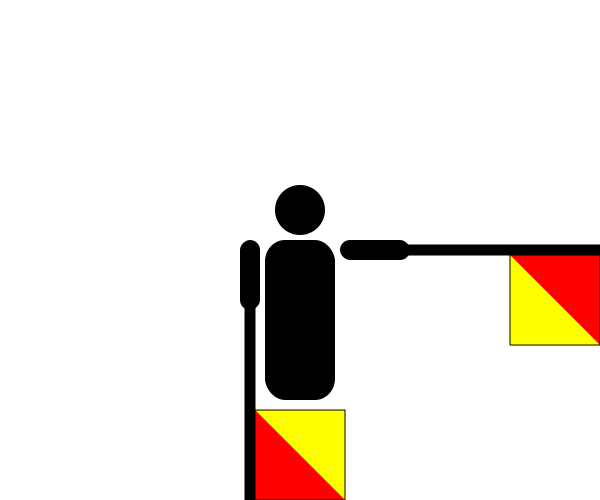
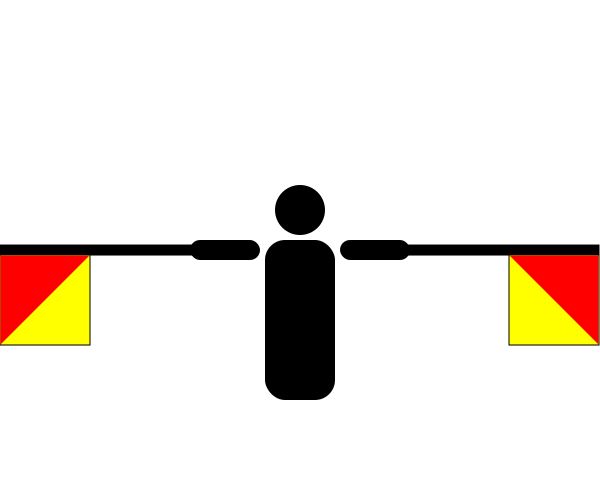

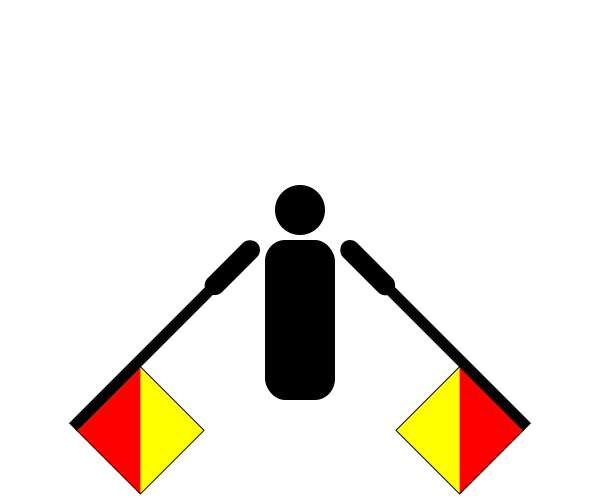

There are approximately 218 people named Franz in the UK. That makes it one of Britain's least common surnames. Only around three in a million people in Britain are named Franz.
Region of origin: Europe
Country of origin: Germany
Language of origin: German
