FLANNIGAN
Flannigan is a surname of Irish origin, rooted in the Gaelic tradition of the British Isles. The name is derived from the Gaelic patronymic Ó Flannagáin, which literally means descendant of Flannagán.
The personal name Flannagán itself is a diminutive of the Gaelic word flann, which denotes a red or ruddy hue. Consequently the surname Flannigan is historically associated with an ancestor who possessed red hair or a ruddy complexion. The suffix -án is a diminutive marker meaning little, so the literal sense of the name is little red one.
During the process of Anglicisation the original Gaelic spelling underwent several variants, including Flannagan, Flanaghan and Falnagan. In English–speaking regions the initial prefix Ó was frequently omitted, producing the form Flannigan. The name remains strongly identified with Irish heritage and is regularly encountered in diaspora communities in North America, Australia and Canada.
The principal clan bearing the surname was located in Connacht, where the Flannigan sept held a hereditary post as stewards to the Kings of Connacht. Historical records of the family reach back to the early fourteenth century. The earliest documented instance of the surname is that of Donough O'Flanagan, Bishop of Elphin, whose name appears in the medieval records of 1308, during the reign of King Edward I of England.
In ecclesiastical registers the surname appears in the late eighteenth century: Robert, son of Richard and Margaret Flannigan, was christened on 3 December 1797 at Dromore Parish, County Down, while Margaret Flannigan married William Allen on 23 October 1798 in St. Giles Cripplegate, London. These entries illustrate the widespread use of the name in both rural and urban contexts at that time.
Notable bearers of the surname (or its variants) include Roderick Flanagan, who lived from 1828 to 1861 and founded the Sydney Chronicle; Thomas Flanagan, born in 1814 and deceased in 1865, who authored the History of the Church in England; and David Flannigan, who emigrated from Ireland during the Great Famine. Together with his wife Jane and daughter Elizabeth, David sailed from Liverpool aboard the Stephen‑Whitney on 6 April 1846 bound for New York, exemplifying the broader pattern of migration during the nineteenth‑century diaspora.
In contemporary times the surname remains one of Ireland’s most common family names, ranked sixty‑ninth in an enumeration of the hundred most widespread Irish surnames. Its persistence and geographical spread attest to the resilience of the Irish diaspora and to the cultural significance of the name within the broader Celtic heritage. The surname Flannigan therefore retains a distinct identity through its historical roots, its linguistic evolution, and its continuing presence across the world.
Typical given names associated with the Flannigan surname
Male
- David
- James
- John
- Mark
- Michael
- Paul
- Peter
- Robert
- Thomas
- William
Female
- Ann
- Barbara
- Catherine
- Elizabeth
- Fiona
- Helen
- Jean
- Joan
- Karen
- Margaret
- Maria
- Mary
- Michelle
- Sarah
- Sheila
Similar and related surnames
Related and similar names are generated algorithmically based on the spelling, and may not necessarily share an etymology.
How to communicate the surname Flannigan in...
Braille
⠋⠇⠁⠝⠝⠊⠛⠁⠝
Morse
..-..-...--.-...--..--.
Semaphore
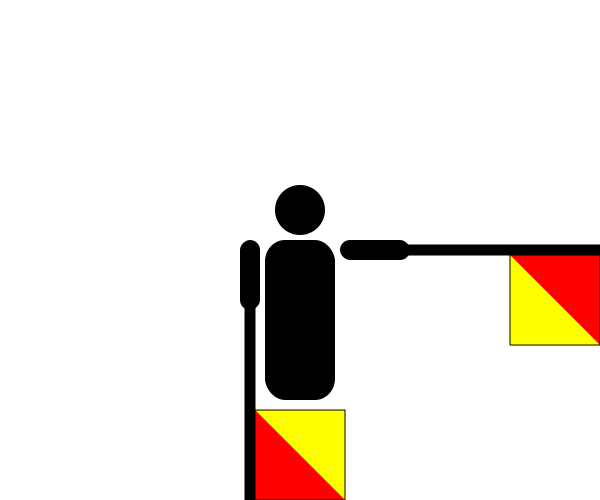


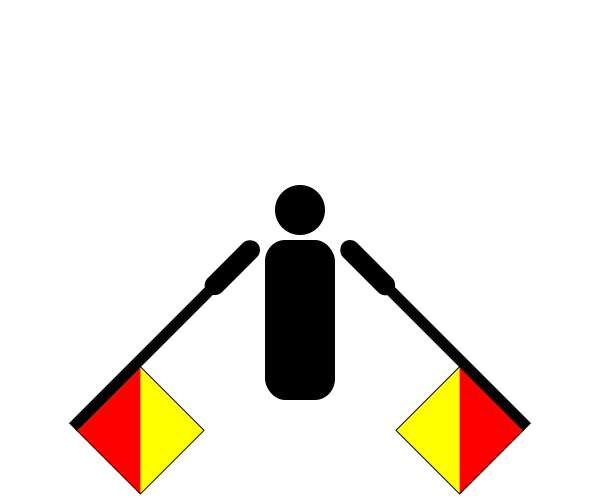
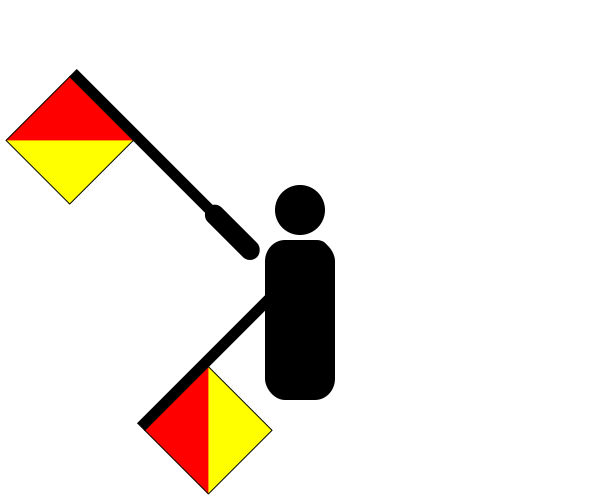

There are approximately 1,529 people named Flannigan in the UK. That makes it roughly the 5,272nd most common surname in Britain. Around 23 in a million people in Britain are named Flannigan.
Origin: Celtic
Region of origin: British Isles
Country of origin: Ireland
Religion of origin: Christian
Language of origin: Gaelic

Famous people named Flannigan
- Jake Flannigan - Football player
- Iain Flannigan - Scottish football player
- Tommy Flannigan - Scottish football player (1908 to 1)
- Patrick Flannigan - Football player (1909 to 1987)
- Ray Flannigan - Football player (1949 to 2015)
Names and descriptions courtesy of Wikipedia, and may contain errors. This is not intended to be an exhaustive list of every famous person with this name.