FANNON
Fannon is a surname of Irish provenance, arising from the Gaelic patronymic Ó Fionnáin, which indicates descent from an individual named Fionnán. The personal name Fionnán is a diminutive of Fionn, a word meaning “fair” or “white” in the Irish language; consequently, the surname may be understood as denoting a descendant of someone with a fair or white head‑hair or complexion.
The earliest documentary appearance of the name in its anglicised form was recorded on 15 June 1788, when a John Fannon appeared as a witness at a church in Drung, County Cavan, during the reign of King George II of England. In the 19th century the name was documented on emigrant lists, for example, a 20‑year‑old Jane Fannon departed for New York aboard the ship Downside of Liverpool on 20 April 1846, and a family consisting of John Fannon, wife Mary, and children Catharine, Maria, Bernard, Patrick and Daniel left from Liverpool on the vessel New World on 22 February 1847.
The surname is strongly associated with several western counties of Ireland, particularly Galway and Roscommon, where it appears as Fannon, Finan and Fannin. Earlier historical references locate the clan in the central county of Offaly and in Connacht, and some records also indicate a presence in County Limerick, where the toponymic settlements of Ballyfanning and Ballynaning were once the principal seats of the clan.
Because of phonetic similarity, the name has frequently been conflated with the English surname Fanning, which is historically prominent in County Limerick. In the 19th century the lack of standardised spelling resulted in many individuals being recorded alternately as Fannon or Fanning, and vice versa.
The surname has several recognised variations, including Fennan, Fennane, Fennin, Fennyn, Finan, Finane, Finin, Finon, Finnin, Finnane, Finnen and, in some instances, O Fionn or O Finn. These different spellings arise from the process of anglicisation of the original Gaelic patronymic Ó Fionnáin and from local linguistic practices. Because the spelling of surnames was not standardised until the end of the 20th century, one individual may appear under several different orthographies in contemporary records.
Following the destruction of a large proportion of Irish state and church records in 1922, many early documentation of the family name has been lost. Nevertheless, surviving parish registers, ship manifests and witness lists continue to provide evidence of the name’s persistence and spread, especially during and after the great potato famine of the 1840s. In the modern era the name is most densely found in Ireland, with continuing pockets in the western counties of Connacht and the province of Offaly, and it is also present in the wider Irish diaspora, notably in the United Kingdom, the United States, Canada, Australia and New Zealand.
Typical given names associated with the Fannon surname
Male
- Andrew
- Anthony
- David
- Edward
- James
- John
- Lee
- Michael
- Paul
- Peter
- Thomas
Female
- Bernadette
- Claire
- Elizabeth
- Emma
- Julie
- Kathleen
- Linda
- Margaret
- Mary
- Michelle
- Susan
- Victoria
- Zoe
Similar and related surnames
Related and similar names are generated algorithmically based on the spelling, and may not necessarily share an etymology.
How to communicate the surname Fannon in...
Braille
⠋⠁⠝⠝⠕⠝
Morse
..-..--.-.----.
Semaphore
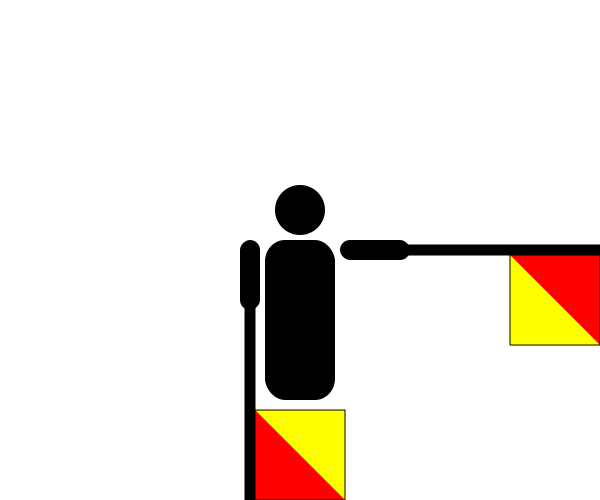

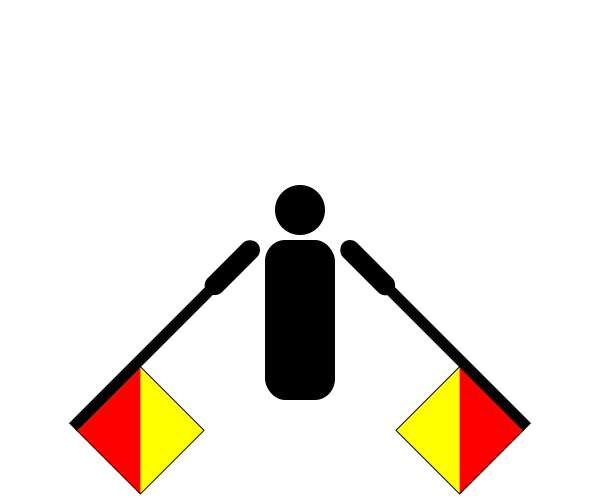
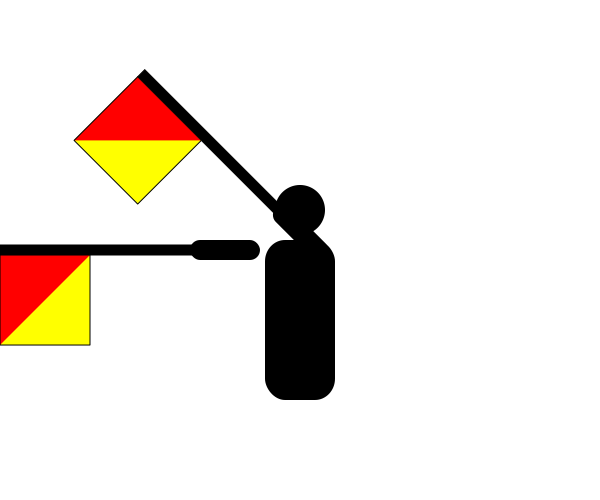
There are approximately 745 people named Fannon in the UK. That makes it roughly the 9,256th most common surname in Britain. Around 11 in a million people in Britain are named Fannon.
Origin: Celtic
Region of origin: British Isles
Country of origin: Ireland
Religion of origin: Christian
Language of origin: Gaelic
