FANNIN
The surname Fannin is an English and Irish family name that finds its earliest roots in the Gaelic language of the British Isles. It is derived from the ancestorial prefix Ó, meaning ‘descendant of’, and the personal name Fionnán, which itself is a diminutive of Fionn meaning ‘fair’ or ‘white’. The combination thus denotes ‘descendant of the fair one’ and was first recorded in the Middle Ages.
Early documentary evidence places the name in County Mayo in western Ireland, where the Ó Fionnáin were a prominent clan belonging to the Ui Fiachrach Muaighe group and served as chiefs of Coolcarney. The surname gained further prominence in County Limerick through Norman influence, where variations such as Fanning were introduced. The Norman-French personal name Panin is thought to have supplied the root for some southern‑Irish bearers, a hypothesis supported by the existence of the place name Fanningstown in Limerick and the recorded origin of the family in Ballingarry, County Tipperary.
Notable historical bearers include St. Finan, who died in 661 and is regarded as the earliest recorded bearer of the name, and Dominick Fanning, who served as mayor of Limerick and distinguished himself during the siege of the city in 1651. Another early record is that of Nicholas Fanning, titled ‘Lord of Aine’, dated 1540 at Knockainy, County Limerick and witnessed during the reign of Henry V.
The modern surname appears in several orthographic forms, including Fannin, Fanning, Finnan, Finan and, in less common instances, Fanan or Faanen. These variations arise from regional dialects, transcription differences and the process of anglicisation of the Gaelic Ó Fainín, whereby the original meaning relating to a ring named ‘fainne’ was altered.
As with many Irish surnames, the Fannin name held geographical significance; modern bearers often find themselves able to trace ancestry back to specific areas within Ireland, most frequently County Mayo or Limerick. The migration of Irish families during the Great Famine and subsequent economic hardship brought many Fannins to the United States, Canada and elsewhere in the British Empire. In the United States the name is most common in Kentucky, while several places and institutions in Texas bear the name of Colonel James Walker Fannin Jr., reflecting his role in the Texas Revolution.
In contemporary use the surname remains relatively uncommon when compared to larger ethnic names, yet it persists as a marker of cultural heritage, connecting present‑day individuals to a lineage that stretches back to medieval Gaelic society and the early medieval period of Norman influence in Ireland.
Overall, the surname Fannin illustrates the complex interplay of linguistic evolution, migration, and local identity that characterises many Irish family names, and it continues to be a testament to the enduring legacy of Gaelic naming traditions in the modern world.
Typical given names associated with the Fannin surname
Male
- David
- John
- Michael
- Nigel
- William
Female
- Ann
- Elizabeth
- Kay
- Linda
- Mary
Similar and related surnames
Related and similar names are generated algorithmically based on the spelling, and may not necessarily share an etymology.
How to communicate the surname Fannin in...
Braille
⠋⠁⠝⠝⠊⠝
Morse
..-..--.-...-.
Semaphore
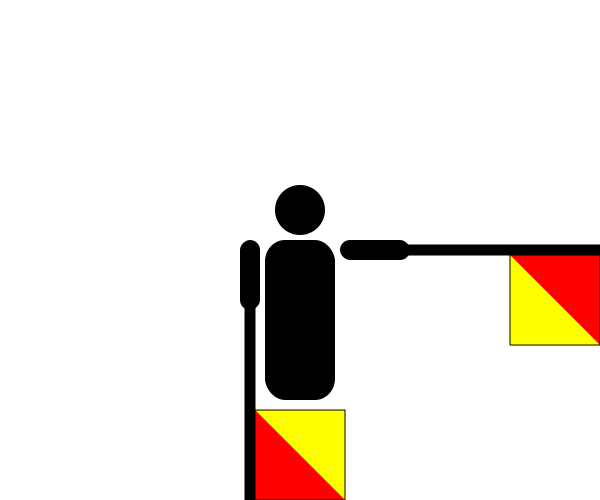

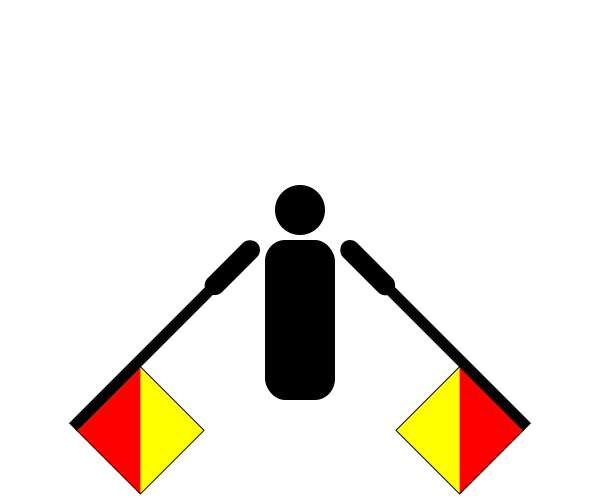
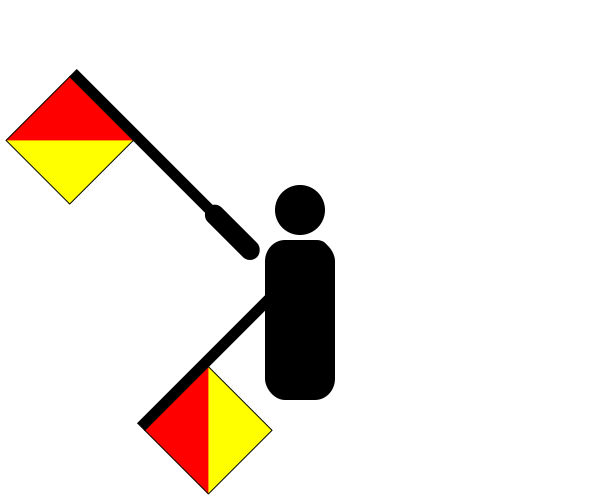
There are approximately 112 people named Fannin in the UK. That makes it one of Britain's least common surnames. Only around two in a million people in Britain are named Fannin.
Origin: English
Region of origin: British Isles
Country of origin: England
Religion of origin: Christian
Language of origin: English
