FADDEN
Fadden is a surname of Gaelic origin, predominantly associated with the British Isles and, more specifically, Ireland and Scotland. It belongs to a class of surnames that were first recorded as patronymic identifiers – descendent of a particular ancestor – and later evolved into fixed family names. The name is also found in the Isle of Man and in parts of England, where it has taken on local variations.
Ó Fadaigh is the most commonly cited source of the surname. In Gaelic, “fada” means “long” or “tall,” so the expression “Ó Fadaigh” translates literally to “descendant of Fadaigh.” The personal name Fadaigh, in turn, was originally a descriptive epithet given to a tall or long‑limbed individual, and the surname eventually became associated with that person’s line. A distinct, though related derivation is Ó Fothadáin, the Gaelic form of fothadán, which means “little bird” or “little poet.” This variant points to an ancient family linked to the Gaelic kingdom of Éile, a region in what was once the province of Ulster and a prominent early adopter of Christianity.
A further layer of complexity arises from the Scottish Highland surname Mac Phaidin, itself a pre‑14th‑century form derived from the personal name Paidin – a diminutive of Padraig (Patrick). From this source emerge spellings such as MacFadan, MacFadden, MacFadyen, MacFadzean, and MacPhaden. Forms without a Mac or Mc prefix include Faden, Fadon, Fadden, Fadian, Faddian, and, in County Mayo, the spelling Vaden.
Earliest documentary references to the surname appear in the late fourteenth and mid‑nineteenth centuries. The sub‑catholic cleric Conghan Macpaden appears in a record for a petition to pursue the archdeaconry of Argyll in Scotland in 1390. An John McFadyeane is mentioned in Edinburgh in 1457. Church registers in Aberdeen document the marriage of James McFadden and Rebeca Dunnaway, while in Ireland, the christening of James Fadian, son of Martin Fadian, is recorded at Achill in County Mayo on 14 July 1866.
The surname is widespread within Ireland, appearing most frequently in County Mayo, Clare, Cork, Tipperary, Limerick, County Galway, and Kilkenny. In Scotland, it is associated with the Highlands, particularly the Lochbuie area and the former jurisdiction of Argyll. The Isle of Man also contains well‑documented families bearing the name.
In recent statistics the surname remains common. In England it is the 1766th most popular surname, while in the United States it ranks at 5293rd and in Canada it holds position 854th. The name persists in diaspora communities across Australia, South Africa, New Zealand, South America, and other parts of the world. These figures illustrate that the Fadden family continues to thrive wherever it has settled, maintaining links to its Gaelic heritage while integrating into new societies.
The extensive list of variants – including Fadan, Faddan, Faedan, Feadhain, Fadehan, and many others – reflects the historical fluidity of orthographic practices in the English‑speaking world, as well as the migrations of families across the British Isles. These variations attest to a lineage that is both ancient and adaptable, anchored in Gaelic tradition yet spread across a variety of linguistic and cultural contexts.
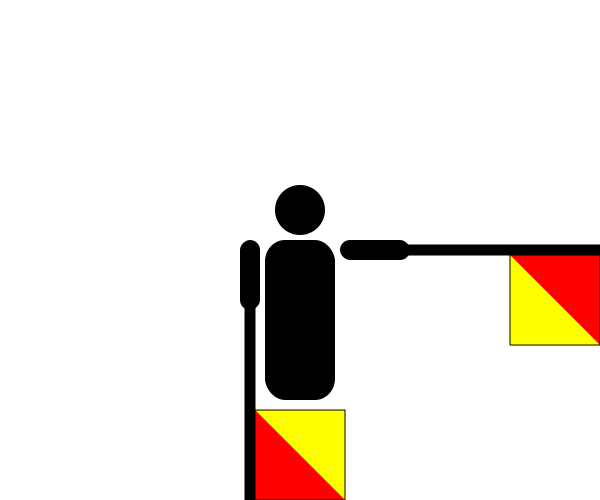


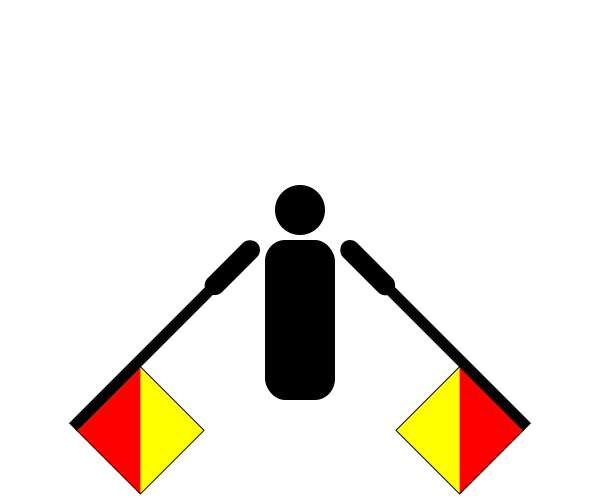
Typical given names associated with the Fadden surname
Male
- Andrew
- Charles
- James
- John
- Marc
- Martin
- Michael
- Patrick
- Paul
- Stuart
- Thomas
Female
- Bridget
- Cassie
- Christine
- Denise
- Gemma
- Jacqueline
- Julie
- Karine
- Lisa
- Mary
- Melanie
- Natalie
- Rebecca
- Sarah
- Vera
Similar and related surnames
Related and similar names are generated algorithmically based on the spelling, and may not necessarily share an etymology.
How to communicate the surname Fadden in...
Braille
⠋⠁⠙⠙⠑⠝
Morse
..-..--..-...-.
Semaphore
There are approximately 236 people named Fadden in the UK. That makes it one of Britain's least common surnames. Only around four in a million people in Britain are named Fadden.
Surname type: From given name or forename
Origin: Celtic
Region of origin: British Isles
Country of origin: Ireland
Religion of origin: Christian
Language of origin: Gaelic
