DYKE
Dyke is a surname of Anglo‑Saxon origin, first recorded in the British Isles during the Twelfth Century. Its root is the Old English word dic, meaning a ditch or a man‑made embankment used for drainage or defence. As a topographical name it was applied to individuals who lived adjacent to such a feature or who were situated at a place called Dyke.
The earliest cited instances include John attedich of Cambridgeshire (1260), John del Dike of Yorkshire (1297), Robert del Dykes of Cumberland (1303) and William del Dikes of Yorkshire (1332). These examples demonstrate how the surname evolved from the pre‑seventh‑century form dic through Middle English variants such as diche and dike, reflecting the widespread use of dykes for defence during the medieval period.
In the period of Norse settlement, the term may have been reinforced by the Old Norse word diki, and the name was occasionally recorded in the Latinised form de Dic. The family acquired a coat of arms featuring a silver shield with a red indented chief and three gold coins (bezants), symbolising the wealth found during pilgrimages to Byzantine lands. One of the more prominent name‑bearers was John Bacchus Dykes (1823‑1847), a theologian, Doctor of Music at Durham, and composer of many hymn‑tunes.
By the seventeenth century the surname had crossed the Atlantic, where a Mr. Dykes was documented as a landholder of some standing on St. Davids, the Sommer Islands, in 1673. Although the name remains most frequently found in the United Kingdom, strong Dutch influences are evident, as the surname also derives from the Dutch Dijk, meaning a bank or dike. Consequently, variants such as Dyck, Dike, Van Dyke, Van Dijk, and Van Der Dijk have arisen, reflecting migration and naturalisation processes across Europe and the Americas.
Across the British Empire and the United States the surname maintains a presence, with concentrations in England, Canada, Australia, New York, California and Michigan. The variants are largely shaped by linguistic and cultural shifts: the anglicised forms are Dike and Dyke, while the Germanic variant may appear as Dieck or Dick. Patronymic derivatives such as Dykeman, Dykeson and Dykenson also appear in the record, though these are less common.
Typical given names associated with the Dyke surname
Male
- Andrew
- Christopher
- David
- James
- John
- Paul
- Philip
- Richard
- Robert
- Stephen
Female
- Caroline
- Elizabeth
- Emma
- Helen
- Julie
- Karen
- Margaret
- Mary
- Sarah
- Sharon
- Susan
Similar and related surnames
Related and similar names are generated algorithmically based on the spelling, and may not necessarily share an etymology.
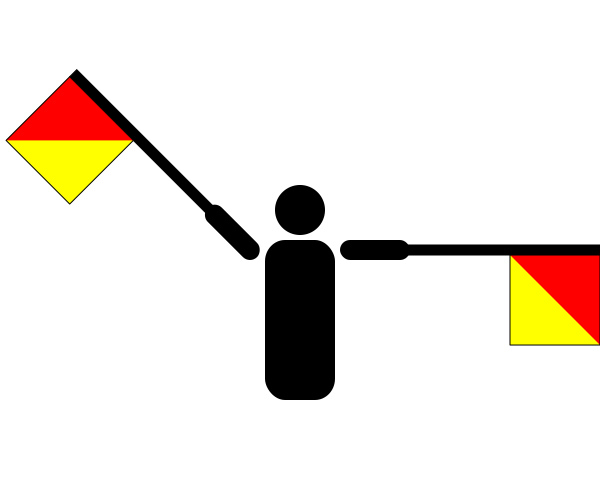
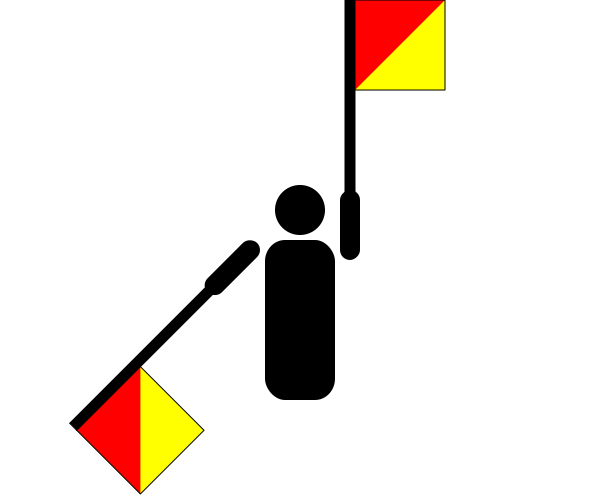
How to communicate the surname Dyke in...
Braille
⠙⠽⠅⠑
Morse
-..-.---.-.
Semaphore


There are approximately 5,281 people named Dyke in the UK. That makes it roughly the 1,790th most common surname in Britain. Around 81 in a million people in Britain are named Dyke.
Surname type: Location or geographical feature
Origin: English
Region of origin: British Isles
Country of origin: England
Religion of origin: Christian
Language of origin: English

Famous people named Dyke
- Miranda Katherine Hart Dyke - Actress, comedian, and writer
- Greg Dyke - Media executive
- David Hart Dyke - Royal Navy officer
- Roy Dyke - Musician
- Thomas Dyke - Cricketer (1801 to 1866)
- Zoe Dyke - Dyke [née Bond], (1896 to 1975)
- Alex Dyke - Radio presenter
Names and descriptions courtesy of Wikipedia, and may contain errors. This is not intended to be an exhaustive list of every famous person with this name.