DICKE
Dicke is a surname of German origin, first recorded in medieval documents within the German states and later found across the British Isles and the United States.
The name derives from the Middle High German word dicke, which means “thick” or “fat.” Traditionally, surnames were often created to distinguish individuals by describing a notable physical trait, and Dicke was thus used as a nickname for someone of a stout or robust build. The meaning could also extend metaphorically to describe someone who was wealthy or influential.
In addition to its descriptive origin, Dicke is also a patronymic surname derived from the pet form Dick of the personal name Richard. Richard originates from the Old Germanic elements ric, meaning “power,” and -hard, meaning “brave” or “strong.” The popularity of the name was reinforced by Norman influence after 1066 and the subsequent fame of Richard I of England in the 12th century. The medieval period saw the rise of many pet forms of Richard, producing surnames such as Dicke, Dikes and Dycks.
Early records in England include the Curia Rolls of Lancashire (1220), where a person named Dicke Smith is mentioned, and the Assize Court Rolls of Cheshire (1286), which record a Dik de Hyde. Subsequent extant documents list individuals such as William Dik (1356, Gloucester), William Dykes (1362, Norfolk), and William Dyckk, the rector of Godwick in Norfolk (1420). A further traceable instance comes from the rolls of Colchester, Essex, around 1250, which show a name Richard Dic, the earliest recorded spelling of the surname.
Prominent bearers of the surname include Sir Alexander Dick of Edinburgh (1703–1785), a distinguished physician, and Sir Robert Dick, who died commanding his troops at the Battle of Sobraon in India during the Sikh War of 1846.
In contemporary times, the surname remains most common in Germany, especially in the regions of North Rhine‑Westphalia, Lower Saxony and Bavaria. There is also a notable demographic presence in the United States and in the Netherlands. Global distribution estimates place the number of individuals bearing the surname between 7,000 and 10,000, with the majority residing in Germany.
The surname Dicke has several variants that share its linguistic roots or have evolved through regional dialects and cultural adaptation. These include Dick, Dicks, Dickes, Dicken, Dickens, and the Dutch Dik or Dyck. In the United States, anglicised versions such as Dickinson or Dickerson have also emerged. While these names may appear similar, their origins can differ; for example, Dickens often derives from the English diminutive Dickin, a pet form of Dick, whereas Dicke in Northern Germany comes from a nickname indicating strength or physical robustness.
It is important to note that while the literal meaning of the surname refers to a person’s physique, there is no inherent derogatory connotation attached to the name in its original cultural context. Consequently, bearers of the surname should not equate it with negative implications, and any attempts to trace lineage should involve a thorough genealogical investigation rather than reliance on superficial similarities between related surnames.
Similar and related surnames
Related and similar names are generated algorithmically based on the spelling, and may not necessarily share an etymology.
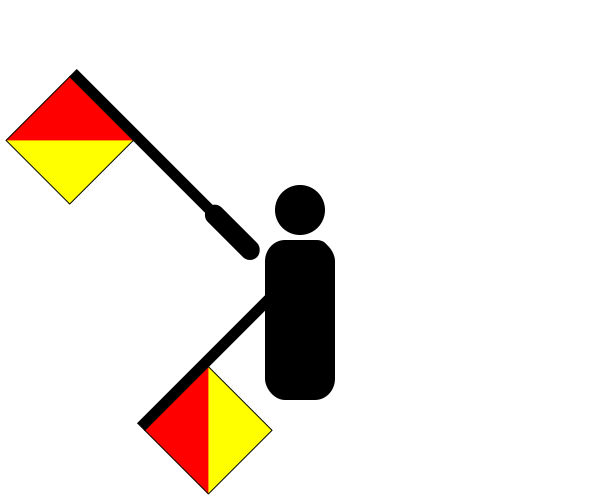
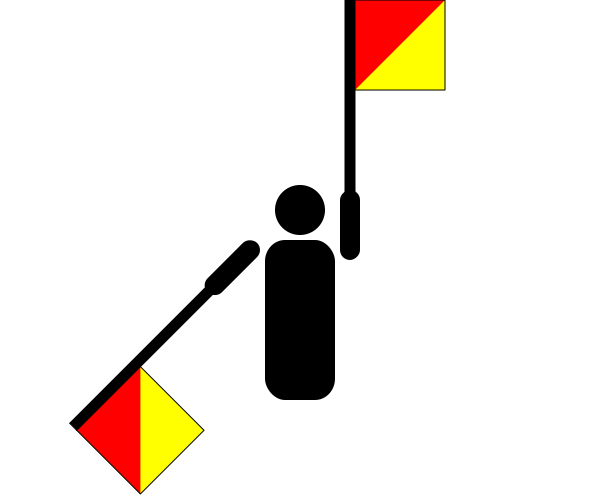
How to communicate the surname Dicke in...
Braille
⠙⠊⠉⠅⠑
Morse
-....-.-.-.-.
Semaphore



Sorry, we don't have any statistics on this name. That's probably because it's very uncommon in Britain.