DURAN
The surname Duran traces its origins to both Latin linguistic roots and Iberian heritage, with significant influences emerging in medieval Europe. The name is traditionally linked to the Latin word durandus, meaning "enduring" or "steadfast", reflecting a sense of resilience and determination that is often associated with its bearers.
In the Iberian Peninsula, particularly within the Spanish-speaking regions of Europe, the name inherited its Latin derivation and became firmly established as a patronymic surname. This indicates that it was originally employed to identify the descendants of an ancestor named Durand, a personal name that gained popularity during the Middle Ages. The designation points to families who were perceived as enduring, and this sense of strength was culturally valuable in a period marked by frequent conflict and social upheavals.
The name also appears in Anglo‑Norman records, suggesting a second avenue of introduction into Britain following the Norman Conquest of 1066. Contemporary documents, such as the Domesday Book, refer to the name as Durandus while the Old French form Durant was recorded in the early twelfth century. Historical sources demonstrate that the personal names Durant and Durand were widespread throughout the Middle Ages, with evidence of use in Hampshire in 1115 and in Yorkshire in 1312, where an alternative spelling “Doraunt” appears. The surname evolved into at least thirteen variants, including Durand, Durrant, Durran, Durand, Durant, Durant, Dorant, Dorran and Dorrins, each retaining the underlying meaning of steadfastness.
The earliest documented instance of the family bearing this name is attributed to Walter Durand, whose record appears in the Pipe Rolls of Westmorland dated 1196, during the reign of King Richard I, known as “The Lionheart.” These accounts highlight the early settlement of the name within England and its subsequent spread across the British Isles.
As the British Empire expanded, carriers of the surname, such as Nathan Durant, emigrated to the West Indies, where he became a land‑owner in Barbadoes by 1678. This migration illustrates the geographical breadth of the name beyond Europe, signalling the surname's adaptability and endurance across cultural boundaries.
The combination of Latin linguistic heritage and Norman transmission has cemented the surname Duran as a marker of resilience and steadfastness, qualities that are reflected in the historical records of families who carried the name across centuries and continents.
Typical given names associated with the Duran surname
Male
- Alexander
- Ali
- Christopher
- Daniel
- David
- Eyup
- Hasan
- James
- Kenan
- Marcus
- Mehmet
- Michael
- Raul
- Thomas
Female
- Abigail
- Angel
- Angela
- Clare
- Elizabeth
- Jane
- Linda
- Louise
- Maria
- Nicola
- Rachel
- Rebecca
- Rosalind
- Sandra
Similar and related surnames
- Darian
- Daran
- Darran
- Darani
- Duarn
- Dura
- Durana
- Durane
- Durani
- Durano
- Dairon
- Darant
- Daren
- Dargne
- Dariani
- Darien
- Darin
- Darn
- Darne
- Darno
- Daron
- Darren
- Darrin
- Darron
- Daurant
- Dauron
- Dawan
- Dearan
- Dearen
- Dearin
- Dearn
- Dearne
- Deeran
- Deerans
- Deerin
- Derain
- Deran
- Deraney
- Derani
- Deren
- Derenne
- Derian
- Derin
- Derine
- Dern
- Derne
- Dernie
- Deron
- Derouen
- Derrane
- Derrien
- Derrin
- Derun
- Diran
- Direen
- Diren
- Dirn
- Diron
- Diurno
- Doehren
- Doern
- Dohren
- Dohrn
- Doiron
- Doohren
- Dooren
- Doorn
- Doorne
- Dorain
- Doran
- Dorand
- Dorane
- Dorani
- Dorans
- Dorant
- Dorean
- Doreen
- Doren
- Dorian
- Dorien
- Dorin
- Dorine
- Dorion
- Dorn
- Dorna
- Dorne
- Dornie
- Doron
- Doronie
- Dorrain
- Dorran
- Dorrans
- Dorrean
- Dorreen
- Dorren
- Dorrian
- Dorrien
- Dorrin
- Dorrion
- Dorron
- Douran
- Dourne
- Dragna
- Dragnea
- Drain
- Draine
- Drainie
- Dran
- Drane
- Dranie
- Drann
- Drawn
- Drayne
- Drean
- Dreano
- Drein
- Dreina
- Dren
- Drene
- Dreni
- Dreon
- Drian
- Drien
- Drine
- Drinn
- Drion
- Droin
- Dron
- Drona
- Drone
- Drouin
- Drouyn
- Drown
- Drowne
- Druian
- Druin
- Drun
- Druon
- Dryne
- Duern
- Duhrin
- Durai
- Duram
- Durame
- Duranay
- Durance
- Durand
- Durando
- Durandt
- Durango
- Durann
- Durans
- Durant
- Durante
- Durantes
- Duranti
- Duranty
- Duras
- Duray
- Durban
- Durcan
- Durdan
- Dureant
- Dureen
- Duren
- Durent
- Durgan
- Durhan
- Durian
- Durien
- Durin
- Durion
- Durkan
- Durlan
- Durman
- Durn
- Durna
- Durnan
- Durnay
- Durne
- Durnie
- Durno
- Duron
- Duroni
- Durra
- Durram
- Durran
- Durrance
- Durrand
- Durrands
- Durrani
- Durrans
- Durrant
- Durrants
- Durren
- Durrin
- Durtan
- Durvan
- Dyrne
- Dyron
- Taran
- Tarani
- Taranu
- Tareen
- Tarin
- Tarini
- Tarn
- Tarna
- Tarnai
- Tarne
- Tarone
- Taroni
- Tarran
- Tarren
- Tarrien
- Tarrin
- Tarrini
- Tarron
- Tarrone
- Tarroni
- Tarun
- Taurani
- Tauren
- Taurina
- Taurino
- Tearn
- Tearne
- Tearon
- Tehran
- Tehrani
- Teran
- Terann
- Teren
- Terigno
- Tern
- Ternie
- Teron
- Terrain
- Terran
- Terrana
- Terraneo
- Terrano
- Terren
- Terreni
- Terrien
- Terrin
- Terron
- Terrone
- Terroni
- Terryn
- Tiran
- Tiren
- Tiron
- Tirona
- Tirone
- Tironi
- Toerien
- Toraine
- Toran
- Torano
- Toren
- Torian
- Torin
- Torina
- Torini
- Torino
- Torn
- Torna
- Tornai
- Torne
- Tornea
- Torno
- Toron
- Torrane
- Torrano
- Torren
- Torriani
- Torriano
- Torrini
- Torun
- Touraine
- Tourne
- Touron
- Tragne
- Tragni
- Traian
- Traianou
- Train
- Traina
- Traine
- Traini
- Traino
- Tran
- Trana
- Trane
- Trani
- Trann
- Tranne
- Trayne
- Trean
- Treen
- Treene
- Trein
- Tren
- Trenn
- Treon
- Trewyn
- Triana
- Triano
- Trin
- Trina
- Trine
- Trinn
- Troein
- Troen
- Troiani
- Troiano
- Troin
- Tron
- Trone
- Troni
- Trono
- Troon
- Troune
- Trown
- Trowne
- Troyna
- Truan
- Truen
- Truin
- Truine
- Trun
- Tryno
- Tuerena
- Turan
- Turani
- Turano
- Turean
- Turen
- Turian
- Turiano
- Turin
- Turina
- Turini
- Turino
- Turn
- Turna
- Turnau
- Turne
- Turnea
- Turneau
- Turnie
- Turno
- Turon
- Turone
- Turrin
- Turrini
- Turron
- Tyran
- Tyren
- Tyrna
- Tyron
- Tyrone
- Dirania
Related and similar names are generated algorithmically based on the spelling, and may not necessarily share an etymology.
How to communicate the surname Duran in...
Braille
⠙⠥⠗⠁⠝
Morse
-....-.-..--.
Semaphore


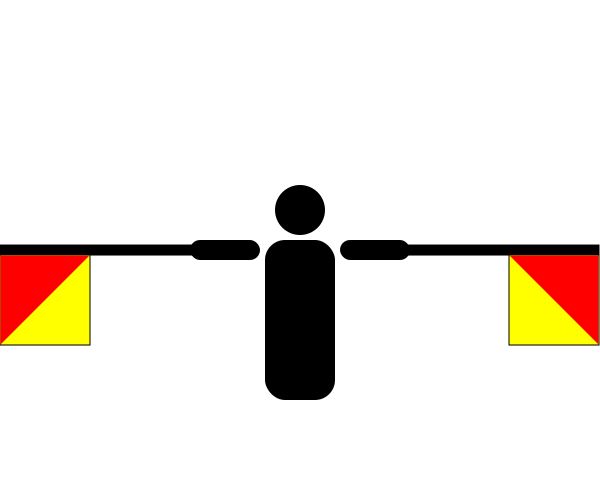

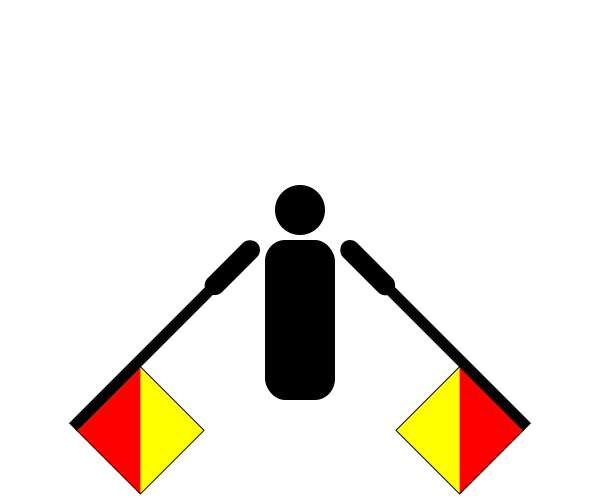
There are approximately 562 people named Duran in the UK. That makes it one of Britain's least common surnames. Only around nine in a million people in Britain are named Duran.
Origin: Iberian
Region of origin: Europe
Country of origin: Spain
Religion of origin: Christian
Language of origin: Spanish
