DOUGHER
Dougher is a surname of Irish and British provenance, the form in which it is known today having evolved through a range of orthographic and linguistic influences over many centuries.
In Irish tradition the name is believed to descend from the Gaelic patronymic Ó Dubhchair. The element dubh means “black”, while chair can be rendered “dear” or “beloved” in the sense of affection. Consequently the literal interpretation of Ó Dubhchair is “descendant of the beloved black‑one”, a construction that reflects the Gaelic custom of attaching a descriptive epithet to the progenitor of a family.
An alternative hypothesis regards the surname as having a locational origin linked to the English place‑names Docker or Docher in the counties of Westmorland and Lancashire. Here the toponym is derived from the pre‑7th-century Old Norse word dokr, meaning “the grazing land in the valley”. In these circumstances, the surname would have arisen after the Domesday survey, with earliest attestations appearing in Lancashire wills of 1579 under the form Docker. The evidence for this theory is limited, and there is no record of the name in Scottish or English censuses before the sixteenth century.
In the Irish context the spelling variations Dooher and Dougher are seen primarily in County Donegal. The Ulster region, which was heavily affected by the Plantation in the seventeenth century, contains the majority of surviving bearers of the name. Historical documents, such as the 1155 Westmorland charter in which the village is recorded as Docherga, indicate that the name has long-standing local roots in Britain, but the limited distribution in Ireland suggests the possibility that the Irish spellings are a later development, perhaps inspired by the English locational form or by the Gaelic patronymic rendering.
From the twelfth century onwards numerous individuals bearing the variant Dougherty appear in records. Many of them migrated to the United Kingdom, and later to the United States during the nineteenth-century waves of emigration. In the United States the surname is regarded as fairly uncommon, with concentrations noted in the Midwestern states of Ohio, Kentucky, Indiana, and Michigan and in the north‑western states of Montana, Washington and Oregon. Census records of the early 1800s indicate that the name was carried by families who settled in these regions in search of agricultural opportunity.
The Dougher surname is also listed as a derivative of the Irish name Mac Dhughaigh, an anglicised form of a Gaelic phrase meaning “son of a warrior”. This form is widespread in Northern and Eastern Ireland, particularly in the counties of Donegal, Antrim and Armagh. Aliases often used alongside Mac Dhughaigh include MacDhuighe, MacDoigh, MacDhoigh, Dougherty, Daugherty and D'Augherty, illustrating the variety of linguistic pathways through which the name has evolved.
Across the British Isles the Dougher surname continues to appear in civil registers, parish records and electoral rolls. The name’s prevalence is markedly lower than that of its more common derivatives; nevertheless, it remains a living testament to centuries of migration, adaptation and the enduring influence of Gaelic naming traditions.
Hence the name Dougher encapsulates a multifaceted heritage that is at once Irish, Scottish, English and, for many bearers, American. Whether an heir of the Gaelic epithet “beloved black‑one”, a descendant of an early warrior clan, or a proprietor of a valley’s grazing land, the modern family who carries the surname preserves an identifiable link to a complex, historically grounded lineage that has persisted across centuries and continents.
Similar and related surnames
Related and similar names are generated algorithmically based on the spelling, and may not necessarily share an etymology.
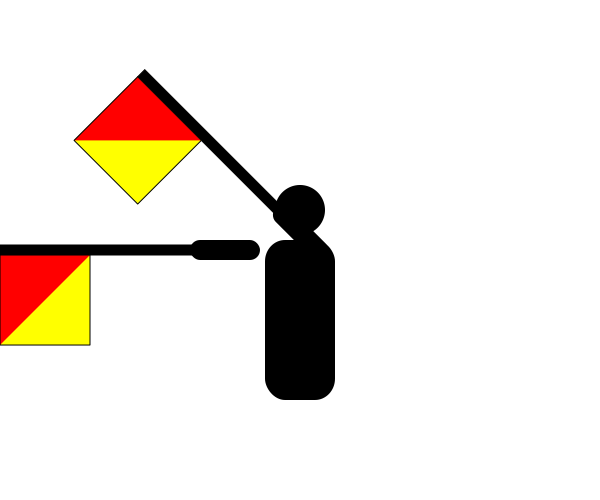
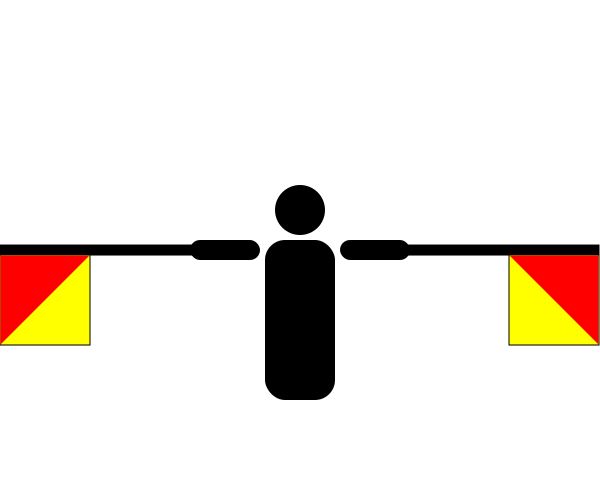
How to communicate the surname Dougher in...
Braille
⠙⠕⠥⠛⠓⠑⠗
Morse
-..---..---.......-.
Semaphore



Sorry, we don't have any statistics on this name. That's probably because it's very uncommon in Britain.
