DACRE
Dacre is an English surname that has persisted throughout the centuries, bearing a lineage marked by noble titles, landholdings, and illustrious service to the sovereign. The name is distinctly locational; it originates from places called Dacre in several districts across England, most notably within the West Riding of Yorkshire and the historic counties of Cumberland and Westmoreland.
In the earliest records the surname is connected to the Domesday Book of 1086, where the place name is recorded simply as “Dacre.” The contemporary appellation of the settlement derives from the river upon which it stands. Scholarly interpretation suggests that the place name itself comes from the Welsh deigr or the Old Breton dacr, meaning “tear,” which in ancient parlance would denote a “trickling stream” that nourishes the surrounding valley.
In the late twelfth century the first evidential appearance of the surname appears in the hunting it with the sheriff of Cumberland, William de Dakyr, dated to 1278 during the reign of Edward I, whose sobriquet was “The Hammer of the Scots”. This document proves that the name had already developed a distinct family identity by the late thirteenth century.
By the early fourteenth century another bearer of the name, Ranulph de Dacre, is recorded within the Norfolk archives in 1292, further indicating the spread of the family beyond its Yorkshire origins. Subsequent parish registers from the same era record marriages involving Dacres, such as Randolf Dacre’s joining to Eleanor Fitzhugh in 1436 at Ravensworth, and a Johanna Dacre’s wedding to Johes Randall in 1574 at Farnham.
The heraldic tradition of the Dacre lineage features prominently in the history of the family. The coat of arms granted to the Dacres of Cumberland and Westmoreland comprises a red field adorned with three gold escallops. Positioned above the shield, the crest depicts a tiger’s head emerging from a ducal coronet and chained in proper colours, a striking emblem that represents courage and dominion.
Alternative theories about the surname’s etymology exist, based on linguistic and geographic analysis. One hypothesis suggests a derivation from the Old Norse word dáski, meaning “dale,” which would designate a person originating in a valley or vale. This theory accounts for valleys situated in northern England where the name was later adopted by local families settled upon the terrain.
Another proposition arises from the Norman influence of the Middle Ages. The name may have an antecedent in the Norman French D'Acier, signifying “of steel,” possibly linked to a personal name that entered the Anglian lexicon following the Norman Conquest of 1066. Over the subsequent decades the spelling and pronunciation evolved, producing variants such as Daeger, Deaker, Dakker, and Decar, among others.
The distribution of the surname has remained concentrated within the north of England. In the nineteenth century, the most frequent concentrations were recorded in the counties of Westmoreland, Cumberland, and Durham, while the early twentieth century noted significant presences in Yorkshire, Lancashire and Northumberland. Modern census data from 1881 and 1901 recorded 4,000 to almost 5,000 individuals with the surname, a figure that has now stabilised at roughly 2,500 bearers throughout the United Kingdom.
The early twentieth century also demonstrates that Dacre families were active in England’s provincial governance, with prominent members such as Humphrey Dacre, Baron Dacre of Gilsland, and his son Thomas serving as Lord Lieutenants of Westmorland and Cumberland. The family’s influence extended to parliamentary summons and royal service; for example, Humphrey and Thomas were frequently present at the court of Henry VIII in the sixteenth century.
The title of Baronet of Greystoke was acquired by the Dacres in 1839, further extending the family’s peerage. Over the last two centuries the surname has continued to be associated with honours and knighthoods, reflecting the sustained prestige of the lineage.
While the surname is predominantly English, a modest number of families bearing the name also reside in Scottish counties, notably Ayrshire and Renfrewshire. Among these, the unofficial association with Annandale indicates that some Scottish Dacres may derive their surname from the valleys of the western highlands, consonant with the “dale” hypothesis presented earlier.
The contemporary list of spelling variants demonstrates the name’s linguistic flexibility over time. Some of the documented variants include Dacre, Dakar, Daeger, Deaker, Dakker, Deicher, Dakur, Daker, Decore, Decar, Daicar, and Dacca, all of which maintain phonetic similarity to the original form.
In summary, the surname Dacre is an anchoring point to England’s medieval past, interwoven with place names that denote rivers and valleys, and enriched by the heraldic symbolism and noble titles of its bearers. Its continuation into the present day remains a testament to the enduring legacy of a family that has played an active role in the history and governance of the north of England.
Typical given names associated with the Dacre surname
Male
- Alan
- Andrew
- David
- Derrick
- Earl
- Ian
- John
- Lee
- Mark
- Michael
- Paul
- Peter
- Richard
Female
- Jane
- Joanne
- Karen
- Linda
- Mary
- Michelle
- Patricia
- Rebecca
- Sarah
- Susan
Similar and related surnames
- Dacer
- Dacke
- Dacker
- Dacres
- Dagar
- Daggar
- Dagger
- Dagher
- Daghir
- Dagra
- Dagrou
- Daguerre
- Daigre
- Dakar
- Daker
- Dakir
- Dakres
- Dakri
- Daukoru
- Dawker
- Deaguiar
- Deaker
- Decaire
- Decaro
- Decker
- Deckker
- Decore
- Decroo
- Deecker
- Deeker
- Degara
- Degger
- Degre
- Deguara
- Deker
- Dekker
- Deokar
- Deucker
- Deuker
- Diacre
- Dicara
- Dicaro
- Dicker
- Dieker
- Digger
- Dighero
- Digra
- Diker
- Dikker
- Dockar
- Docker
- Dockra
- Dockree
- Docquier
- Docra
- Docura
- Docwra
- Doegar
- Dogar
- Dogaru
- Doggar
- Dogger
- Doghor
- Dogra
- Dogru
- Doker
- Dooker
- Doucar
- Doucoure
- Dougher
- Douker
- Doukir
- Dowcra
- Dowker
- Ducar
- Ducarre
- Ducker
- Ducre
- Ducrue
- Duecker
- Dugar
- Duggar
- Dugger
- Dugher
- Duker
- Dukker
- Dyker
- Dykier
- Tacker
- Tacouri
- Taecker
- Tagar
- Tagari
- Taggar
- Tagger
- Tagore
- Taguri
- Takar
- Takara
- Takaro
- Taker
- Takiar
- Takkar
- Takoor
- Takooree
- Takor
- Takura
- Taugher
- Tauqir
- Teagar
- Teaukura
- Tecar
- Tecker
- Tegher
- Teker
- Ticker
- Tickuar
- Tigar
- Tigger
- Tigher
- Tikare
- Tiker
- Tocker
- Togher
- Tokar
- Toker
- Tokoro
- Tokura
- Tooker
- Toquero
- Tougher
- Tuccori
- Tucker
- Tuckor
- Tugger
- Tuiker
- Tuker
- Tukker
- Tukur
- Tyker
- Whttaker
Related and similar names are generated algorithmically based on the spelling, and may not necessarily share an etymology.
How to communicate the surname Dacre in...
Braille
⠙⠁⠉⠗⠑
Morse
-...--.-..-..
Semaphore


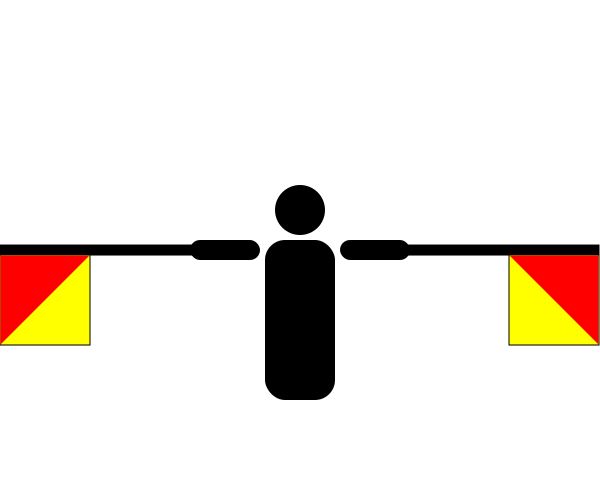

There are approximately 838 people named Dacre in the UK. That makes it roughly the 8,484th most common surname in Britain. Around 13 in a million people in Britain are named Dacre.

Famous people named Dacre
- Paul Dacre - Journalist
- Peter Dacre - Entertainment journalist (1925 to 2003)
- Thomas Dacre, 2nd Baron Dacre - Knight of Henry VIII of England (1467 to 1525)
- Thomas Dacre, 6th Baron Dacre - Noble (1387 to 1458)
Names and descriptions courtesy of Wikipedia, and may contain errors. This is not intended to be an exhaustive list of every famous person with this name.