DILLINGHAM
Dillingham is an English surname that arises from the Old English elements Dylla or Dylling, a personal name meaning “diligent” or “industrious”, and ham, which denotes a “homestead” or “village”. Consequently the name may be interpreted as “the homestead of the diligent one” or “the village of the industrious person”.
The surname is locational, belonging to families who lived in or near a place called Dillingham. Over the High Middle Ages the village itself, like many others across the British Isles, fell away from contemporary maps. Causes were manifold: the large-scale clearance of land for sheep pastures during the peak of the wool trade in the mid‑fifteenth century, the plague of 1348, and general depopulation. The surviving records are therefore few. The earliest known spelling is that of Esdra Dyllingham, christened at Burwell, Cambridgeshire on 21 March 1567 during the reign of Queen Elizabeth I.
Marriage entries in the London church registers document the surname in the early‑seventeenth century: the wedding of Gilbert Dillingham and Ann Steer at St. Mary the Virgin, Aldermanbury on 18 March 1605, and that of Katherine Dillingham and Henry Dill at St. Mary Mounthaw on 27 December 1617. Variants of the name, such as Dillingam, Dillingeham, and Dyllingham, reflect differing spellings that arose from changes in pronunciation and the lack of a standardised orthography at the time.
The name has also been linked, albeit less convincingly, to the village of Dullingham in Cambridgeshire, recorded in the Domesday Book of 1086 as “Dullingeham”. In that case the first element would be the Old English given name dull, producing the meaning “the homestead of Dull’s people”. However, the consensus favours the derivation from Dylla as the primary source.
In modern times the surname is far more common outside of England, especially in the United States where it is found in significant numbers in North Carolina, Georgia, Missouri, Tennessee and Alaska. The American community of Dillingham in Alaska was named for Vermont Senator Paul Dillingham, in recognition of his role in the Alaska Purchase. Though the name persists in England, Canada and Australia, it remains relatively uncommon in comparison with other English surnames.
The spelling of Dillingham has varied considerably over the centuries. Recognised variants include Dillingam, Dilingham, Dillingeham, Dyllingham, Dilnghm and several others such as Dillyngham, Dilligham, Dyllinghm, Dillngham and Dillnghm. In some phonetic contexts a silent initial D was replaced by T or Th, producing Tillingham or Thillingham; similarly the final ham was occasionally rendered as hamm or hame for the variant Dillinghame.
Despite its rarity, the surname Dillingham preserves a direct link to the Anglo‑Saxon linguistic and cultural heritage and offers a clear illustration of how place names evolved into family names, reflecting both personal virtue and community identity.

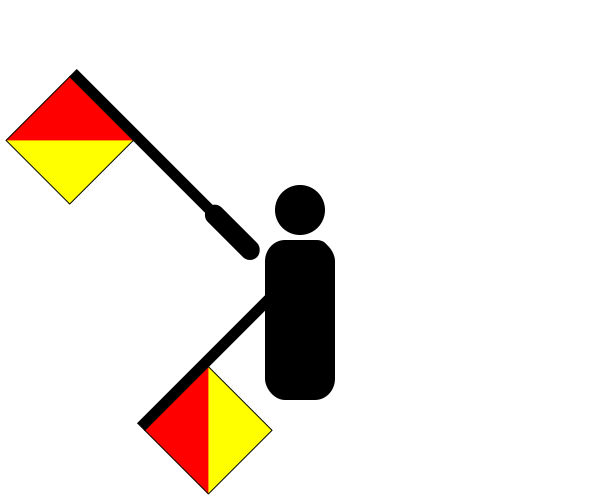

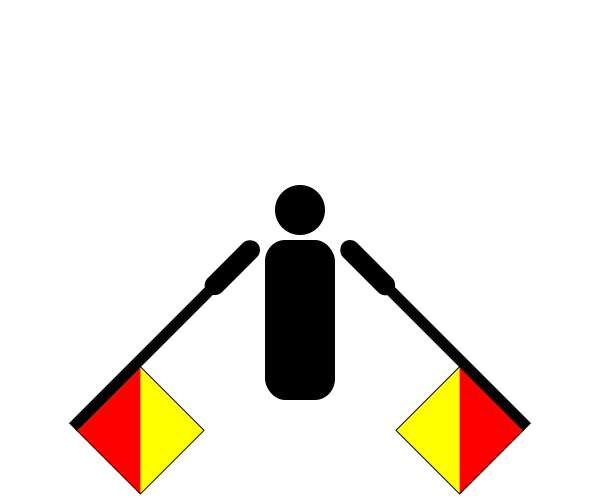


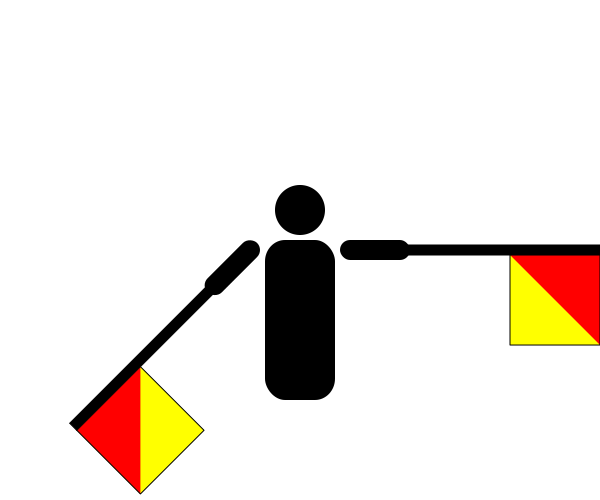
Typical given names associated with the Dillingham surname
Male
- Christopher
- David
- John
- Leslie
- Mark
- Matthew
- Paul
- Peter
- Robert
- Stephen
Female
- Amelia
- Geraldine
- Joan
- Julie
- Laura
- Michelle
- Nicola
- Samantha
- Sarah
- Susan
- Tracy
- Wendy
Similar and related surnames
Related and similar names are generated algorithmically based on the spelling, and may not necessarily share an etymology.
How to communicate the surname Dillingham in...
Braille
⠙⠊⠇⠇⠊⠝⠛⠓⠁⠍
Morse
-.....-...-....-.--......---
Semaphore
Did you know?
According to a survey carried out by Democracy Club, politicians and candidates with the surname Dillingham are most likely to say that their favourite biscuit is a Chocolate Hobnob.
There are approximately 348 people named Dillingham in the UK. That makes it one of Britain's least common surnames. Only around five in a million people in Britain are named Dillingham.
Surname type: Location or geographical feature
Origin: English
Region of origin: British Isles
Country of origin: England
Religion of origin: Christian
Language of origin: English
