DILLINGER
Dillinger is a surname of German origin, deriving from the personal name Tillinger, which itself is a diminutive form of the given name Dietrich. The elements of Dietrich are diot (meaning “people”) and ric (meaning “ruler” or “king”), so that the surname can be interpreted as “ruler of the people” or “king of the people”.
The name has been recorded in a number of forms, including Delger, Dillinger, Tilger, and others, reflecting both spelling variations over time and the influence of dialects. In the early medieval period, surnames were typically residential, indicating either the place where a person lived or where they had come from. The most common explanation for Dillinger points to the town of Dillingen in Bavaria, a form of the name that has also been spelt Dillgen or Dilgen. The generic Germanic suffix -er means “from” or “of”, signalling that the original bearer was a resident of that town.
Other sources, such as the Dictionary of German Names, suggest that Dillinger could also be a patronymic derivation from the ancient personal name Ottilie, though this is considered unlikely in most cases. The period from the 14th century onward saw the beginnings of fixed surnames, so many possibilities remain open, but the toponymic explanation is most widely accepted.
Recorded in the mid‑forties of the fifteenth century are early examples such as Konrad Dillinger, noted in Villingen in 1437, and Mathis Dilger, recorded in the charters of Tübingen in 1456. These early documentary sources confirm the surname’s presence in southern Germany.
By the nineteenth century, the surname had begun to appear outside Germany as a result of emigration. A noteworthy instance is Mark Dilger, who married Elizabeth Skinner at St John’s Hackney in London on 14 June 1870. This period was marked by substantial German immigration to England, then described as the workshop of the world, and home to many skilled workers.
Later, particularly in the United States, a significant number of individuals bearing the surname settled in the Midwest, an area that attracted many German immigrants during the 19th and early 20th centuries. In modern usage, Dillinger remains relatively uncommon globally, being most frequently encountered in countries with sizeable populations of German descent such as the United States, Germany, Canada, and to a lesser extent, South America.
The surname has a range of variants, including Dillenger, Dilinger, Dyllinger, and Dillinder. Minor forms such as Dill, Diller, and Dilling also exist, often reflecting phonetic spellings that evolved when German names were adapted for English usage. Some variants incorporate occupational references, for example Dillman, denoting an individual who dealt with dill, the aromatic herb, though occupational derivations are considered less likely to be the primary source of the surname.
In sum, the surname Dillinger is firmly rooted in German linguistic and geographical tradition, with its most credible origins in the town of Dillingen and its carrying meanings associated with rulership and people. Its variants and early documentary evidence illustrate the complex pathways through which surnames develop and spread across regions and languages.
Similar and related surnames
Related and similar names are generated algorithmically based on the spelling, and may not necessarily share an etymology.
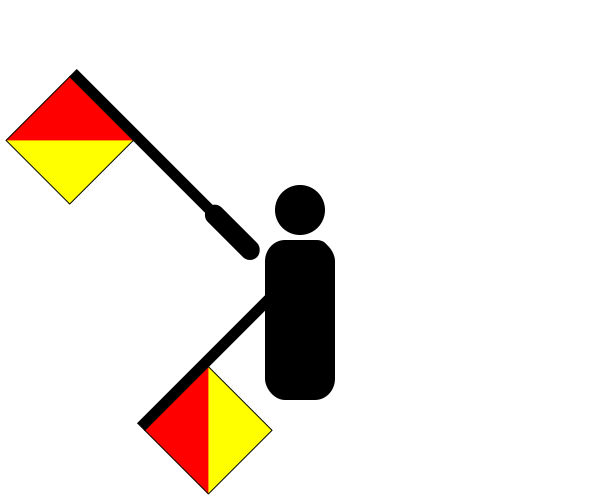
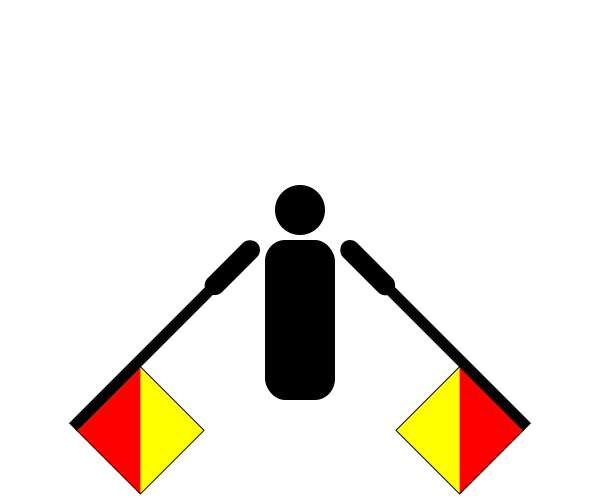
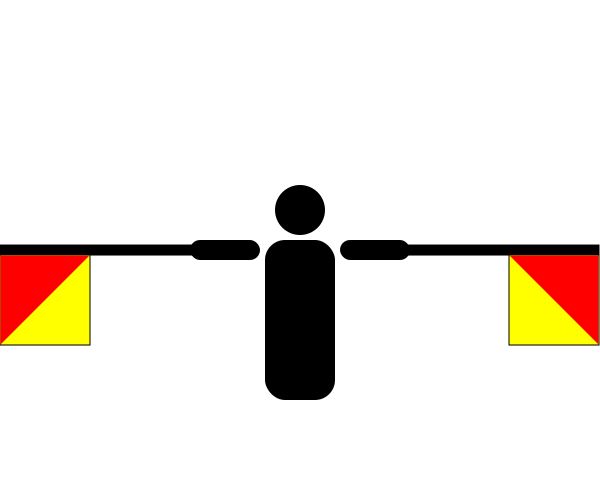
How to communicate the surname Dillinger in...
Braille
⠙⠊⠇⠇⠊⠝⠛⠑⠗
Morse
-.....-...-....-.--...-.
Semaphore




Sorry, we don't have any statistics on this name. That's probably because it's very uncommon in Britain.

Famous people named Dillinger
- John Dillinger - American bank robber (1903 to 1934)
Names and descriptions courtesy of Wikipedia, and may contain errors. This is not intended to be an exhaustive list of every famous person with this name.