DIES
The surname Dies is of German origin. It is derived from the Middle High German word dius or diusen, meaning “thick” or “dense”. The name was originally a nickname for someone who was stout or heavy set, and over time various spellings and pronunciations have evolved within German‑speaking regions, where the name remains relatively uncommon.
In other traditions, the surname Dies is recorded as a derivative of Dutch, Flemish and Frisian patronymic forms of the male given name Mathiess, itself ultimately stemming from the Hebrew Matityahu “Gift of God”. Pet forms such as Th(ew)ys, Thees and Dies appeared in these communities. The name was introduced into England by Flemish weavers during the reign of Edward III (1327-1377) and later expanded with the arrival of Huguenot refugees after the Revocation of the Edict of Nantes in 1685. Notable individuals bearing variants of the name include Geerardt Dewes (deceased 1591), a painter descended from the ancient lords of Kessel in Guelderland, and Sir Simonds D'Ewes (1602-1650), a barrister of the Middle Temple and high sheriff for Suffolk in 1639. The coat of arms registered for the Dewes family of Stow Hall in Suffolk consists of a gold shield with a fesse vair between three red quatrefoils.
Alternate etymological accounts connect the surname Dies to the personal name Theodore, meaning “gift of God” in Greek, which in Middle High German was shortened to Diet. Another possibility traces the name to Didier, derived from the Latin Desiderio or Desiderius meaning “the one who is longed for”. In this view, Dies was originally a patronymic meaning “son of Didier”. Both derivations place the surname’s genesis in the 13th century within German territory, and historical migration has carried it beyond Europe to the Americas and other parts of the world.
Presently, the surname Dies is uncommon. It is still most frequently encountered in Germany and other German‑speaking areas. The name is also recorded in the United States, Spain, the Netherlands and several Latin‑American countries, with variations influenced by regional orthographies. The most common alternative spellings are Die, Diez and Diaz. Other forms that arise through the addition of prefixes or suffixes include DeDie, DeDiez and DeDiaz. In Spanish‑speaking regions the surname is occasionally altered by appending an s or z to give Dieses or Diezes. Additional variations seen in different countries are Dyes, Dize and Dyeses. Related surnames that share a similar sound or root are Dier, Diel, Diers, Diehl, Rodies, Modeis and Nodies.
The distribution of the surname Dies has been markedly shaped by migration patterns, including the movement of German, Dutch and Flemish settlers to England and the subsequent dispersion to the New World. Although the name remains relatively rare, its variety of forms and the geographical spread of its bearers reflect the broader historical shifts in population and cultural exchange across Europe and America.
Similar and related surnames
Related and similar names are generated algorithmically based on the spelling, and may not necessarily share an etymology.
How to communicate the surname Dies in...
Braille
⠙⠊⠑⠎
Morse
-........
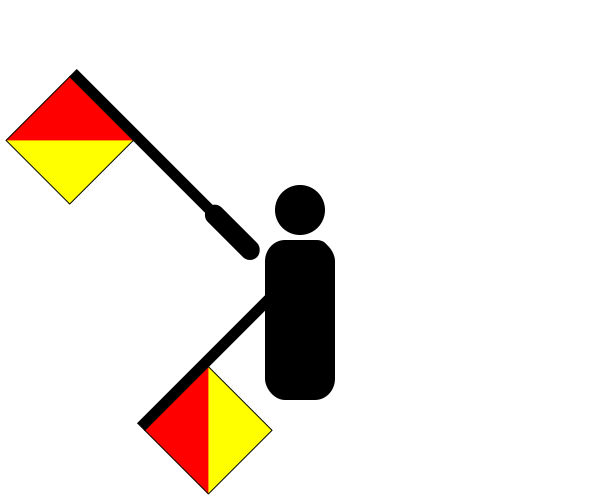
Semaphore



Sorry, we don't have any statistics on this name. That's probably because it's very uncommon in Britain.