DEDMAN
Dedman is a surname of English origin. It is classed as an occupational name and has been documented in the British Isles from the late thirteenth century onwards.
The earliest recorded spelling, John de Debenham, appears in the Hundred Rolls of Huntingdonshire, dated 1273, during the reign of King Edward I. This form is linked to the locational name Debenham in Suffolk, derived from the Old English pre‑7th century river name Deopa meaning “deep” combined with the suffix ham meaning “homestead”. Subsequent dialectal variations produced spellings such as Debnam and Deadman. The surname thus has a dual association: a place name origin and a descriptive occupational element.
In the Middle English period the word dede meant “dead” and was combined with man to form dedman. This construction is understood to refer to a person involved with death – traditionally a gravedigger or another person engaged in burial rites. The occupational nature of the name is corroborated by surviving church records that list individuals such as Rachell Deadman (married in 1580 at St. Dunstan’s, Stepney), Andrew Dedman (christened in 1637 at St. Botolph without Aldgate), and Frances Dedman (christened in 1638 at St. Margaret’s, Westminster). These entries illustrate the name’s presence among ordinary medieval and early modern English parishioners.
There is also an alternative derivation from the Old English personal name Deodmund, composed of deod meaning “dear” and mund meaning “protection”. In the Middle Ages it was common for a patronymic surname to arise from a father’s given name, suggesting that some bearers of the surname may have been sons of a person named Deodmund. The resulting sense of security or peace aligns with social values of the period. However, this explanation is less widely attested than the occupational derivation.
In modern times the surname is predominantly concentrated within the United Kingdom. According to the Office of National Statistics, it was most common in England and Wales, reaching a population peak in the late nineteenth century before a gradual decline. The name is also found, though in smaller numbers, in Scotland and Ireland, and remains far rarer in continental Europe and the United States, Canada, Australia, and New Zealand.
Variations of the spelling include Deadman, Dedham, Dydman, and Dydmanne. These differences arose from regional dialects and orthographic practices over the centuries. Despite their diversity, all forms share a common linguistic heritage rooted in Old and Middle English.
In sum, the surname Dedman encapsulates a range of historical meanings – from the stark reference to burial work to a possible link with a personal name connoting affection and safety – and reflects the linguistic evolution of English surnames from medieval parish records to contemporary demographic distributions.
Typical given names associated with the Dedman surname
Male
- Andrew
- Anthony
- Christopher
- David
- John
- Mark
- Martin
- Michael
- Paul
- Peter
- William
Female
- Claire
- Elizabeth
- Heather
- Janet
- Jennifer
- Julie
- Linda
- Margaret
- Nicola
- Patricia
- Rachel
- Rebecca
- Sarah
- Susan
Similar and related surnames
- Deadman
- Dedmon
- Deadmon
- Deddman
- Dadman
- Deadmen
- Dedanan
- Dedmen
- Deedman
- Dettman
- Dettmann
- Didman
- Didmon
- Dietman
- Dietmann
- Diteman
- Ditman
- Dittman
- Dittmann
- Dodman
- Doodman
- Dudman
- Tadman
- Tateman
- Tatman
- Tattman
- Teatman
- Teddyman
- Tedman
- Teideman
- Teidman
- Tettman
- Tiddeman
- Tiddiman
- Tideman
- Tidemann
- Tidiman
- Tidman
- Tidyman
- Tiedeman
- Tiedemann
- Tiediman
- Tiedman
- Titman
- Tittman
- Toddman
- Todman
- Tootman
- Totman
- Tottman
- Tudman
Related and similar names are generated algorithmically based on the spelling, and may not necessarily share an etymology.
How to communicate the surname Dedman in...
Braille
⠙⠑⠙⠍⠁⠝
Morse
-...-..--.--.
Semaphore


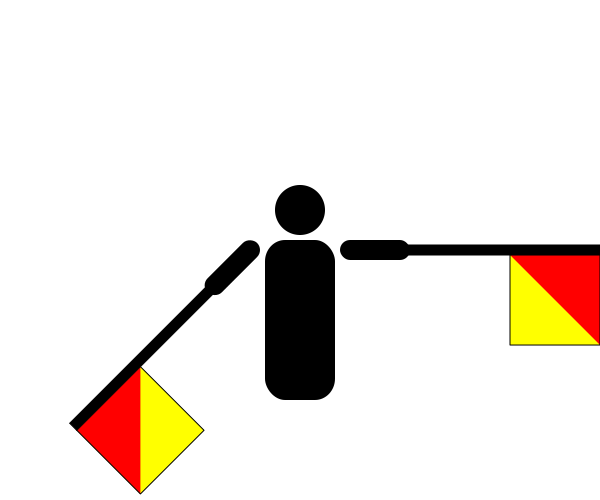

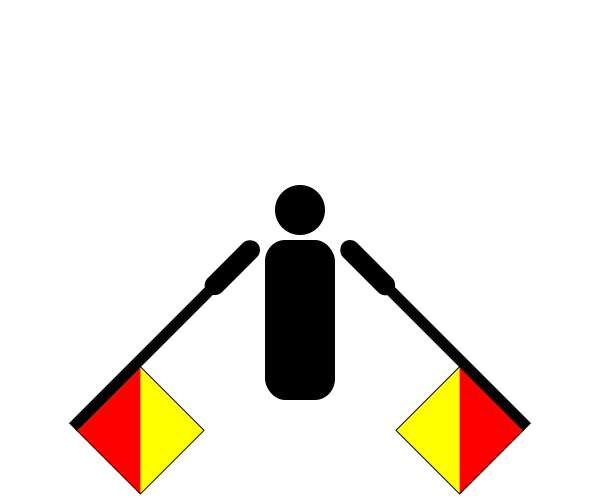
There are approximately 1,464 people named Dedman in the UK. That makes it roughly the 5,447th most common surname in Britain. Around 22 in a million people in Britain are named Dedman.
Surname type: Occupational name
Origin: English
Region of origin: British Isles
Country of origin: England
Religion of origin: Christian
Language of origin: English
