DEADMAN
Recorded variant spellings include De-Adman
Deadman is an English surname whose earliest documented usage can be traced back to the medieval period. The name derives from the Old English words dēad meaning “dead” and mann meaning “man.” Consequently, it has been interpreted as a descriptive nickname, possibly applied to individuals who performed jobs associated with mortal remains, such as gravediggers, executioners or undertakers.
Contrary to this occupational view, subsequent scholarship has identified a locational origin. The name appears in the historical record as de Debenham, a reference to the Norfolk village situated near Norwich. Over time the spelling evolved along the path de Debenham → Debenham → Dedman → Debnam → Deadman. The first known appearance of the family name is that of John de Debenham, recorded in the Pipe Rolls of Yorkshire in 1273, during the reign of King Edward the First. John was noted by the sobriquet “The Hammer of the Scots.”
Throughout the 17th century, various iterations of the surname were documented. For instance, Edward Debnam was listed at St Michael’s Church on Cornhill in London in 1669, while Robert Debnam of Suffolk was recorded in 1674. A 1688 burial register mentions Martha Harris, sister of Samuel Deadman, in St Dionis Backchurch, London.
The surname has a number of recognised variants that stem from the same linguistic root. These include Curly Saturday Deadman with notable spellings such as Dedman, Debnam, Deadmon, Deddman, Deadmence and occasionally Deadmeadow. The forms Dedman and Deadman are the most common and appear earliest in the 1600s and 1700s. Later variants, such as Deadmeadow and Deadmon, are thought to have emerged in the 19th century.
Geographically, the name is most frequently associated with North West England, particularly Lancashire and Cumbria. Significant concentrations can also be found in Preston, Blackpool, Wigan and the surrounding region. Beyond England, the surname is present in Scotland, the Isle of Man, and Ireland, as well as in Commonwealth countries including Canada, the United States and Australia, reflecting patterns of emigration from Britain in the past few centuries.
Although relatively uncommon today, the Deadman surname persists as a marker of English heritage. Its etymology, whether seen as a morbid nickname or a locational indicator, and the variety of spellings that have survived offer a window into the linguistic and social history of medieval Britain.
Typical given names associated with the Deadman surname
Male
- Alexander
- Andrew
- Christopher
- David
- Greg
- James
- John
- Kevin
- Mark
- Michael
- Paul
- Peter
- Roy
- Stephen
Female
- Am
- Angela
- Christine
- Emma
- Jacqueline
- Julie
- Margaret
- Mary
- Maureen
- Patricia
- Rachel
- Sarah
- Susan
Similar and related surnames
- Dadman
- Dadnam
- Deadmen
- Deadmon
- Deddman
- Dedman
- Dedmen
- Dedmon
- Deedman
- Dettman
- Dettmann
- Didman
- Didmon
- Dietman
- Dietmann
- Diteman
- Ditman
- Dittman
- Dittmann
- Dodman
- Doodman
- Dudman
- Tadman
- Tateman
- Tatman
- Tattman
- Teatman
- Teddyman
- Tedman
- Teideman
- Teidman
- Tettman
- Tiddeman
- Tiddiman
- Tideman
- Tidemann
- Tidiman
- Tidman
- Tidyman
- Tiedeman
- Tiedemann
- Tiediman
- Tiedman
- Titman
- Tittman
- Toddman
- Todman
- Tootman
- Totman
- Tottman
- Tudman
Related and similar names are generated algorithmically based on the spelling, and may not necessarily share an etymology.
How to communicate the surname Deadman in...
Braille
⠙⠑⠁⠙⠍⠁⠝
Morse
-....--..--.--.
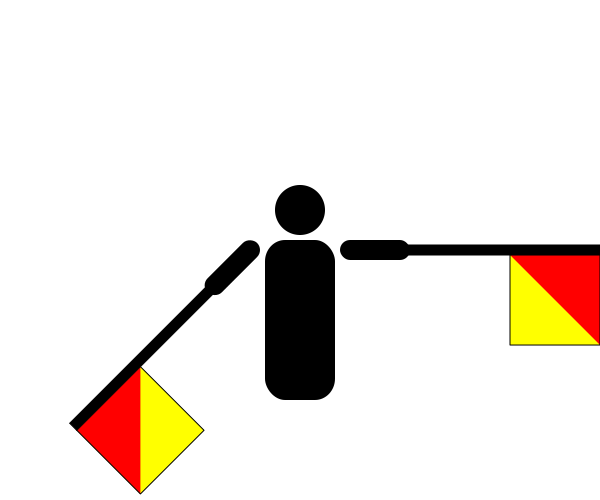
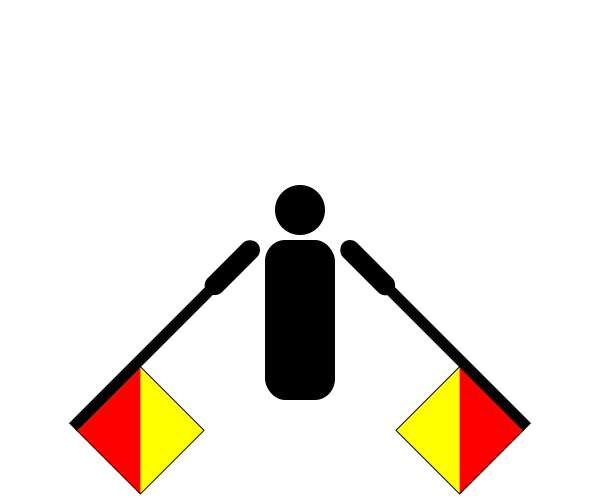
Semaphore


There are approximately 1,799 people named Deadman in the UK. That makes it roughly the 4,599th most common surname in Britain. Around 28 in a million people in Britain are named Deadman.
