CORAM
Coram is a surname of English origin that has been documented in the British Isles since at least the sixteenth century. It is a locational name, traditionally assigned to individuals who resided near a particular geographical feature such as a bend in a road or a low‑lying meadow.
The name derives from the Old English word corn, meaning "corner" or "bend," and the suffix ham, meaning a small settlement or dwelling. Consequently, Coram historically signified “dweller by the corner” or “resident near a bend.” An alternative derivation, recorded in some medieval sources, combines corn with hamm to denote a “low‑lying meadow.” Both interpretations emphasise a connection with a specific landscape.
In Devon, England, the name is linked to a now‑lost village, possibly named Corham, whose disappearance is attributed to 12th‑ and 13th‑century land clearance for sheep pasture and other social upheavals such as plague and war. The existence of this village is suggested by the concentration of Coram records in that county.
The earliest documented instance of the surname appears in the marriage register of Emelyn Coram to Thomas Jesse on 17 October 1546 at St. Mary Arches, Exeter, Devon, during the reign of King Henry VIII. Further early records include the christenings of Walter Coram at St. Martin’s, Ludgate, London on 5 January 1586 and of James Coram at Clayhanger, Devon on 21 October 1587.
In the eighteenth century, a prominent bearer of the name was Thomas Coram, a philanthropist credited with establishing the London Foundling Hospital, a pioneering institution for abandoned children. His efforts lent the surname a notable association with charitable work in British history.
One source proposes a Latin origin for Coram, whereby the word means “in the presence of” or “before.” This interpretation has been offered as an alternative explanation, though it is not universally accepted and is not supported by the prevailing locational derivation.
Although uncommon, the surname Coram can still be found today in England, the United States and Canada. It has also been recorded in place names such as Coram, New York and Coram, Montana, which may reflect settlement by families bearing the name. The surname remains rare on a global scale.
Variants and related surnames include Corem, Corum, Coreum, Coran, Coren, Corame, and spelling alterations such as Koram, Corram and Korum. Such variations illustrate the historical lack of standardised spelling in medieval records and the fluidity of surnames over time.
Given the surname’s documented origins, early settlers and notable bearers, the Coram name continues to be recognised for its historical depth and the legacy of its most famous adherent, Thomas Coram, whose charitable endeavours left a lasting imprint on British society.
Typical given names associated with the Coram surname
Male
- Andrew
- Anthony
- Christopher
- David
- Gregory
- James
- John
- Michael
- Neil
- Richard
- Robert
- Simon
- Stephen
Female
- Amanda
- Bryony
- Eva
- Helen
- Julie
- Karen
- Margaret
- Michaela
- Rebecca
- Samantha
- Sandra
- Susan
Similar and related surnames
- Caram
- Cora
- Carames
- Caramma
- Careem
- Caramah
- Coran
- Coray
- Corea
- Corham
- Coriam
- Corma
- Corram
- Correm
- Curram
- Currams
- Karam
- Koram
- Corain
- Corak
- Coral
- Coreas
- Corkram
- Corlam
- Corm
- Coroama
- Coroma
- Corra
- Cortham
- Couran
- Cram
- Cream
- Karame
- Karram
- Khoram
- Khorami
- Khorram
- Khuram
- Koramoa
- Kuram
- Cormie
- Corum
- Crame
- Crome
- Grime
- Groome
- Karim
- Koroma
Related and similar names are generated algorithmically based on the spelling, and may not necessarily share an etymology.
How to communicate the surname Coram in...
Braille
⠉⠕⠗⠁⠍
Morse
-.-.---.-..---
Semaphore

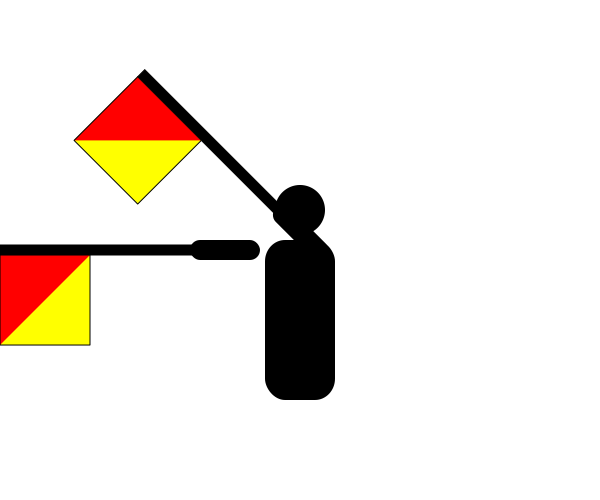
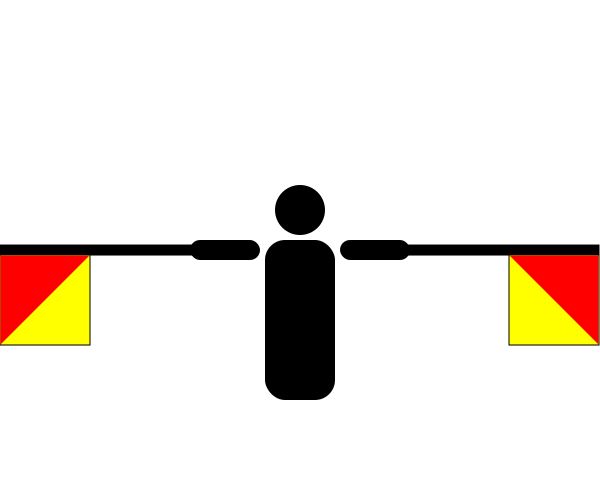

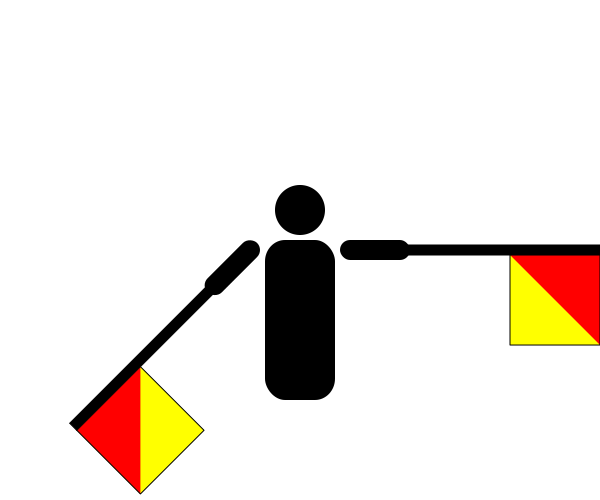
There are approximately 578 people named Coram in the UK. That makes it one of Britain's least common surnames. Only around nine in a million people in Britain are named Coram.
Origin: English
Region of origin: British Isles
Country of origin: England
Religion of origin: Christian
Language of origin: English
