COLLING
The surname Colling is firmly situated within the Anglo‑Saxon heritage of England, and it first appears in the Domesday Book of 1086. The earliest recorded bearer, Aluuardus Colling, is listed in Wiltshire under the reign of King William the Conqueror, a fact that demonstrates the name’s continuity from the immediate aftermath of the Norman Conquest.
Its linguistic origin is a patronymic construction, combining the personal name Cola—a term meaning ‘black’ or ‘coal’ in Old English—with the suffix -ing, which denotes belonging or descent. Consequently, Colling originally signified ‘the son of Cola’ or ‘the people of Cola’. Because surnames were not yet common until the 12th or 13th century, such a patronymic made it possible to distinguish individuals who shared the same given name, particularly in rural communities.
Another plausible source is the Old Norse personal name Kollungr, a cognate of the Old English Cola. This name is believed to describe someone of dark or swarthy appearance, a description that would have been useful in a period when surnames often referred to physical traits. This Norse connection is reinforced by the presence of the name in northern England, an area that experienced considerable Viking settlement.
In addition to the Anglo‑Saxon base, the name Colling can evolve from the diminutive Coll, itself a short form of the Greek name Nicholas meaning ‘victory of the people’. The popularity of this diminutive in the Middle Ages was partly due to the veneration of St. Nicholas, patron saint of children and sailors. Variants recorded in the 14th century, such as Griffin Collingus (1114, Staffordshire) and John Collynges (1376, Shropshire), display the flexibility of spelling during a time before orthographic standardisation.
The surname’s distribution is most prominent in the northern regions of England, particularly Yorkshire, Northumberland, and the surrounding counties. From these centres of origin, bearers of the name migrated to other English‑speaking countries such as the United States, Canada, and Australia throughout the 18th and 19th centuries. In the United Kingdom today, the name remains less common than its kin, e.g. Collings or Collin, but it can be found with relative frequency in county registers and civil documents.
Variations of the spelling are numerous. Besides the standard Colling, one finds Collings, Colings, Collinge, Collin, Collis, Collen, and Collens. Each variation arose in different regions, reflecting local dialects and the influence of scribes who transcribed names by phonetic approximation. As such, the surname is occasionally conflated with occupational surnames such as Collin or with locational surnames like Collingwood and Collington, which refer to specific places and follow a different genealogical trail.
Church registers provide personal details that illustrate the social history of the family. For instance, Edward Colling was christened on 24 May 1562 in St. Andrew Hubbard with St. Mary at Hill, London, and Francisca Colinge was baptised on 17 April 1675 in St. Martin in the Fields, Westminster. A later record shows Ely Collings, born 15 July 1792, baptised in St. Mary le Bow, London. The narrative of Catherine Colling, who emigrated from Liverpool aboard the “Liberty” to New York in 1847, underlines the broader pattern of migration that dispersed the surname across the Atlantic.
Today, while the surname Colling is not among the most frequent in the United Kingdom, it remains a distinct marker of Anglo‑Saxon lineage. Its etymology reflects the blend of personal naming practices, linguistic evolution, and historical events that collectively shaped the development of surnames across England. By tracing the surviving records—from the Domesday Book through parish registers to emigration entries—researchers can assemble a coherent picture of how the Colling name has been carried through generations and across continents, preserving a tangible link to England’s early medieval past.
Typical given names associated with the Colling surname
Male
- Andrew
- David
- George
- John
- Mark
- Michael
- Paul
- Peter
- Robert
- Stephen
Female
- Anne
- Gemma
- Helen
- Hilary
- Janet
- Jean
- Joanne
- Julie
- Lisa
- Margaret
- Patricia
- Sarah
- Susan
Similar and related surnames
- Collins
- Collings
- Collinge
- Collin
- Collinson
- Colin
- Cling
- Coling
- Coaling
- Calling
- Collina
- Coleing
- Colinge
- Colingham
- Colings
- Colins
- Collind
- Colline
- Collines
- Collingan
- Collingbine
- Collingdale
- Collingdon
- Collinger
- Collingham
- Collinghan
- Collingr
- Collingson
- Collington
- Collingwood
- Collini
- Collinjr
- Collinns
- Collino
- Colllins
- Cooling
- Couling
- Coulling
- Cowling
- Cowlings
- Cowlling
- Culling
- Kolling
- Coalin
- Colington
- Colingwood
- Collan
- Colli
- Collingborn
- Collingburn
- Collingford
- Collingridge
- Collon
- Collyn
- Collyns
- Cowlin
- Kollin
- Clingo
- Colding
- Gowling
- Keeling
Related and similar names are generated algorithmically based on the spelling, and may not necessarily share an etymology.
How to communicate the surname Colling in...
Braille
⠉⠕⠇⠇⠊⠝⠛
Morse
-.-.---.-...-....-.--.
Semaphore

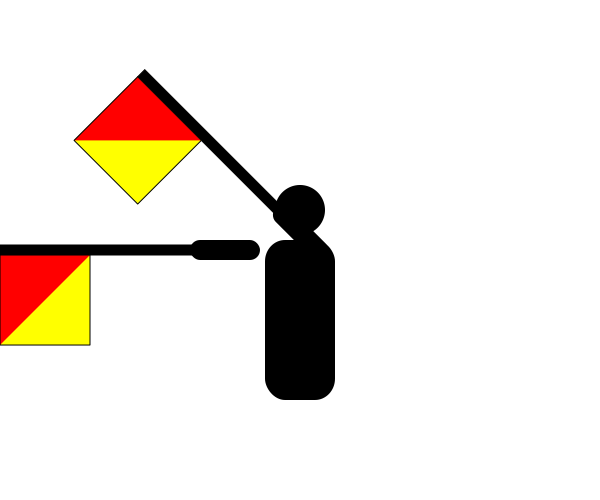

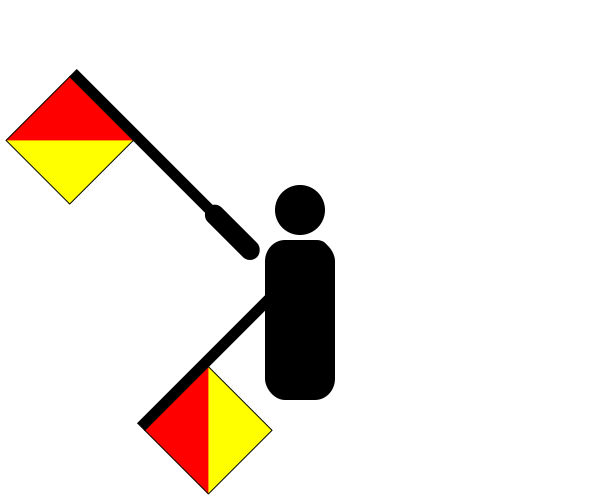
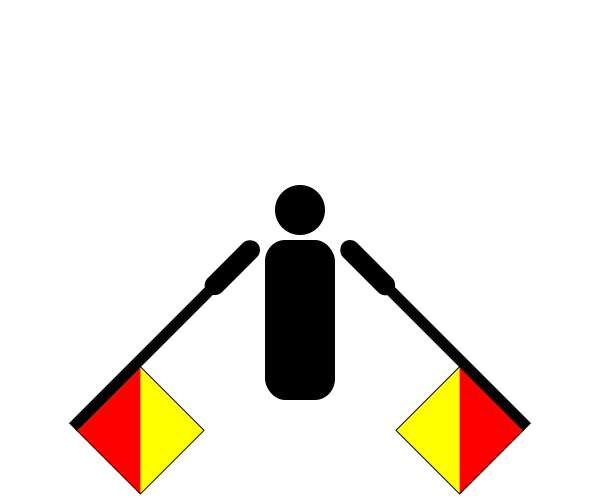

There are approximately 1,182 people named Colling in the UK. That makes it roughly the 6,496th most common surname in Britain. Around 18 in a million people in Britain are named Colling.
Surname type: Location or geographical feature
Origin: English
Region of origin: British Isles
Country of origin: England
Religion of origin: Christian
Language of origin: English
