CANON
Canon is a surname that derives from several linguistic and cultural sources, primarily the English, French and Irish traditions. Its earliest traces are found in the medieval English record of Reginald Canun, dated 1177 in the Pipe Rolls of Cambridgeshire, a period coinciding with the reign of King Henry II, who was renowned as “The Builder of Churches.” This early instance suggests a connection between the name and ecclesiastical life.
In the English and Irish contexts the surname is generally understood to be an occupational or nickname surname. It originates from the Old French word canon, itself borrowed from Latin canon and ultimately from Greek kanon, meaning “rule” or “measure.” In medieval usage the term came to signify a cleric or church official, especially one who worked within a cathedral or collegiate church. Consequently, individuals who served in a clergy house, or who exhibited a dignified, rule‑keeping manner, were at times identified by the sobriquet canon. Over time this appellation became hereditary and was passed down through successive generations.
Other Anglicisation processes have produced a number of orthographic variants, including Cannon, Cannan, Cannun, Canning and others. In Irish genealogical records the surname may additionally represent an anglicised form of the Gaelic patronymics O’Canain or MacCanannain, the latter meaning “son of Canannan,” with cana translating to “wolf‑cub.” The Gaelic usage shows the capacity of the name to transcend purely occupational roots and acquire a patronymic dimension.
In France and Spain the word canon is occasionally associated with a topographic meaning, referring to a canyon or deep valley. This semantic shift is reflected in certain regional branches of the family where the name might describe a person’s place of residence rather than occupation. Nevertheless, the dominant etymology in English‑speaking nations remains linked to the clerical sense described above.
Heraldic traditions of families bearing the surname Canon are exemplified by a recorded coat of arms. The escutcheon is a silver shield charged with a black chevron engrailed; between the flanks of the chevron a garniture of three silver martlets overlooks a space punctuated by three black crosses pattee. This device, granted to the family during the medieval period, visually encapsulates a continuity of identity across centuries.
In contemporary times the surname Canon remains relatively uncommon. It is most frequently encountered in the United Kingdom, the United States, France and Ireland, with a noticeable, though lesser, presence in Canada, Australia and South Africa. A statistically notable straggler exists in the Philippines. Across these regions, however, the name does not appear among the highest frequency surnames, underscoring its continued rarity.
Typical given names associated with the Canon surname
Male
- Geoffrey
- Marcus
- Richard
- Roy
- Ryan
Female
Similar and related surnames
Related and similar names are generated algorithmically based on the spelling, and may not necessarily share an etymology.
How to communicate the surname Canon in...
Braille
⠉⠁⠝⠕⠝
Morse
-.-..--.----.
Semaphore


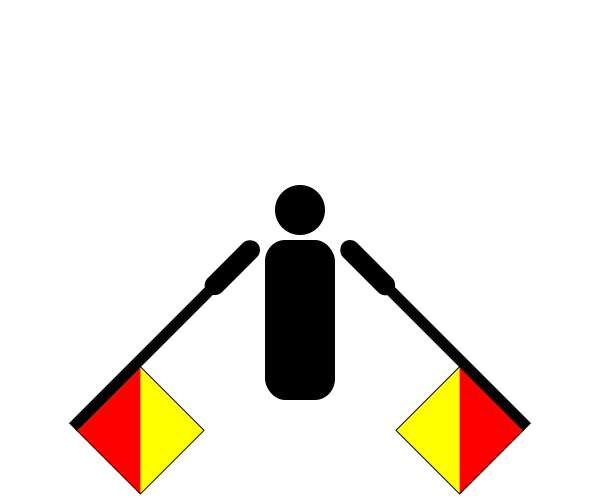
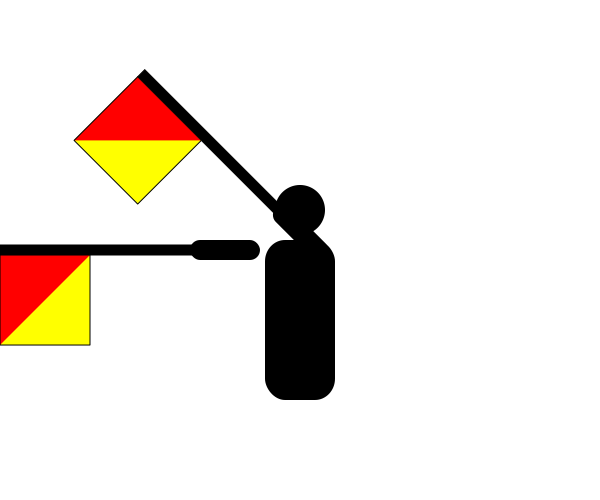
There are approximately 87 people named Canon in the UK. That makes it one of Britain's least common surnames. Only around one in a million people in Britain are named Canon.
Origin: English
Region of origin: British Isles
Country of origin: England
Religion of origin: Christian
Language of origin: English
