CANO
Cano is a surname of Iberian origin, primarily arising in the Spanish and, to a lesser extent, Portuguese linguistic realms. The name is first recorded in Spain, where it has been associated with a range of etymological roots, each reflecting a different aspect of medieval society and geography.
The most common derivation links the surname to the Latin word canus, meaning “white” or “gray‑haired.” In medieval Spanish, the word cano was used descriptively to identify an individual with fair or grey hair, and by extension it came to denote a man of knowledge or age, a figure of respect within the family nucleus. This semantic line of thought extends to the notion that the family adopted the name to signify an elder’s characteristic and the associated moral rectitude that was prized throughout the Spanish‑speaking world.
Another influential line of origin attaches the name to the Latin root canna. In ancient Iberian and Roman contexts, canna could refer either to a cave or to a reed bed, depending on regional dialect. In the southern Iberian peninsula, it is normally understood as a cave, suggesting that early bearers of the name were cave dwellers or inhabited a settlement situated near one. In France, Italy, and Catalonia, the term tended to describe reeds and so could point to an occupational origin: a person who harvested or processed reeds for thatching, basketry or other artisanal activities.
Further variants of the name – Cane, Cana, Canna, Caneo and Canet – record a blend of linguistic influence. The diversity of spellings illustrates the multiplicity of local dialects, evolving orthography and the transference of the name through different European cultures. In Portugal the surname appears as Canas, Canes, Canizzo, and Canez, a testament to its migration during the Christian Reconquista when Spanish and Portuguese peoples conversed and intermarried.
The distribution of the surname today remains concentrated in the Spanish‑speaking world. In Spain, more than seventeen thousand individuals carry the name, with a particularly dense presence in Andalusia and Granada where it ranks among the ten most common surnames. Mexico records a proliferation of the name in central states such as Hidalgo and in peripheral provinces including Veracruz, Guanajuato and Morelos, where census figures show upwards of thirty thousand bearers. The Dominican Republic hosts over eighteen thousand people named Cano, making it the seventh most prevalent surname in the nation.
In addition to descriptive and locational origins, some historians note a possible link to the city of Caen in Normandy. The medieval name of the city, derived from a Gaullish element meaning “battle field,” could have given rise to surnames such as de Caen, which, after linguistic evolution, may appear as Cano in English records. This hypothesis is supported by an early London entry from 1300, where Hugh de Caen is documented as a citizen. Although this scenario is less widely accepted than the Iberian derivations, it illustrates the name’s potential expansion into British territories during the early modern period.
Butterflying the interchangeable use of metaphor, some regional traditions in Latin America attach the name Cano to notions of nobility and courage. Scholars trace this association back to a Romanised Latin name Caunus, meaning “brave”, “valiant” or “noble”. Consequently, families bearing the surname are often perceived as upholding honourable values, an image reflected in affectionate diminutives such as Canito in Mexican and Guatemalan vernacular, signalling familial affection and the close bond between members.
Altogether, the surname Cano embodies a rich tapestry of linguistic, topographical, and cultural strands. Its multiple derivations—descriptive, locational, occupational and nominal—mirror the complex history of Iberia, adaptation to continental dialects, and migration through Spain’s former colonies. The name remains a prominent marker of identity across vast stretches of Spanish‑speaking territory, testament to the enduring legacy of Iberian heritage in a globalised world.
Typical given names associated with the Cano surname
Male
- Anthony
- Antonio
- Carlos
- Christian
- Daniel
- Francisco
- John
- Jorge
- Jose
- Joseph
- Juan
- Richard
- Thierry
Female
- Ana
- Anne-laure
- Aurora
- Beatriz
- Cristina
- Dawn
- Elena
- Karen
- Maria
- Mary
- Olga
- Sheila
- Stephanie
- Victoria
Similar and related surnames
- Can
- Cain
- Cane
- Cahn
- Caan
- Caine
- Cana
- Cani
- Cagnon
- Cainn
- Caen
- Caon
- Canoe
- Canoo
- Cann
- Canne
- Cannew
- Cannow
- Canon
- Canow
- Canu
- Cayne
- Kanno
- Kano
- Kanoo
- Khano
- Cagneux
- Canm
- Canoy
- Cans
- Cany
- Kanu
- Keno
- Cannon
- Cone
- Coon
- Cownie
- Ghani
- Gunn
- Gwyn
- Gwynn
- Gwynne
- Kahn
- Kane
- Kean
- Keen
- Keene
- Kenn
- Keown
- Kewn
- Kiani
- Kyne
- Quan
- Quinn
Related and similar names are generated algorithmically based on the spelling, and may not necessarily share an etymology.
How to communicate the surname Cano in...
Braille
⠉⠁⠝⠕
Morse
-.-..--.---
Semaphore


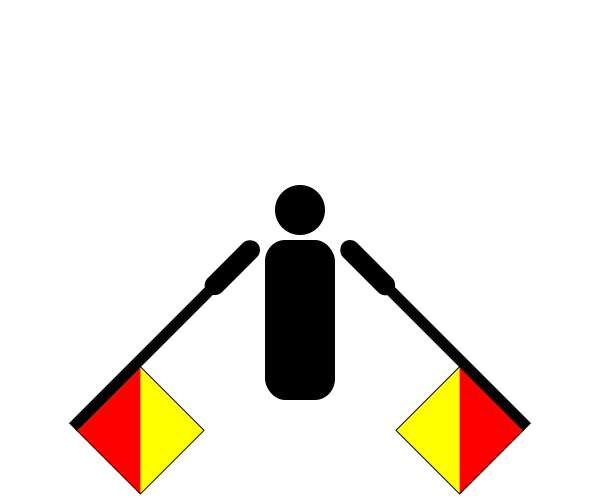
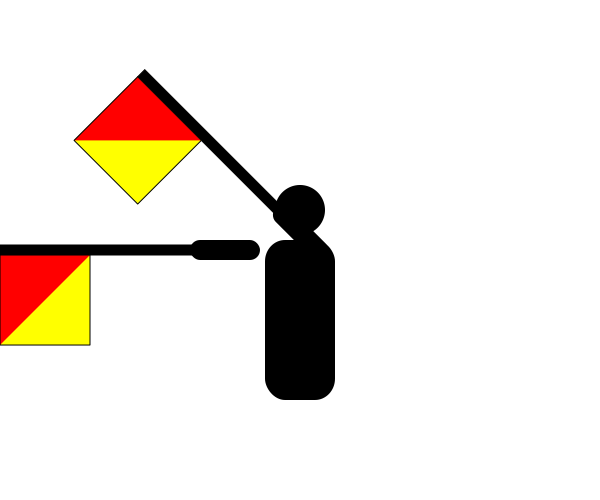
There are approximately 429 people named Cano in the UK. That makes it one of Britain's least common surnames. Only around seven in a million people in Britain are named Cano.
Origin: Iberian
Region of origin: Europe
Country of origin: Spain
Religion of origin: Christian
Language of origin: Spanish
