BRUCK
Bruck is a surname of Germanic origin that has entered the surname registers of many European countries and beyond. It is traditionally understood to be a topographic name derived from the Middle High German word brücke, which translates as “bridge”. Persons bearing this name were, in historical records, often noted as dwelling near, or working upon, a bridge or a place that resembled one.
In addition to its bridge association, certain genealogical studies point to an alternative German toponymic root in the medieval word brocken, meaning “hill”. The resulting spelling variants such as Brück or Bruch thus reflect both the bridging and hilltop aspects that have been attached to the surname over the centuries.
The name has produced several orthographic variants across linguistic borders, including Brück, Brueck, Bruch, Brock, and the English habitational form Brook. In English‑speaking records the spelling Brooke is traditionally preferred, whereas Brook and other derivative forms appear less frequently and often indicate distinct regional origins, such as those in Yorkshire or the Low Countries.
Statistical evidence shows that Bruck is a common surname in Germanic territories. In Germany it is the 50th most common surname, with a population of more than 26,000 bearers. The name is similarly widespread in Austria, where it ranks 45th. In Switzerland it appears as the 59th most prevalent surname, with about 8,700 individuals. Outside Europe, the surname is recorded in the United States as the 4,730th most common, with an estimated 15,000 persons, and in Canada and the United Kingdom in much lower numbers. The distribution pattern reflects the historical migration of Germanic peoples and, later, of European emigrants to the Americas and Australasia.
Historical documents from the Norman period provide additional context for the English adaptation of the name. Early medieval references to places called Broc or Brok appear in the Domesday Book of 1086. By the 14th century, surviving notarial entries include the names William de la Broke (1208) of Surrey, William atte Bruck (1327) of Cambridge, and Eustace delbroc (1130) in Northumberland. The surname reached the North of England with occasional use of the spelling Brock, a variation thought by some scholars to derive from the Dutch or Flemish Broek, meaning a water meadow.
Across the globe, the surname Bruck maintains a presence in diverse cultural contexts, including limited but measurable occurrences in India, Israel, South Africa, and Canada. Its endurance and adaptability illustrate the historic mobility of European naming practices and the persistence of a name rooted in the practical realities of landscape and occupation.
Similar and related surnames
Related and similar names are generated algorithmically based on the spelling, and may not necessarily share an etymology.
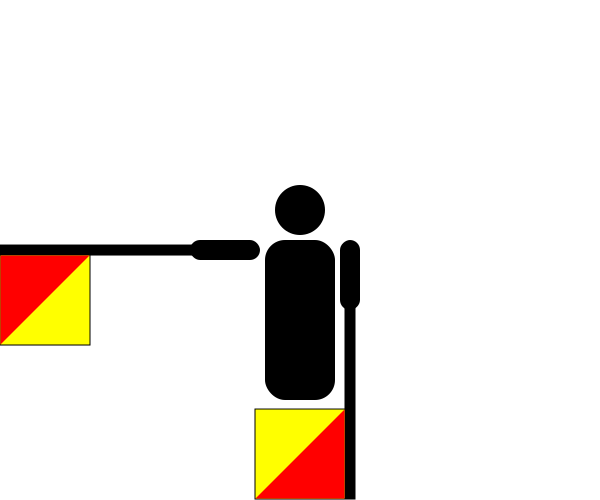
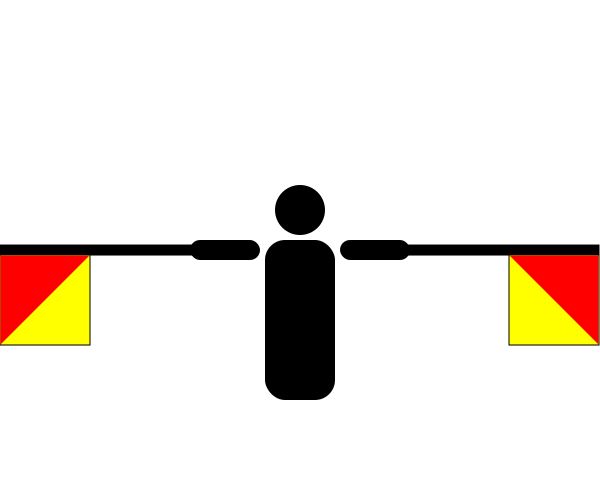
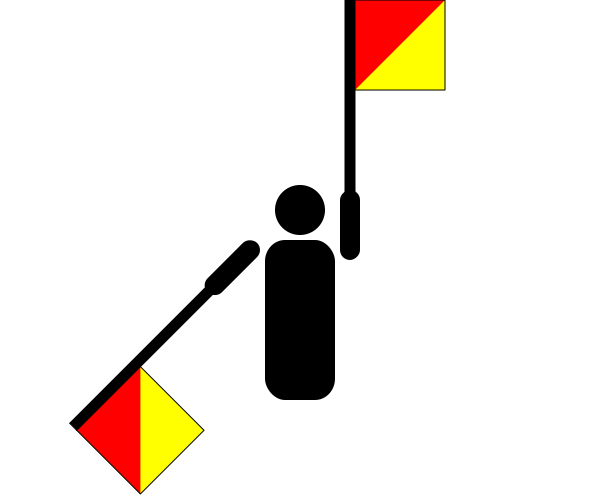
How to communicate the surname Bruck in...
Braille
⠃⠗⠥⠉⠅
Morse
-....-...--.-.-.-
Semaphore


There are approximately 141 people named Bruck in the UK. That makes it one of Britain's least common surnames. Only around two in a million people in Britain are named Bruck.