BRITT
Britt is a surname of English origin that appears in historical records throughout the British Isles. It is predominantly associated with Britain itself, and its etymology reflects a direct connection to the ancient Britons who inhabited the island before the arrival of Anglo Saxon settlers.
The name derives from the Old English word brytt, which means “Briton” or “British.” As a surname, it originally functioned as a nickname for a person of British descent or someone who displayed qualities associated with the Britons. Over time, the surname spread across England and later across English‑speaking countries, preserving its link to ancestral Britain in the families that bear it.
According to several linguistic traditions, Britt also has a French origin, used as an ethnic designation for the Bretons. The Bretons were a Celt group that was displaced from South-West England to North-West France during the 6th Century, under pressure from the invading Anglo Saxons. Some of them returned to England with William the Conqueror during the 1066 invasion. Many settled in East Anglia, where the surname Brett became common. Alternative medieval forms such as Byrttas and Brettas were used by the people of Strathclyde in Scotland until the 13th Century.
Early documentary evidence surfaces in medieval London and Norfolk. For example, the marriage of William Brett and Johanna Hayward was recorded in 1559, and the union of Richard Brett with Elizabeth Leive took place on 23 September 1552 at St. George's, Colegate, Norwich. Diana De Brett’s marriage to Henry Johnson is noted in 1802 at St. Mary's, St. Marylebone, London. The Domesday Book of 1066 records a person named Edward Brit in Devon, thereby establishing an incumbent instance of the surname during King William I’s reign.
In contemporary usage, Britt is a fairly common surname in English‑speaking regions, often seen as a variant of Brett or as a distinct family name. Its closest variants include Breton, Bretton and De Brett, all of which share a common linguistic heritage rooted in the ancient Britonic and Breton peoples.
Thus, the surname Britt preserves a historical memory of Britain’s early inhabitants, reflecting both the Old English linguistic tradition and the broader Celtic migrations that shaped the cultural landscape of the British Isles.
Typical given names associated with the Britt surname
Male
- Christopher
- Colin
- Daniel
- David
- James
- John
- Mark
- Paul
- Robert
- Stephen
- Stuart
Female
- Alice
- Barbara
- Catherine
- Christine
- Claire
- Helen
- Jacqueline
- Jane
- Jennifer
- Linda
- Margaret
- Mary
- Sharon
- Theresa
Similar and related surnames
- Brite
- Bright
- Brett
- Breit
- Brit
- Britee
- Brights
- Brighte
- Birtt
- Britti
- Britto
- Brites
- Brith
- Brito
- Brits
- Brittow
- Britts
- Britty
- Brity
- Britz
- Bryte
- Baritt
- Beritt
- Brewitt
- Bri
- Briat
- Brighty
- Britos
- Brittal
- Brittam
- Brittan
- Brittel
- Britten
- Britter
- Brittin
- Brittle
- Britton
- Brittum
- Broit
- Brouitt
- Browitt
- Baird
- Bardoe
- Barot
- Barrat
- Barrett
- Barretto
- Birdi
- Brade
- Bradie
- Bratt
- Brodie
- Burt
- Burtt
- Byrd
Related and similar names are generated algorithmically based on the spelling, and may not necessarily share an etymology.
How to communicate the surname Britt in...
Braille
⠃⠗⠊⠞⠞
Morse
-....-...--
Semaphore
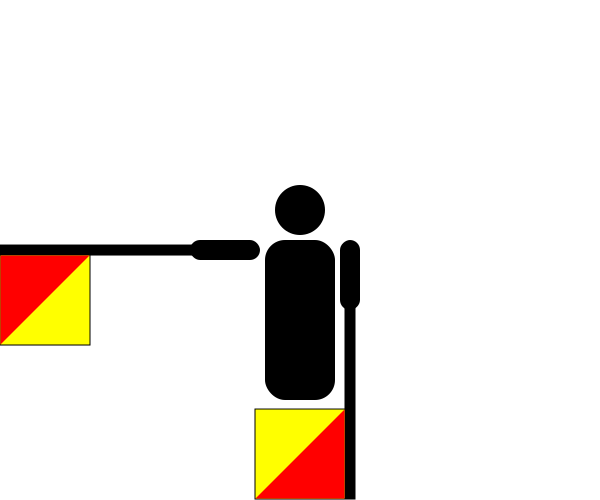
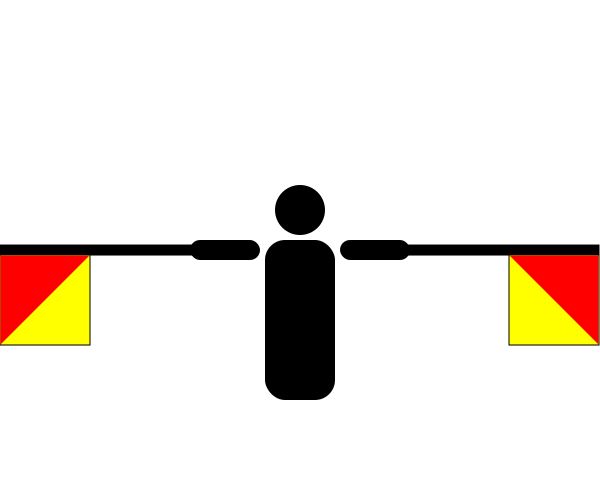
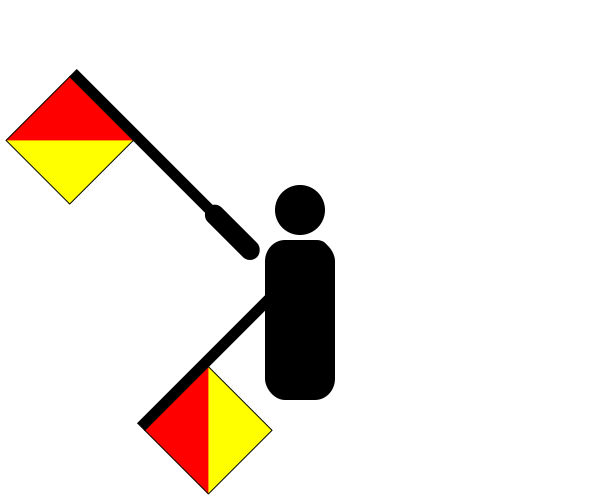
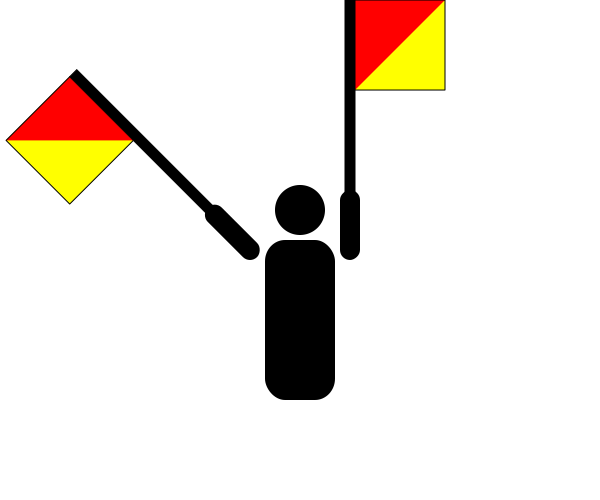
There are approximately 863 people named Britt in the UK. That makes it roughly the 8,285th most common surname in Britain. Around 13 in a million people in Britain are named Britt.
Origin: English
Region of origin: British Isles
Country of origin: England
Religion of origin: Christian
Language of origin: English

Famous people named Britt
- Leo Britt - Actor (1908 to 1)
- Martin Britt - Football player
- L.D. Britt - American surgeon
Names and descriptions courtesy of Wikipedia, and may contain errors. This is not intended to be an exhaustive list of every famous person with this name.