BREEN
The surname Breen is a distinct name of Irish provenance, characterised by its connection to the Gaelic patronymic Ó Braoin. The element Ó denotes “descendant of”, while Braon is a personal name that has been interpreted in various ways. In the most common derivation, braon means “moisture” or “drop”, suggesting a link to water or a wet climate. An alternative scholarly view translates braon as “sorrow” or “moan”, a sentiment reflected in the emotional quality often associated with the name in modern usage. The duality of meaning underlines the rich linguistic heritage intrinsic to Gaelic nomenclature.
Historical evidence places the earliest usage of the name in the annals of Ireland. The first recorded spelling is that of Tighearnach O'Braoin, dated to 1088 in the Ecclesiastical Records of Clonmacnois. This situates the name firmly within the late‑Eleventh‑Century milieu of the High Kings of Ireland. The name continued to appear in medieval documents, with a Donal O'Breen serving as Bishop of Clonmacnois from 1303 to 1324, and an O'Breen of Brawney mentioned in 1421 as a great chieftain alongside O'Connor and Mac Morogh. Such references demonstrate the name’s early establishment as a marker of social standing within Irish society.
A notable historical distinction lies in the existence of two principal septs bearing the name. The Mac Breens were situated near Knocktopher in County Kilkenny. By 1659 the patronymic prefix Mac had largely been omitted, a trend that echoes broader patterns of Anglicisation in post‑Mopping‑the‑Yeast Ireland. The O'Breens formed a larger sept that held lands in the counties of Westmeath and Offaly, near Athlone. In contemporary records the name there is often obscured under the alias O'Brien, further illustrating the fluidity of surname evolution in the face of linguistic and political change.
Geographically, the surname has deep roots in the province of Munster. County Kilkenny, where the Mac Breens were first recorded, is regarded as the original point of origin. From there the name expanded into neighbouring counties such as Tipperary, Waterford and, more recently, Clare and Wexford. In these regions, local chronicles and parish registers consistently list individuals known as Breen, indicating the name’s widespread native presence. The surname also appears in County Galway and County Clare, where a sept of the Ui Fiachrach aidhne once dwelt before later migrating to Kerry and Limerick.
The linguistic journey of the name is reflected in its many orthographic variants. Contemporary forms include Breen, Breene, Brean and Breane. Earlier documents show forms such as Brevald and Brine, while later records incorporate Anglicised prefixes like O' and Mc to produce O'Breen, O'Breene and McBreen. Related surnames that share a common root include Brennen, Breadan, Brien and Breheny, signalling a broader family of names derived from the same Gaelic origin.
In the course of the Great Famine of the 1840s the surname crossed the Atlantic with marked migration. A documented instance of a Denis Breen, a 24‑year‑old farmer, left Glasgow aboard the ship John R. Skiddy bound for New York on 4 November 1846. The diaspora that followed carried the name to the United States, Canada, Australia and the United Kingdom, where Irish emigrants settled in valleys, towns and cities across the English‑speaking world.
Today the name persists predominantly within Ireland, with the largest concentrations found in the counties of Clare and Wexford, as well as in the areas of Kilkenny and Galway. In addition, considerable communities of Breen descendants exist in countries that historically witnessed significant Irish emigration. Consequently, the surname remains a familiar and respected element of the Irish onomastic landscape.
Although the precise meanings attributed to the root braon differ in scholarly tradition, the overarching narrative of the Breen surname is clear. It demonstrates a lineage of medieval prominence, a capacity for linguistic adaptation, and a resilience that has ensured its survival across centuries and continents.
Typical given names associated with the Breen surname
Male
- Anthony
- Christopher
- David
- James
- John
- Mark
- Michael
- Patrick
- Paul
- Thomas
Female
- Catherine
- Elizabeth
- Helen
- Karen
- Margaret
- Mary
- Michelle
- Nicola
- Patricia
- Ruth
- Sarah
- Susan
Similar and related surnames
- Brans
- Bradeen
- Brean
- Breden
- Brano
- Braen
- Brayen
- Berreen
- Beren
- Bree
- Breene
- Breens
- Brenno
- Breon
- Breyen
- Bareen
- Braneen
- Breem
- Brein
- Bremen
- Bren
- Brena
- Brene
- Brenen
- Brenk
- Brenn
- Breun
- Brewen
- Brewn
- Brian
- Briand
- Briant
- Brien
- Brine
- Brione
- Broen
- Bruen
- Bryan
- Bryant
- Bryon
- Byrn
- Byron
- Barone
- Birnie
- Birrane
- Bourne
- Brain
- Braine
- Bran
- Brown
- Bruno
- Burn
- Burne
Related and similar names are generated algorithmically based on the spelling, and may not necessarily share an etymology.
How to communicate the surname Breen in...
Braille
⠃⠗⠑⠑⠝
Morse
-....-...-.
Semaphore
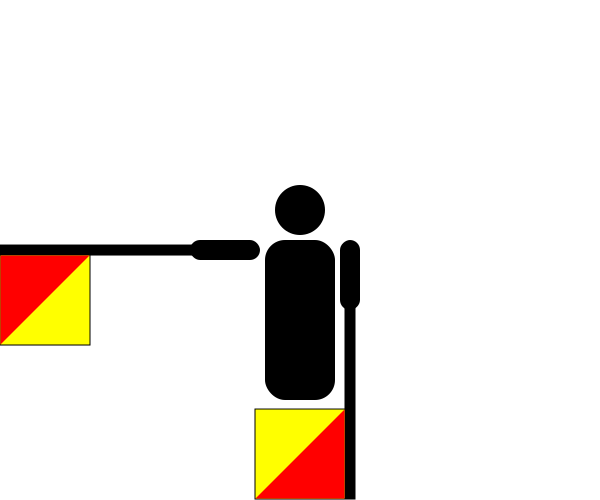
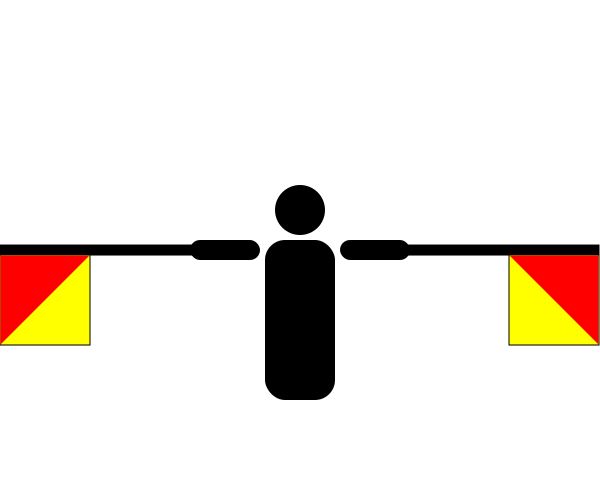

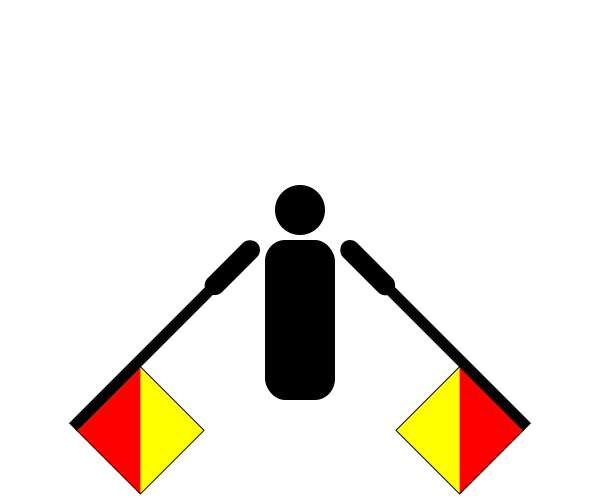
There are approximately 5,566 people named Breen in the UK. That makes it roughly the 1,700th most common surname in Britain. Around 85 in a million people in Britain are named Breen.
Origin: Celtic
Region of origin: British Isles
Country of origin: Ireland
Religion of origin: Christian
Language of origin: Gaelic

Famous people named Breen
- Richard Abidin Breen - Singer, rapper, dancer, and DJ
- Gary Breen - Irish football player
- Michael Breen - Writer
- Olivia Breen - Athlete
- John Breen - Acaedmic
- James Breen - Irish astronomer (1826 to 1866)
Names and descriptions courtesy of Wikipedia, and may contain errors. This is not intended to be an exhaustive list of every famous person with this name.