BISSETT
Bissett is a surname with a distinctly Scottish pedigree, yet its roots reach back to continental France and the broader Celtic linguistic family of the British Isles. The name bears the characteristic Gaelic suffix that marks its connection to the clans of the Highlands while simultaneously reflecting a linguistic history that began in the early Middle Ages.
The earliest known appearance of the name is in the 12th‑century chapter of the Abbey of Bury St. Edmunds, where a Leunsgileman named Ernulf Biset is recorded in a 1155 charter under King Henry I. This early source confirms that the surname was already in use in England shortly after the Norman Conquest, and it provides the first documented example of a Bissett holding land in the north‑east of Scotland.
From a linguistic perspective, biset is an Old French term meaning “fair‑haired” or “light‑haired”. Descriptive surnames of this type were typically employed to distinguish individuals with a particular physical trait. In the case of the Bissett name, it is believed that the original bearer was noted for pale or light hair, a characteristic that was significant enough to become hereditary.
The name evolved through the medieval period and appeared in a variety of forms. Early records name Walter Biset of Schedenestun in 1226, and Maunsel Bisset of Worcester in 1273, illustrating the spread of the surname beyond Scotland into England. The 14th‑century religious community lists Jacobus Besat, prior of St. Andrews in 1395, while the 1591 marriage record at St. Nicholas church, Aberdeen mentions both Alexander Bissett and Kattrin Cultis. These entries show that the name was carried by individuals of varying social standing, from clerics to laity.
District land‑patronage is another key feature of the Bissett heritage. In 1174, King William the Lion of Scotland returned from captivity at Falaise accompanied by Henricus Byset, who was later given extensive estates in Aberdeenshire and designated Lord of Aboyne. The Bissets of Lessendrum, who sourced their influence from these lands, remain noted in the region today. Further evidence of political prominence appears in the 14th and 15th centuries, when Alexander Bissett was granted a charter for Kilbucho near Peebles in 1377, and Sir Andrew Bissett of Corehouse was elected the first Sheriff of Lanark during the same century.
By the 17 century, the Bissett family had secured landholdings in Corehouse, Lanarkshire, and formed an alliance with the Campbells, Earls of Argyll. While they never rose to the power of the major Highland clans, the Bissetts were respected enough to be mentioned in contemporary histories and included in alliances that shaped the political landscape of Scotland.
The surname has multiple variants stemming from phonetic spelling changes and regional dialects. Common orthographic forms include Bisset, Biset, Byset, Bysset, Bissette, Bissote, and Bissot. The variations often derive from the Old French root bes meaning “thicket” or “cluster of trees”, and the Middle English suffix et meaning “of” or “belonging to”. The occasional reference to Old Norse bísast – “to grow or increase” – has also been proposed, reflecting the fertility of lands associated with certain Bissett holdings.
Distribution records show that the surname remains predominantly found in the United Kingdom, particularly in Scotland, where it is dispersed across Glasgow, Inverness, and Caithness, and in the north‑western parts of England, including Yorkshire, Essex and Surrey. In Canada, Australia, New Zealand, the United States and Mexico, the name appears, though in smaller numbers. The American census lists Bissett as the 2,820th most common surname, with significant concentrations in the states of California, Florida, New York, Texas, Massachusetts, and Pennsylvania.
Modern bearers of the surname Bissett often trace their lineage back to the Scottish clans or to the early Norman settlers in England. The longevity of the hereditary name, coupled with its early documentation, provides a rich genealogical resource for descendants seeking to understand the historical significance of their family name. The surname serves as a cultural anchor that connects individuals to their ancestors' physical traits, landholdings, and the broader historical tapestry of Scotland and the wider British Isles.
Typical given names associated with the Bissett surname
Male
- Alan
- Andrew
- David
- Ian
- James
- John
- Mark
- Michael
- Paul
- Robert
- Thomas
- William
Female
- Catherine
- Cheryl
- Eileen
- Elizabeth
- Emma
- Jacqueline
- Jean
- Kelly
- Margaret
- Mary
- Nicola
- Sarah
- Susan
- Valerie
- Victoria
Similar and related surnames
Related and similar names are generated algorithmically based on the spelling, and may not necessarily share an etymology.
How to communicate the surname Bissett in...
Braille
⠃⠊⠎⠎⠑⠞⠞
Morse
-............--
Semaphore
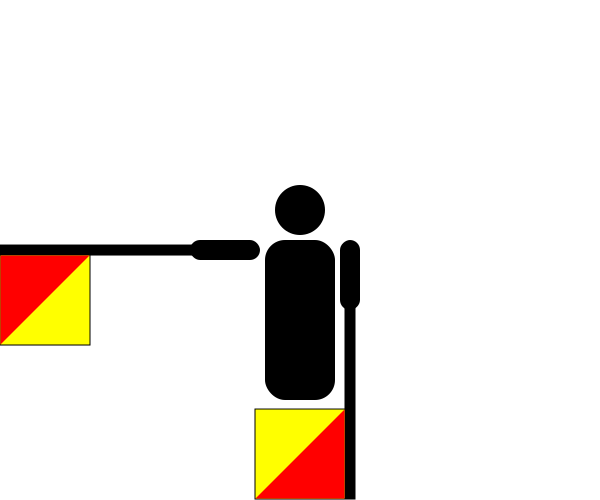
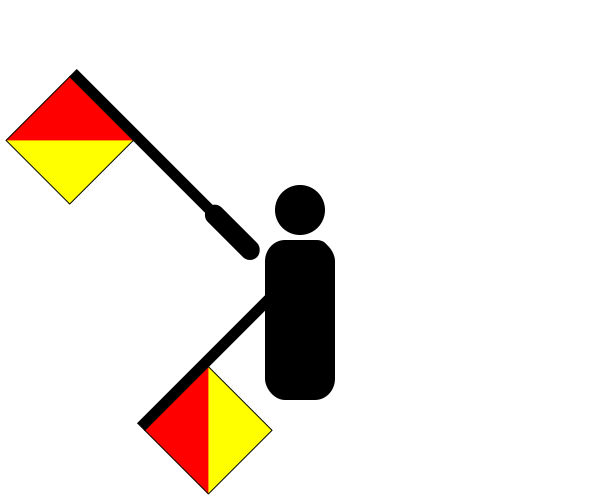


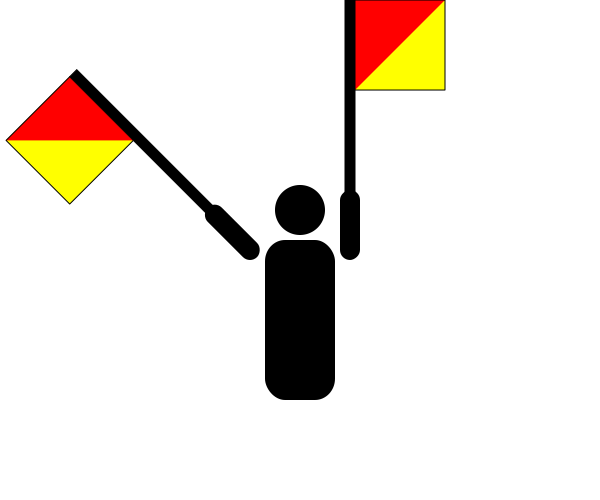
There are approximately 2,340 people named Bissett in the UK. That makes it roughly the 3,695th most common surname in Britain. Around 36 in a million people in Britain are named Bissett.
Surname type: Diminutive
Origin: Celtic
Region of origin: British Isles
Country of origin: Scotland
Religion of origin: Christian
Language of origin: Gaelic

Famous people named Bissett
- Alan Bissett - Scottish writer
- William Davidson Bissett - Recipient of the Victoria Cross (1893 to 1971)
- George Bissett - Football player (1887 to 1)
- Jimmy Bissett - Football player
- Nicky Bissett - Football player
Names and descriptions courtesy of Wikipedia, and may contain errors. This is not intended to be an exhaustive list of every famous person with this name.