BISSET
Bisset is a surname that traces its roots to both French and Scottish origins. The earliest recorded form, Ernulf Biset, appears in the charter of the Abbey of Bury St. Edmunds in 1155, a period that immediately follows the Norman Conquest of England in 1066.
The name is believed to have been brought to England from Normandy by followers of William the Conqueror. It is derived from the Old French word bezaz or bezace, meaning “a small animal with a reddish‑brown coat.” An alternative etymology links the surname to the Old French bisset or buisson, meaning “weedy area” or “shrub.” These interpretations suggest that the original bearers of the name were either nicknamed for a particular appearance, or that they lived in or worked in overgrown woodlands.
Following the conquest, members of the Bisset family were granted lands in England and, subsequently, in Scotland by King David I in the 12th century. The clan became prominent in the regions of Beauly and Ross, where the Bissets were known as a noble and influential family. In 1174, King William the Lion of Scotland returned from captivity in Falaise accompanied by a companion named Henricus Byset; together with his son John, they were invested with extensive estates in Aberdeenshire, a title that culminated in the lordship of Aboyne. The Bissets of Lessendrum continue to be associated with these lands to the present day.
Early documentary evidence of the surname includes a 1226 reference to Walter Biset of Schedenestun in Scotland and a 1273 record of Maunsel Bisset in Worcester, England. Ecclesiastical records further attest to the name: in 1395, Jacobus Besat served as prior of St. Andrews, while in 1591, Alexander Bissett married Kattrin Cultis at St. Nicholas Church in Aberdeen.
The coat of arms traditionally borne by the Bisset family is described heraldically as a blue field charged with a silver bend. The escutcheon, together with the clan motto articulated in the Scots language, underscores the family's long-standing association with feudal honour and landholding.
In modern times the Bisset name remains most common in Scotland, where it still echoes its historical associations with land and status. Through waves of emigration from the United Kingdom, the surname can now be found throughout Australia, New Zealand, Canada, the United States and South Africa. Variants of the name include Bissett, Bissette, Bissitt, Besset, and Bessett; some early forms even employed a prefix de, suggesting a geographical link to a place in France.
Typical given names associated with the Bisset surname
Male
- Alan
- Alexander
- Andrew
- David
- Ian
- James
- John
- Mark
- Michael
- Robert
- Steven
- William
Female
- Alison
- Claire
- Elizabeth
- Fiona
- Jacqueline
- Jennifer
- Julie
- Karen
- Linda
- Margaret
- Mary
- Sarah
Similar and related surnames
Related and similar names are generated algorithmically based on the spelling, and may not necessarily share an etymology.
How to communicate the surname Bisset in...
Braille
⠃⠊⠎⠎⠑⠞
Morse
-............-
Semaphore
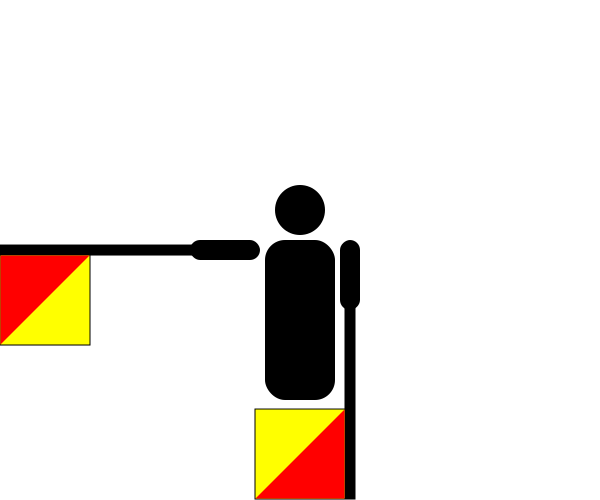
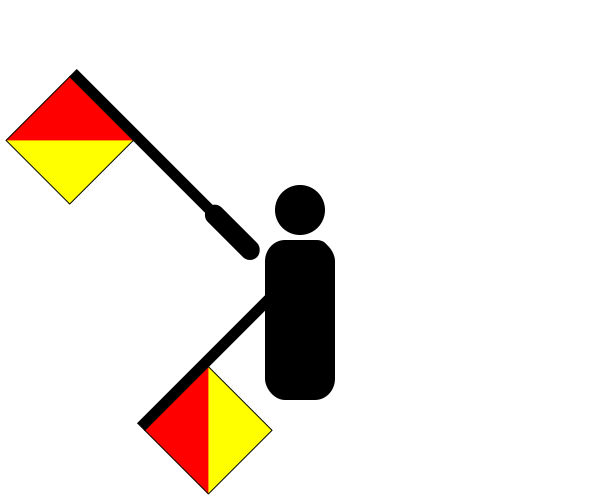


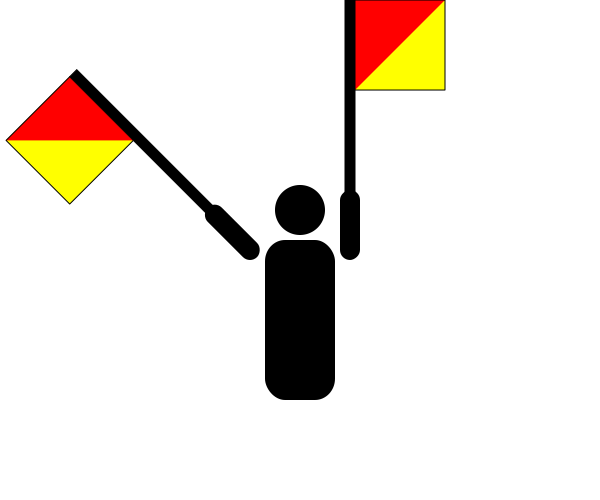
There are approximately 2,449 people named Bisset in the UK. That makes it roughly the 3,564th most common surname in Britain. Around 38 in a million people in Britain are named Bisset.
Origin: Celtic
Region of origin: British Isles
Country of origin: Scotland
Religion of origin: Christian
Language of origin: Gaelic

Famous people named Bisset
- Jacqueline Bisset - Actress
- Donald Bisset - Actor (1910 to 1995)
- Douglas Robertson Bisset - (1908 to 1)
- James Bisset - South African engineer and architect (1836 to 1919)
- Tommy Bisset - Football player
- Andrew Bisset - Scottish barrister and writer on law of the United Kingdom (1801 to 1891)
Names and descriptions courtesy of Wikipedia, and may contain errors. This is not intended to be an exhaustive list of every famous person with this name.