BENE
Bene is a surname that traces its origins to Italy and the Latin language. The base form of the word is the Latin bene, meaning good or well and is often found as an element in Italian names that denote a virtuous or favourable character.
The earliest documented use of the name appears in England in the late twelve‑teenth century with records such as the Durham rolls, where a William Benet is listed in 1208. This would be one of the first instances of a family adopting the name as a hereditary surname in the English canon.
In Italy, the surname arose primarily as a nickname for individuals who displayed a kindly, upright disposition. Those referred to as Bene were recognised by their community for their benevolence and moral conduct, a tradition confirmed by historical documents that describe the name as a marker of good standing within local villages.
What further broadens the historical record of the surname is its connection to the Latin name Benedictus. The personal name means “blessed” and was popularized by St. Benedict of Monte Cassino (c. 480‑550). In the centuries that followed, variations of this name were recorded across Europe under forms such as Beneit in France; Benedicte in Germany; and Bennett in Anglo‑Saxon contexts. By the eleventh and twelfth centuries, the name had migrated from ecclesiastical use to a common given name for all members of society, particularly after the Crusades when returning pilgrims often named children after saints.
These earlier ecclesiastic connections turned into permanent surnames over the next two centuries. Relatively early examples in England include Robert Benyt of Yorkshire, documented in 1327, and in Germany a recorder notes a Hainrich Benedicte at St. Blazien in 1330. By the early seventeenth century, the surname had also reached the New England colonies in North America, most notably with Edward Bennett of Virginia, who was known as a substantial landowner.
In addition to its Latin origin, regional variants have arisen from toponymic and linguistic influences. In Hungary, Slovakia, and surrounding areas, the surname can be linked to place names that include the word Bene, suggesting that early bearers of the name were residents of or otherwise connected with those locations. These toponymic uses are well documented in parish records and census entries from the fifteenth and sixteenth centuries.
Another set of variations includes forms that incorporate bene in a compound structure: Benelli, Benetti, Benna, and Benni are frequently recorded in the southern and northern Italian regions of Lombardy, Piedmont, and Veneto. These names are generally understood to be diminutives or affectionate forms of the core root and reflect local dialectal patterns.
According to contemporary demographic surveys, the surname remains relatively uncommon. It is predominantly found in Italy, particularly in the aforementioned regions, and among Italian emigrants in the United States, Brazil, and Australia. In the United Kingdom, the name is usually associated with Italian immigrant families recorded in the nineteenth‑century immigration registers.
Notable individuals bearing the surname include the modern Italian economist Marco Bene, who has contributed to research on European fiscal policy, and the American civil engineer Elena Bene‑Smith, whose work on sustainable urban infrastructure has received international recognition. While these contemporary figures are not necessarily connected to the historical lineage, their shared surname continues to serve as a cultural link to the name’s origins.
Because the root of Bene is a common Latin word, the surname may also be encountered in contexts that have a different etymological background, such as the Hebrew‑derived term meaning “children of” used within extended family names. Such variants are rare and generally confined to specific genealogical branches, according to the current scholarly consensus.
Thus, the surname Bene exemplifies how a simple Latin adjective can evolve into a family name that not only carries a sense of moral quality but also reflects a complex tapestry of linguistic, religious, and migratory histories across Europe and beyond.
Similar and related surnames
- Been
- Ben
- Bena
- Benea
- Benee
- Benei
- Baan
- Bagne
- Bahn
- Baigne
- Bain
- Baine
- Ban
- Bane
- Banea
- Banee
- Banes
- Bann
- Banne
- Bayn
- Bayne
- Beagne
- Bean
- Beane
- Beanes
- Beaney
- Beani
- Beann
- Beano
- Beans
- Beena
- Beene
- Beenie
- Behn
- Behne
- Behney
- Bein
- Beine
- Beines
- Beins
- Benes
- Beney
- Benez
- Beni
- Benie
- Benna
- Benne
- Bennee
- Bennes
- Benney
- Benni
- Bennie
- Benno
- Benns
- Beno
- Benu
- Beny
- Benz
- Beyne
- Beynes
- Biehn
- Biene
- Baines
- Bawn
- Baynes
- Beeny
- Bence
- Bend
- Benek
- Benet
- Benge
- Benn
- Benny
- Bent
- Bona
- Bone
- Boon
- Bown
- Byne
Related and similar names are generated algorithmically based on the spelling, and may not necessarily share an etymology.
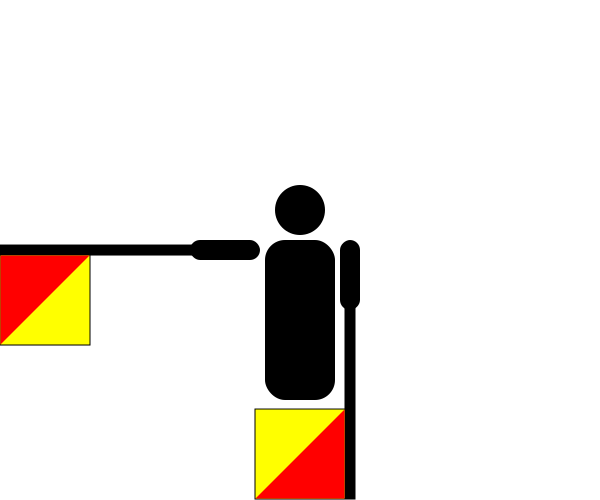
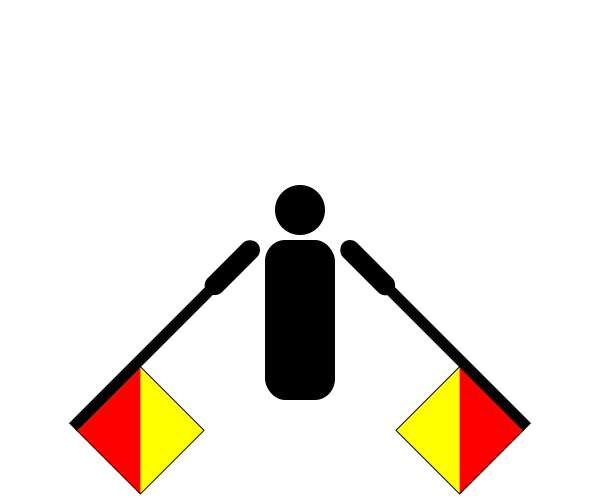
How to communicate the surname Bene in...
Braille
⠃⠑⠝⠑
Morse
-....-..
Semaphore

There are approximately 81 people named Bene in the UK. That makes it one of Britain's least common surnames. Only around one in a million people in Britain are named Bene.
