BEEN
The Been surname traces its earliest attestations to the 12th century, with the name recorded as Ailwardus Bene in the Norfolk County Pipe Rolls dated 1166 during the reign of King Henry XI. The spelling Bene and later variations such as Biene and Bene appear in medieval documents across England, for example in Cumberland in 1168 and in Lancashire in 1278. A reference to Ferchard Bean in Edinburgh in 1428 demonstrates the name’s penetration into the Scottish Lowlands as well.
In Dutch, the word been translates as “leg” or “bone.” Consequently, the surname is often regarded as an occupational or descriptive nick‑name, perhaps applied to an individual whose work involved legs or bones—such as a shoemaker, a tailor who specialised in leg garments, a medieval leg surgeon, or a bone collector. The name might also have been assigned to a person noted for distinctive lower limbs, for instance a tall or lean figure. While many Dutch bearers of the name were historically associated with such professions, the exact occupational linkage can vary according to local custom and family history; the evidence does not preclude the possibility that the name could also describe a physical characteristic rather than a vocation.
English and Scottish traditions provide additional etymological possibilities. One hypothesis derives from an Anglo‑Saxon occupational word for a grower or seller of beans, the Old English stem bean, which later evolved into the surname Bean. Another suggests a nickname from the Middle English term bene, meaning friendly or amiable. A third lineage points to a Scottish origin, whereby Been is an anglicised rendering of the Gaelic personal name Beathan, itself a diminutive of be(a)tha meaning “life.” Through these traditions, variants such as Bean, Benn, and the clan prefixes MacBean, MacBain, and MacBayne are all traceable to the same root.
Contemporary distribution statistics indicate that the Been surname is uncommon in the Netherlands today, a phenomenon attributable to migration and changing naming customs. In the former British Empire, the name is more frequently encountered: it ranks as the 23 930th most common surname in Australia, the 25 105th in the United States, and it also appears in Canada, Belgium, and England, though to a lesser extent. The most common orthographic variant remains Bean, especially in Scotland, while English variants like Binn and Bane appear occasionally in record evidence.
Variants and related surnames can reflect both phonetic evolution and cultural adaptation. In addition to Bean, Benn, Bain, Bayn, and Bane, surname directories list Bein, Beyn, Byne, and Biehn as possible cognates, most often arising from Germanic or French influences. Prefixes such as Van or Von relate the name to Dutch or German contexts, generating forms like Van Been and Von Bien. Likewise, Irish tradition occasionally records O’Bein and O’Bean, indicating the name’s penetration into Gaelic-speaking regions.
When analysing any surname, attention to historical records, linguistic shifts and migratory patterns is essential. The Been surname exemplifies how a name of continental Germanic origin can simultaneously acquire distinct meanings in Dutch, Anglo‑Saxon, and Scottish contexts, reflecting the complex interplay of language, occupation, and personal description that characterises surname histories.
Typical given names associated with the Been surname
Male
Female
Similar and related surnames
Related and similar names are generated algorithmically based on the spelling, and may not necessarily share an etymology.
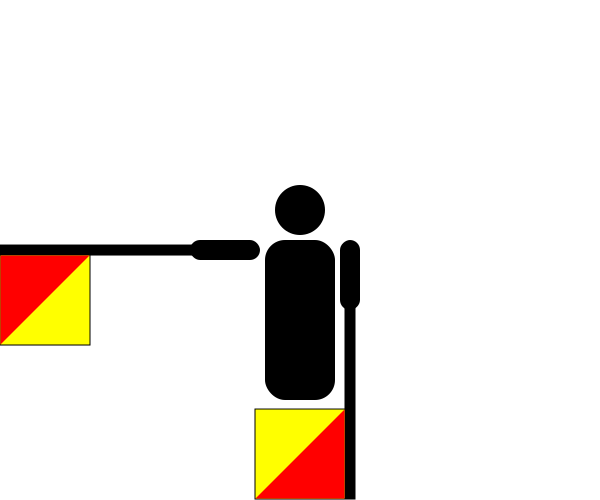
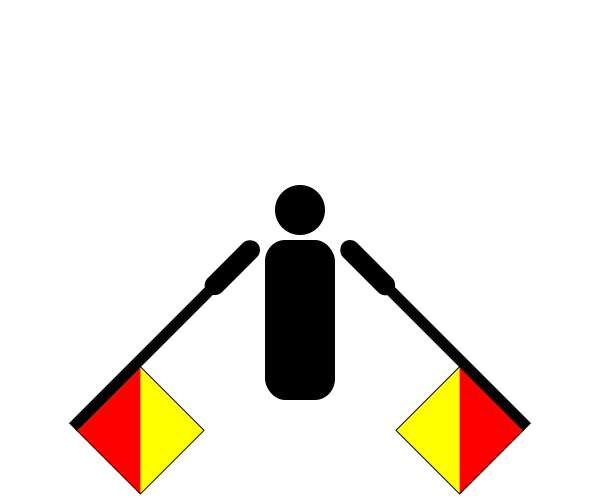
How to communicate the surname Been in...
Braille
⠃⠑⠑⠝
Morse
-.....-.
Semaphore

There are approximately 48 people named Been in the UK. That makes it one of Britain's least common surnames. Only around one in a million people in Britain are named Been.