BELLER
Beller is a surname that has intrigued historians and genealogists alike for its layered origins and remarkable historical persistence across several linguistic and geographic landscapes.
At its core, Beller is German in origin. The name traces back to the Middle High German term bel or belle, signifying a bell. This etymology suggests that the earliest bearers of the name may have been bell ringers, bell makers or individuals who lived near a bell tower. The occupational connotation is further reinforced by historic records, such as the 1281 entry for Richard le Beller, described as a bell founder.
Variation in the surname’s spelling reflects the linguistic diversity of the regions in which it has appeared. Forms such as Belle, Bellay, Bellee, Bellie, Belly, and Bellye attest to a fluid orthography influenced by local dialects and the phonetic priorities of record keepers. A rarer form, Bellyman, may be a distant cognate of Bellman, hinting at roles such as a town crier, a job that historically involved a loud, barking‑like proclamation.
Beyond the German roots, the surname also bears traces of French influence. In early Norman England, surnames derived from the French words bel or belle, meaning good or fair, migrated into the British Isles after the Norman Conquest of 1066. The diminutive or patronymic suffixes –ie or –y produced forms such as Bellie or Belly, conveying meanings like Little Bell or son of Bell. Other sequelae of this French influence include Belson or Bellson, surnames that emerged in early English onomastics.
Documentation from early ecclesiastical registers highlights several instance of the surname’s use in medieval London: John Bellye a witness to a church covenant in 1590; Mary Bellay christened in 1610 at St Andrews by the wardrobe; and Alice Belly, recorded in 1645 at St Dunstans in Stepney. A 1838 register noted the Italian variant Belli in London, indicating the surname’s capacity to absorb continental influences.
The breadth of the surname’s variants extends further. Among them are Bellen, Bellers, Bellerose, Bellar, Bellerd, Belair, Belaire, and Bellier. Each variation reflects a distinct phonetic or orthographic legacy, yet many share a common semantic root tied to the bell, the act of ringing, or the sound of barking.
Today, the name Beller is recognised principally in German‑speaking regions, reflecting its origin. Its diaspora, however, extends to the United States, Canada, and Israel, where individuals of German or Ashkenazi Jewish descent have carried the name into new cultural contexts. The migration of bearers over the centuries has rendered the surname broadly common in several countries, with notable populations maintaining the name’s original spelling while others have adjusted it to fit local spelling conventions.
In sum, the surname Beller encapsulates a confluence of occupational history, linguistic evolution, and migratory patterns. While the name’s core meaning links to the bell—a symbol of call, warning, or celebration—its manifold branches across Europe and the wider world demonstrate the dynamic nature of surnames and the legacy they preserve across generations.
Similar and related surnames
- Belle
- Bahler
- Bailer
- Bailler
- Bailor
- Bailur
- Balar
- Baler
- Balera
- Balier
- Balir
- Ballar
- Ballara
- Ballaro
- Baller
- Ballerio
- Balyer
- Bayler
- Baylor
- Bealer
- Bealor
- Beehler
- Beeler
- Behler
- Belair
- Beler
- Belier
- Bellaers
- Bellair
- Bellaire
- Bellairs
- Bellar
- Bellara
- Bellare
- Bellars
- Bellary
- Bellau
- Bellears
- Bellee
- Bellei
- Bellerby
- Bellerly
- Bellerose
- Bellers
- Bellier
- Belliere
- Bellor
- Bellur
- Belor
- Belur
- Beyeler
- Beyler
- Beylier
- Biehler
- Bieler
- Bueler
- Bellard
- Bloore
- Boler
- Bowler
Related and similar names are generated algorithmically based on the spelling, and may not necessarily share an etymology.
How to communicate the surname Beller in...
Braille
⠃⠑⠇⠇⠑⠗
Morse
-.....-...-....-.
Semaphore
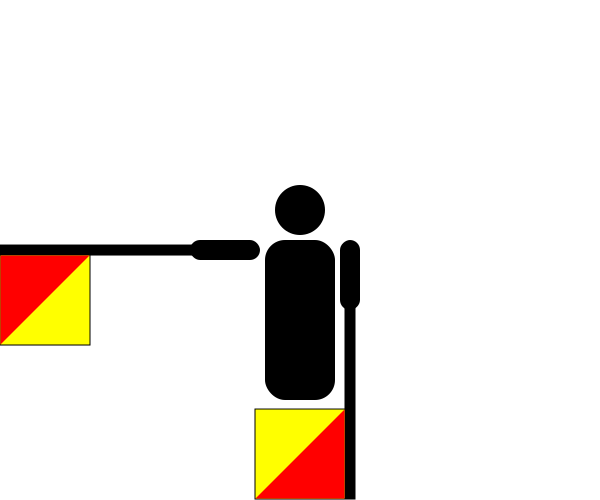


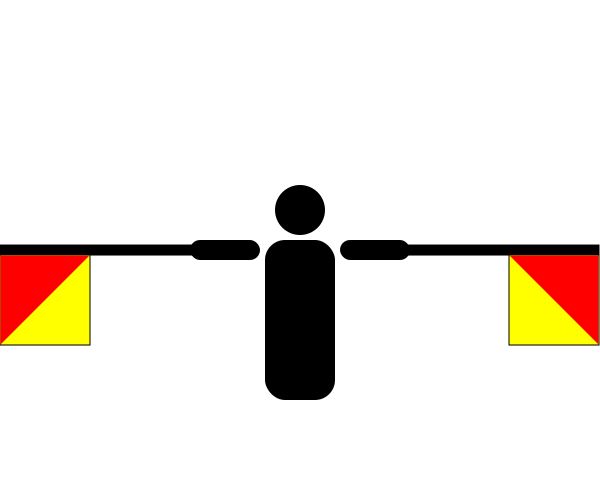
There are approximately 41 people named Beller in the UK. That makes it one of Britain's least common surnames. Only around one in a million people in Britain are named Beller.
Region of origin: Europe
Country of origin: France
Language of origin: French
