BELLARD
Bellard is a surname that finds its roots in both French and Germanic linguistic traditions. The earliest recognisable use of the name appears in English records from the early fifteenth century, particularly within the British Isles.
The formative elements of the name derive from the Old French word bel, meaning “beautiful” or “fair”, and the Germanic word hard, which conveys the sense of “brave” or “strong”. When combined, these elements give the surname the interpretation of “beautiful and brave” or “fair and strong”, and it is likely that the name was originally bestowed upon individuals who possessed or admired these qualities.
There is, however, scholarly discussion concerning a second source for the surname. One theory proposes that Bellard is a variant of the Old English occupational name Bull Ward, which referred to a keeper of bulls. Another hypothesis links it to the English surname Belwood, a name that was common in Yorkshire and is believed to originate from a medieval village of that name in Lincolnshire. A third possibility, suggested by evidence of Huguenot refugees, is that the name emerged from French nicknames such as Beliard, meaning “machine of war” or specifically “battering ram”, and Berard, meaning “the good looking one”.
Documentation of the name in England is attested from the early 1500s. An individual named John Bulward appears in the Subsidy Rolls of Suffolk in 1524, during the reign of King Henry VI. Subsequent records include a Bellard in London in 1541, an Alice Bellard at St Dunstans Church in Stepney in 1572, and, in 1705, a marriage under the spelling Belvard at St Katherine's by the Tower. The first surviving spelling of the name that is recognisable as the modern Bellard is associated with Robert Bellward documented at All Hallows Church, London Wall, on 3 April 1716. A later example is Mary Belward marrying John Scarf at St Giles Cripplegate in 1732.
Geographically, while the name was first recorded in England, its influence can be traced back to French regions such as Picardie and Normandie, where it is thought to have been widespread. In contemporary times, the surname has migrated beyond France, with notable concentrations in the United States—especially in Louisiana, where French heritage remains strong—and in Canada. It remains relatively uncommon on a global scale but still retains a measurable presence in France.
Variants of the name include Bellart, Belliard, Belard, Bilard, Blard, Bellared, and Beliard. These phonetic spellings often arose from regional pronunciation differences and the natural evolution of spelling within parish registers and other documentary sources. Related surnames that share the bel element are Bellan, Bellance, Bellanger, Bellay, and Bellaud, and these names are commonly found across France, Belgium and Canada.
Typical given names associated with the Bellard surname
Male
- Andrew
- Daniel
- David
- Frederic
- Giuseppe
- Ian
- John
- Michael
- Paul
- Philip
- Stephen
- William
Female
- Amanda
- April
- Brenda
- Diana
- Gillian
- Helen
- Karen
- Lisa
- Lynn
- Mary
- Rachel
- Rebecca
- Sarah
Similar and related surnames
- Balard
- Bellar
- Bellara
- Balerdi
- Ballard
- Ballardie
- Ballards
- Ballerd
- Ballord
- Belardi
- Belardo
- Belaud
- Bellaart
- Bellair
- Bellaire
- Bellairs
- Bellards
- Bellare
- Bellars
- Bellary
- Bellears
- Bellgard
- Belliard
- Bellord
- Bellouard
- Bellward
- Belward
- Billard
- Bollard
- Bullard
- Ballar
- Ballardin
- Ballardini
- Belair
- Belardini
- Bella
- Bellaera
- Bellaers
- Bellaris
- Bellau
- Bellegarde
- Beller
- Bellor
- Bellur
- Blard
Related and similar names are generated algorithmically based on the spelling, and may not necessarily share an etymology.
How to communicate the surname Bellard in...
Braille
⠃⠑⠇⠇⠁⠗⠙
Morse
-.....-...-...-.-.-..
Semaphore
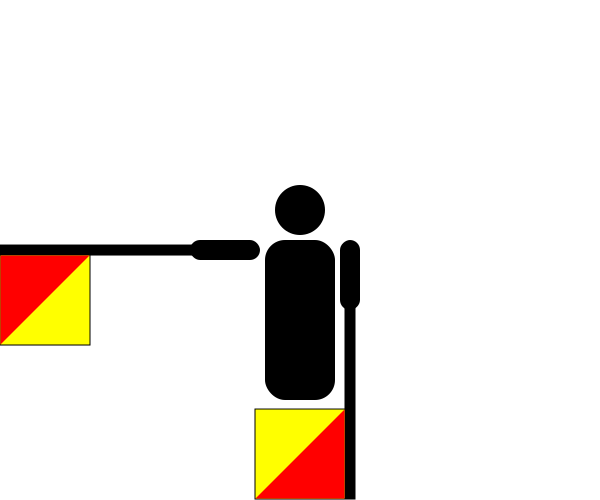


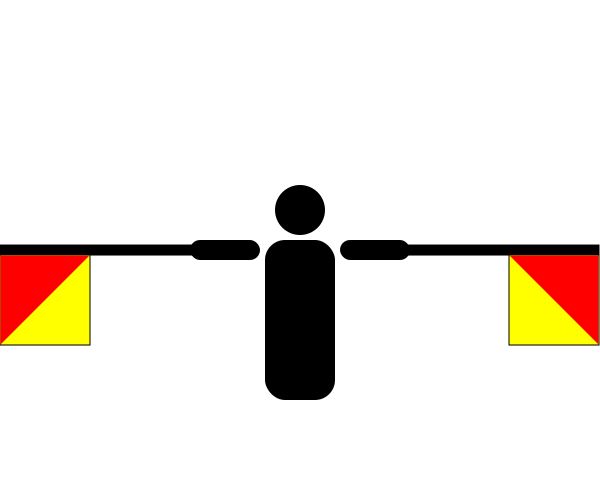

There are approximately 153 people named Bellard in the UK. That makes it one of Britain's least common surnames. Only around two in a million people in Britain are named Bellard.
Surname type: Occupational name
Origin: English
Region of origin: British Isles
Country of origin: England
Religion of origin: Christian
Language of origin: English
