BARRITT
Origin and Etymology
The surname Barritt is of English origin and is derived from the personal name Barrett, which itself is of Germanic origin. The Germanic elements are berht, meaning “bright” or “famous”, and hard, meaning “brave” or “strong”, so that the name may be interpreted as “bright and brave” or “famous and strong”.
Another tradition holds that the name could be linked to the Germanic personal names Bernhard or Bernwald that were introduced into England after the Norman Conquest of 1066. In this view the elements ber(n) would refer to a bear, with hard again meaning bravery or strength, while Bernwald would mean “bear‑rule”. A further possibility, recorded in the Middle English barrette, is that the name originally meant a quarrelsome or deceitful person, with barrette standing for trouble or strife. Finally, the Old French barette meaning a cap or bonnet might suggest a metonymic occupational name for a maker or seller of caps.
Early Recordings
The surname first appears in the mid‑12th century. In the Pipe Rolls of Nottinghamshire (1165) a Robert Barate is recorded, and in the Pipe Rolls of Hampshire (1207) a Seman Barette is noted. From the “Social and Economic Documents of London” it is known that a Matthew Baret was documented in 1150, during the reign of King Stephen (1135‑1154). These early attestations show a range of spellings – Baret, Barette, Barate, Barrett – that would later evolve into the standard form Barritt.
In the 14th century the surname appears again in calculated documents such as the Curia Regis Rolls, where a Thomas Barrete is listed in 1273 in Buckinghamshire. This early series of records demonstrates that the name had spread across England by the late Middle Ages.
Geographic Distribution
In England the surname has been recorded in Staffordshire since the 12th century and, during the Victorian era, spread to the counties of Lancashire and Cheshire. In Ireland it is particularly common in Ulster, where families bearing the name are documented from the 17th century onward. In Scotland the name is rarer but can be found in Angus and East Lothian. Across the Atlantic, the name appears in colonial‑era Virginia and is now present throughout the United States, with concentrations in the southern states and a widespread national distribution. In Australia and Canada the surname arrived in the 19th century and has since become well established. The name is also recorded in New Zealand.
The surname may originally have been toponymic, referring to a person from the village of Barrow in Lincolnshire. The place name Barrow could derive from Old English bearu (grove) and hēah (high place). An alternative place of origin is Barrow‑upon‑Soar in Leicestershire, a settlement founded before the Norman Conquest. The exact original place remains uncertain, but both possibilities are consistent with the historic record.
Variants and Cross‑Cultural Forms
The surname has many variants. English records include Barratt, Barrat, Barratts, Baret, Barett, Barit, Baritt and occasionally Barrittt. It has been related to the surname Burrough, suggesting a possible Norman influence. In the United States the name has appeared as Bratt, Britt, Barrat, Brat, Barrett, Barrit, Beerit; in Ireland it has been rendered Barreade, Barrett; and in other countries it has appeared as Brett, Berrett. These variations reflect orthographic changes over time and across dialects.
Notable Bearers
A notable individual was Alfred Barratt (1844‑1881), a philosophical writer and secretary of the Oxford University Commission in 1880. In more recent centuries, writers, artists, politicians, soldiers and sports players have carried the surname, contributing to its visibility in the public record.
Coat of Arms
The Barritt family Crest features a silver shield with three lozenge buckles in bend gules, and a galley as the crest, with its oars in sable and flags gules. This heraldic description is drawn from surviving family traditions and is typical of noble families in medieval England.
Conclusion
The surname Barritt exhibits a long and well‑documented history across the British Isles and the wider English‑speaking world. Its origins lie in Germanic personal names, toponymic references, and possibly occupational descriptors. The many historical attestations and spelling variants illustrate the linguistic diversity of English surnames during the Middle Ages and beyond. Today the name continues to be borne by individuals throughout the United Kingdom, Ireland, Scotland, the United States, Canada, Australia and New Zealand.
Typical given names associated with the Barritt surname
Male
- Adrian
- Andrew
- Christopher
- David
- Ian
- John
- Michael
- Paul
- Peter
- Richard
- Stephen
- Thomas
Female
- Elizabeth
- Emma
- Helen
- Jean
- Julie
- Karen
- Linda
- Margaret
- Marie
- Patricia
- Samantha
- Susan
Similar and related surnames
- Barett
- Bariteau
- Barit
- Baratt
- Barrit
- Barritte
- Baretti
- Baritt
- Baritz
- Barratt
- Barret
- Barrett
- Barri
- Barriett
- Barriot
- Barriteau
- Barrith
- Barrtt
- Bearitt
- Beritt
- Berritt
- Birit
- Borritt
- Burritt
- Barid
- Bariett
- Barrat
- Barrette
- Barretto
- Barrie
- Barriet
- Barris
- Barrot
- Barrott
- Barti
- Bartie
- Bartt
- Barttey
- Berits
- Berritta
- Borrits
- Burity
- Baird
- Bardoe
- Barot
- Birdi
- Brade
- Bradie
- Bratt
- Brett
- Brito
- Brodie
- Burt
- Burtt
- Byrd
Related and similar names are generated algorithmically based on the spelling, and may not necessarily share an etymology.
How to communicate the surname Barritt in...
Braille
⠃⠁⠗⠗⠊⠞⠞
Morse
-....-.-..-...--
Semaphore
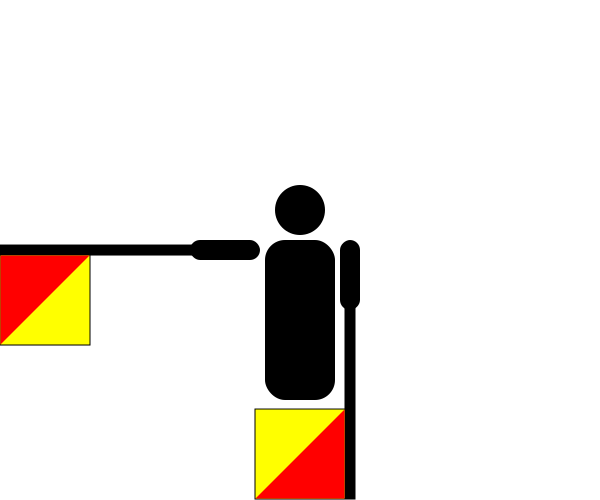

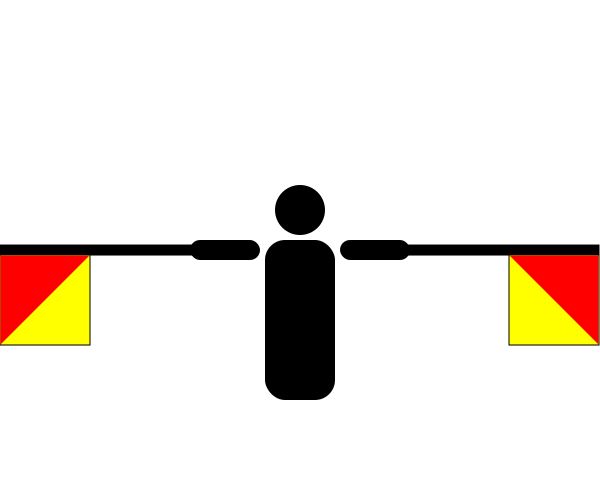
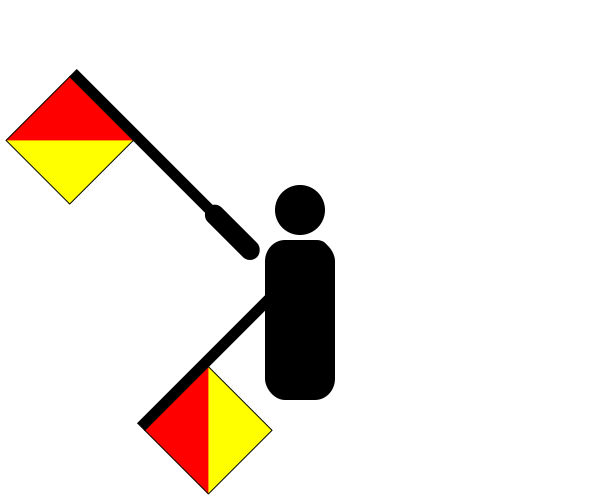
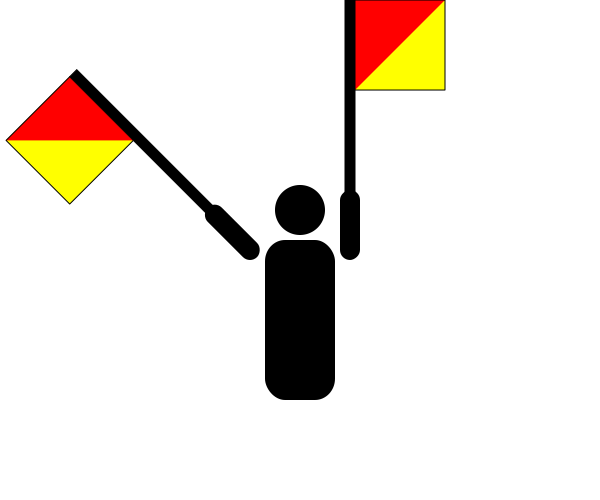
There are approximately 1,057 people named Barritt in the UK. That makes it roughly the 7,070th most common surname in Britain. Around 16 in a million people in Britain are named Barritt.
Origin: English
Region of origin: British Isles
Country of origin: England
Religion of origin: Christian
Language of origin: English

Famous people named Barritt
- Daniel Barritt - Rally co-driver
- Ron Barritt - Football player (1919 to 1)
Names and descriptions courtesy of Wikipedia, and may contain errors. This is not intended to be an exhaustive list of every famous person with this name.