BARON
Recorded variant spellings include Bar-On
Baron is a surname that traces its origins to the French language and the Norman conquest of England in 1066. The name derives from the Old French barun or baro, which means a man, a freeman or a nobleman. Following the Norman invasion, the term was introduced into English usage and came to denote the lowest rank of the feudal nobility, positioned below an earl or duke.
Early recorded instances of the surname appear in the Domesday Book of 1086, illustrating that the name was already established among the landholding and administrative elite of the Anglo‑Saxon and newly conquered societies. The Domesday survey, conducted in England as a fiscal and administrative record, lists the name Baron among other presences of the name in the southern counties.
In the 1095 register of the abbey of Bury St Edmunds, a figure named Lefuine Barun is noted. This documentation, carried out during the reign of King William the Conqueror, showcases the surname in its early Norman form and places it firmly within the context of the shifting administrative structures of early medieval England.
Throughout the 13th and 14th centuries, the name appeared in various legal and tax documents. Records such as Gervase Baronn in the London Names Lists of 1251 and Richard le Baron in the 1273 Pipe Rolls of Devon confirm the widespread adoption of the name among freemen and minor officials. These documents indicate that the surname was employed either as a status name for those who served a baron or as a nickname for individuals who exhibited a baronial bearing.
Beyond England, the surname travelled to Ireland and Scotland, where it acquired additional meanings tied to civic authority. In those regions, a person bearing the title of Baron could be a civic official responsible for the jurisdiction of a barony, as well as a freeman of major cities such as London, York, or the Cinque Ports in Kent and Sussex. The name, therefore, held an administrative connotation that extended beyond the aristocratic sphere.
In Jewish communities, particularly among Ashkenazi families, Barons were occasionally adopted as ornamental surnames or occupational names for those belonging to rabbinic aristocracy. These Jewish uses of the name place it within the broader context of European surname development in the late medieval to early modern periods, when many families chose surnames that reflected social status or professional affiliation.
The surname exhibits a rich array of spelling variations. Early forms include Barun, Barin, Birin, Burren, and Birrane, while later iterations such as Byron or Byron‑like spellings appear in English records. In addition, modern forms such as Barron, Barends, and Barra are documented across different linguistic landscapes. These variations are often a reflection of regional pronunciation and the flexible orthographic practices of the time.
In contemporary times, the name Baron is found widely across Europe and North America. Its spread is particularly notable in the United States, where it ranks around the 2709th most common surname, in France and French‑speaking Canada, as well as in Israel due to Jewish immigration patterns. The name also retains a presence in England, Germany, and other European nations, appearing in professions ranging from academia to politics.
While the name is associated with regal and noble undertones, it should be understood that, as a surname, it does not automatically confer status. Indeed, many individuals bearing the surname historically served as officials, freemen, or ordinary citizens who simply adopted the name because of its occupational or status connotations. The surname thus offers a nuanced view of medieval societal structures and the transmission of language across borders.
In summary, the surname Baron encapsulates a heritage that is intrinsically linked to the Norman conquest, the feudal hierarchy, and the evolving administrative identities of medieval Europe. Its continued use today underscores a lasting legacy of linguistic and cultural interchange that has shaped the identity of families across continents.
Typical given names associated with the Baron surname
Male
- Andrew
- Christopher
- David
- James
- John
- Mark
- Michael
- Paul
- Peter
- Richard
Female
- Elaine
- Elizabeth
- Helen
- Jacqueline
- Julie
- Karen
- Linda
- Margaret
- Nicola
- Patricia
- Sarah
- Susan
- Victoria
Similar and related surnames
- Barron
- Baren
- Barens
- Bairo
- Barbon
- Bardon
- Bareen
- Baehren
- Abron
- Baro
- Barona
- Barone
- Baroni
- Baharon
- Barion
- Barno
- Barom
- Barons
- Baroo
- Baros
- Barou
- Baroun
- Barow
- Barran
- Barren
- Barrens
- Barrion
- Barro
- Barrons
- Barun
- Baruni
- Bayeren
- Bearen
- Bearon
- Beeren
- Beren
- Beron
- Berren
- Berron
- Biren
- Biron
- Birron
- Boren
- Boron
- Borron
- Borun
- Bouren
- Bouron
- Buren
- Buron
- Burren
- Burron
- Burrons
- Bahorun
- Bargon
- Barlon
- Barn
- Barne
- Barnon
- Barnow
- Barouni
- Barrin
- Barrn
- Barrom
- Barson
- Barton
- Bartron
- Bauen
- Bawen
- Bearo
- Boaron
- Boiron
- Borno
- Borren
- Borrons
- Burion
- Baronne
- Birnie
- Birrane
- Bourne
- Brain
- Braine
- Bran
- Brown
- Bruno
- Burn
- Burne
- Byron
Related and similar names are generated algorithmically based on the spelling, and may not necessarily share an etymology.
How to communicate the surname Baron in...
Braille
⠃⠁⠗⠕⠝
Morse
-....-.-.----.
Semaphore
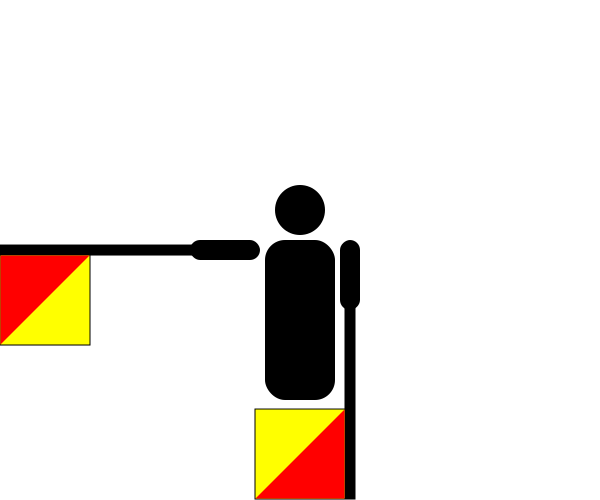

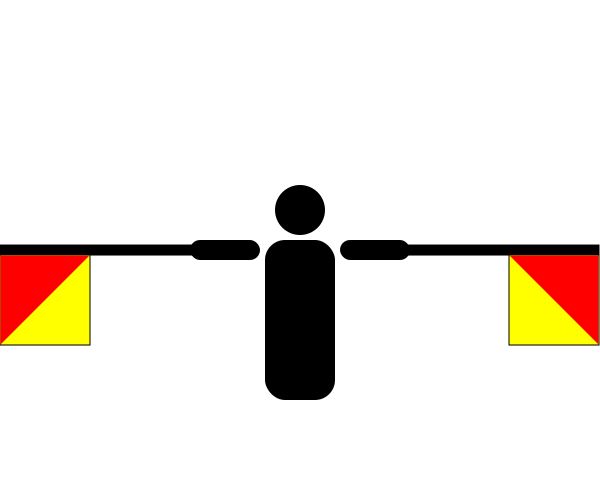
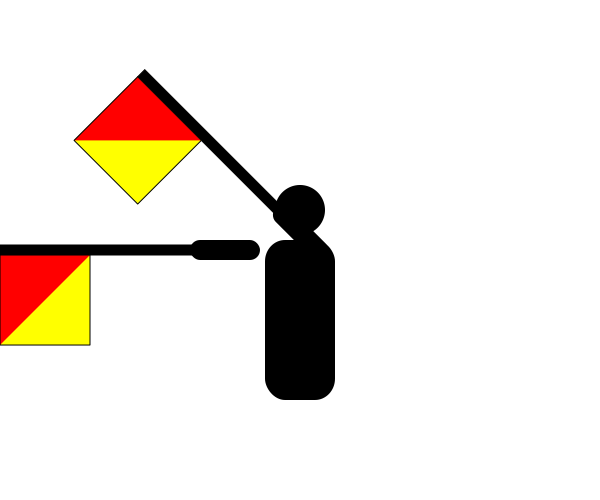
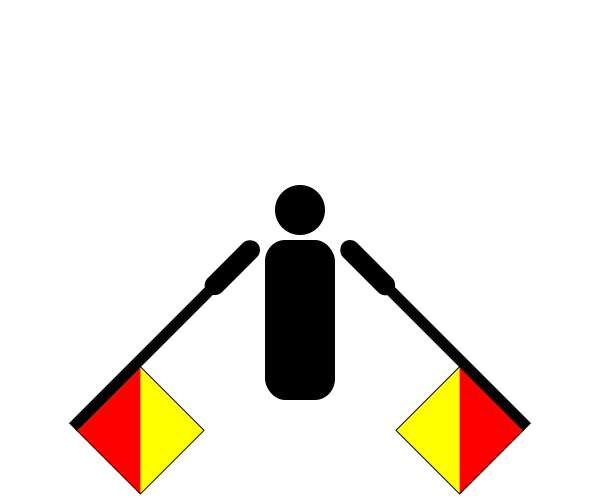
There are approximately 5,510 people named Baron in the UK. That makes it roughly the 1,721st most common surname in Britain. Around 85 in a million people in Britain are named Baron.
Origin: English
Region of origin: British Isles
Country of origin: England
Religion of origin: Christian
Language of origin: English

Famous people named Baron
- Lynda Baron - Actress
- John Baron - Politician
- Alexander Baron - Screenwriter (1917 to 1999)
- Kevin Baron - Football player (1926 to 1971)
- Leo Baron - Bridge player, Zambian and Zimbabwean jurist (1916 to 1985)
- Fred Baron - Football player
Names and descriptions courtesy of Wikipedia, and may contain errors. This is not intended to be an exhaustive list of every famous person with this name.