BARK
Bark is a surname of English origin that is traditionally understood as a topographical name derived from the Old English word beorc, meaning birch tree. The designation was given to individuals who lived close to a prominent birch tree or in an area characterised by birch trees, or to those who worked with such trees, for example as a woodcutter or basket weaver.
In the British Isles the name is also associated with Gaelic and other Celtic linguistic traditions. The surname has been recorded in Scotland, where references indicate a Scottish source and Christian religious affiliation, reflecting the wider Celtic heritage of the region.
Parallel origins exist in continental Europe. In Germany the surname arises from the Middle High German word berc, also meaning birch. The earliest known reference to a noble family bearing the Bark name dates to the 12th century in Bavaria. From there the name spread throughout Europe, reaching the Netherlands and Scandinavia. In England it appears in the legal record of 1379, suggesting an early Anglo‑Saxon presence.
Early documentary evidence in the 16th and 17th centuries demonstrates a continued use of the name in both territories. For example, Hanss and Reineke Bark were married on 7 September 1628 in Detmold, Lippe, Germany, and John Bark was christened on 27 May 1654 at St. Dunstan's Stepney in London. The family coat of arms, most commonly associated with the Bark line, depicts a blue shield charged with a chevron between three gold crescents.
The surname has several recognised variants, including
While some sources note that the surname could be derived from the English and Scots word barker, meaning a tanner or a leather worker, the evidence for this particular occupational derivation remains uncertain. As such, it is recognised as a potential variant arising from later linguistic influences rather than the primary origin of the name.
The birch tree itself, whether considered in English or German tradition, is frequently viewed as a symbol of rejuvenation and new beginnings. Where historical records mention the bark surname in the context of noble families, notably in Bavaria, the tree’s symbolic significance has occasionally been highlighted, though such associations should be understood within the broader cultural interpretations of the period rather than as a defining element of the surname’s history.
Typical given names associated with the Bark surname
Male
- Andrew
- Colin
- David
- Gary
- James
- John
- Michael
- Peter
- Robert
- Stephen
- Thomas
- William
Female
- Claire
- Elizabeth
- Emma
- Hazel
- Joanne
- Karen
- Lisa
- Louise
- Margaret
- Mary
- Michelle
- Pearl
- Sarah
- Susan
Similar and related surnames
- Barck
- Barc
- Barco
- Barca
- Bar
- Baark
- Barek
- Barcks
- Barcz
- Brak
- Bakr
- Bara
- Barka
- Barke
- Barki
- Barko
- Barg
- Barkai
- Barkas
- Barkay
- Barkes
- Barkey
- Barkho
- Barkie
- Barkis
- Barkow
- Barks
- Barkus
- Bauck
- Bauks
- Baulk
- Bawks
- Berck
- Berk
- Berka
- Berke
- Berki
- Berko
- Berks
- Birck
- Birk
- Birke
- Birks
- Boarke
- Borck
- Borek
- Bork
- Borke
- Borko
- Borks
- Bourk
- Bourke
- Burck
- Burk
- Burka
- Burke
- Burki
- Burko
- Burks
- Barcoe
- Barcy
- Bargh
- Barkess
- Barku
- Barkway
- Barok
- Bars
- Barz
- Baucke
- Baulks
- Berkes
- Berky
- Bierc
- Birkes
- Birky
- Burkes
- Burkie
- Burky
- Barrack
- Barrick
- Berkey
- Borg
- Brack
- Bragg
- Brigg
- Brook
- Brooke
- Burkey
Related and similar names are generated algorithmically based on the spelling, and may not necessarily share an etymology.
How to communicate the surname Bark in...
Braille
⠃⠁⠗⠅
Morse
-....-.-.-.-
Semaphore
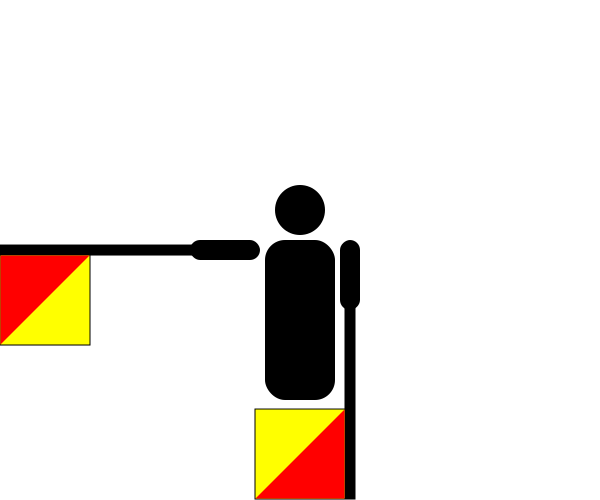

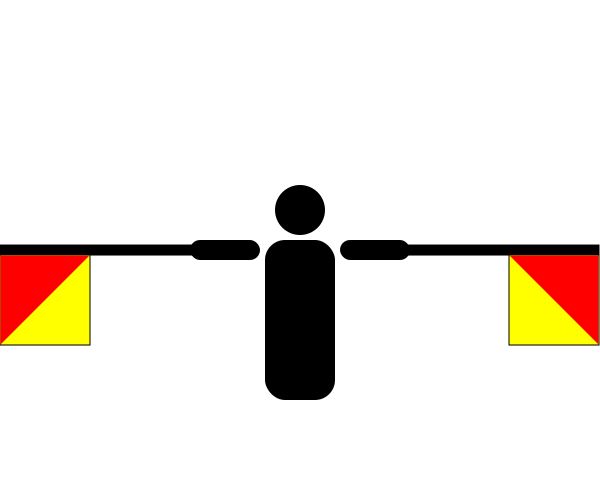
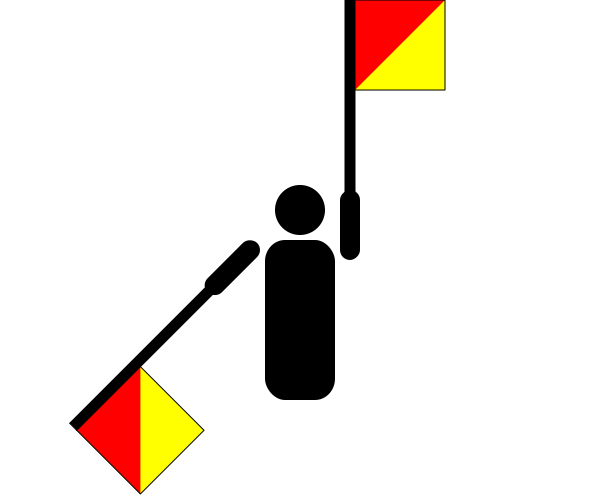
There are approximately 922 people named Bark in the UK. That makes it roughly the 7,845th most common surname in Britain. Around 14 in a million people in Britain are named Bark.
Origin: Celtic
Region of origin: British Isles
Country of origin: Scotland
Religion of origin: Christian
Language of origin: Gaelic
