ABRAM
Abram is a surname of Hebrew origin, deriving from the biblical name Abram, which carries the meaning of “exalted father” or “father of many.” The name is thus a patronymic form, indicating descent from a male ancestor named Abram.
Early medieval records from the British Isles identify the surname as either locational, originating from the village of Abram in the parish of Wigan, or as a form of the Hebrew male given name Abraham, meaning “father of a multitude.” In this context the name was adopted by returning Crusaders to commemorate their visit to the Holy Land. The Domesday Book of 1086 records a priest named Abraham in London, and in 1170 a document relating to the Danelaw of Lincolnshire mentions Abraham de Stradtuna.
In England the surname was never of Jewish origin; Jews were forbidden from residence in the country until 1655. During the eighteenth century non‑conformists used ‘Abraham’ and ‘Abram’ as baptismal names, and the name remained popular among Christian families, notably in Wales.
Among Jewish communities the surname Abram is common, particularly among Ashkenazi Jews. It is one of several derivatives of the Hebrew name Abraham and can be found worldwide, including the United States, Israel, Poland and Russia. In Russia the name may appear as a shortened form of Abramovich or Abramov, which literally means “son of Abram.”
Variants of the surname include Abrams, Abrahams, Abramson, Abramovich, Abramov, Abramowski, Abramoff, Abramvitz, Ablam, and a contraction Bram. Each variant follows the same patronymic principle, signifying descent from an ancestor named Abram.
The heraldic description most commonly associated with the name is a shield lozengy gold and red, on a black chief the sun in his splendour, gold, with a crest consisting of a cap of maintenance decorated with a plume of ostrich feathers, all proper.
Early documentary evidence of individuals bearing the surname includes John Abraam in the Hundred Rolls of Bedfordshire in 1273, Gilbert de Abraam in London in 1461, William Abram of Sephton, Lancashire in 1617, and Sarah Abram, daughter of Andrew and Gillian Abram, christened at St Mary Abbots, Kensington, London, on 11 November 1646. The first recorded spelling recognised in the “Chartulary of the Monastery of Ramsey” in 1252 is that of Robert Abram.
In contemporary times the surname Abram remains widely distributed across the United Kingdom and the United States, with significant concentrations in England, Israel and Poland, reflecting both its Hebrew roots and its long history within English-speaking Britain.
Typical given names associated with the Abram surname
Male
- Brian
- Christopher
- David
- James
- John
- Mark
- Michael
- Paul
- Richard
- Robert
- William
Female
- Caroline
- Elizabeth
- Jane
- Joanne
- Linda
- Louise
- Margaret
- Mary
- Nicola
- Patricia
- Rachel
- Susan
Similar and related surnames
Related and similar names are generated algorithmically based on the spelling, and may not necessarily share an etymology.
How to communicate the surname Abram in...
Braille
⠁⠃⠗⠁⠍
Morse
.--....-..---
Semaphore

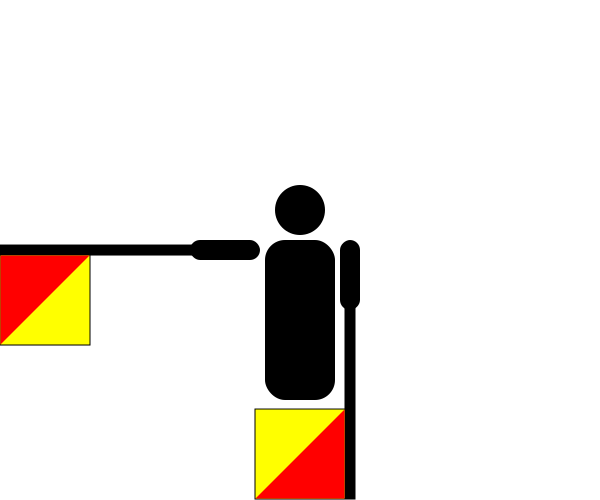
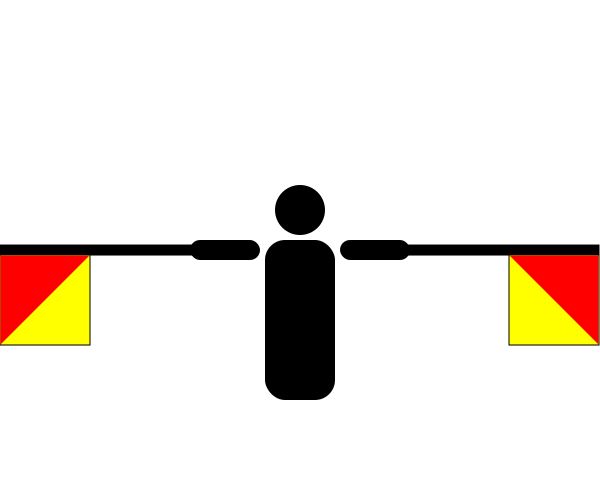
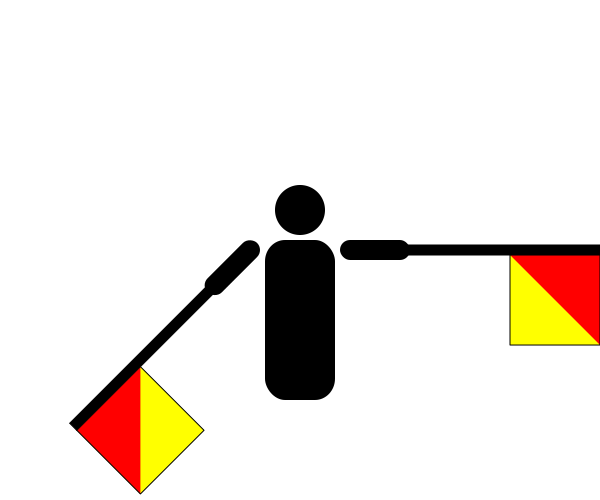
There are approximately 1,890 people named Abram in the UK. That makes it roughly the 4,410th most common surname in Britain. Around 29 in a million people in Britain are named Abram.
Surname type: Location or geographical feature
Origin: English
Region of origin: British Isles
Country of origin: England
Religion of origin: Christian
Language of origin: English

Famous people named Abram
- Syd Abram - Rugby league player (1906 to 1988)
Names and descriptions courtesy of Wikipedia, and may contain errors. This is not intended to be an exhaustive list of every famous person with this name.