ABELLA
Abella is a surname that traces its roots to several cultural and linguistic traditions, primarily within the Romance‑language families, with occasional connections to Hebrew nomenclature. Its etymology is intertwined with the Latin word abello, meaning “bee”, which has been passed down through Slavic, Catalan and Italian linguistic developments.
The name is ascribed to a number of descriptive origins. It may have arisen as a nickname for an individual associated with bees, such as an apiarist or someone whose activities resembled the industrious nature of bees. Another plausible derivation is from place‑names, for example the Catalan town of Abella de la Conca in the province of Lleida. The town’s name translates as “bee hive” in Catalan and hints at a history of apiculture or abundant wild bee populations. In both cases, the surname signifies attributes of hard work, productivity and community service, traits traditionally associated with bees.
Beyond the Spanish and Catalan contexts, the surname may reflect a Greek or Latin *metonymic* occupational reference, with the Latin term apis evolving into various vernacular forms such as Abellia and Abello. Some scholars suggest a locational link to the ancient Roman province of Abellia, whose name is thought to be of Etruscan origin and may point towards a burial place. A further etymological thread connects the surname to the Hebrew name Hevel (commonly recorded in Europe as Abel), introduced into Spanish on account of Crusaders returning from the Holy Land in the thirteenth century. This demonstrates the surname’s potential multifaceted heritage, encompassing occupational, locational and patronymic elements.
In Jewish tradition, Abella often functions as a habitational surname, derived from the town of Àvila in Castile, historically referred to as Obila. The dispersal of this name is frequently linked to the migration of Spanish Jews during the Inquisition. In the diaspora, the surname has been noted in Malta, where records include the 1724 marriage of Maria Abela and Michaelis Fenech, and in the United States, Philippines and Latin America, where Spanish colonisation facilitated its spread.
Documented instances of the surname date back to at least the seventeenth century. One early record is that of Eularia Abella, married in Santa Maria La Bisbal, Gerona, Spain, on 24 August 1675, during the reign of King Charles XI. Other licit entries in the seventeenth and eighteenth centuries include Bernardo de Abela and Sebastean Abella, both marrying in various Spanish provinces. The surname also possesses heraldic registration; the Maltese coat of arms for Abella is blazoned as a blue field with a gold chevron and three gold spurs in chief.
The surname has a number of orthographic variants that have emerged across language borders and over time. These include Abell, Abelle, Abellia, Abelli, Abelo, Abele, Aballi, Abellan, Abellanosa, Abellano and the anglicised Abell. Such variations often arise from regional dialectal influences, civil registration practices, or transliteration during migration. In Spanish‑speaking societies, it is not unusual to encounter compounded forms, for example Abella‑Rodríguez or Gómez‑Abella, reflecting the customary use of both paternal and maternal surnames.
Today, the Abella surname remains present in Spain, where it continues to be found across Catalonia, Valencia and the Balearic Islands. Its diaspora is evident in Latin American nations such as Mexico, Argentina, Chile and Peru, as well as in former Spanish colonies like the Philippines. Within the United Kingdom, the name is less common but can still be encountered, often within families of Iberian ancestry. The surname’s multiplicity of origins and its spread across continents make it a fascinating example of the ways in which cultural, occupational and geographical factors intertwine in family history.
Similar and related surnames
Related and similar names are generated algorithmically based on the spelling, and may not necessarily share an etymology.
How to communicate the surname Abella in...
Braille
⠁⠃⠑⠇⠇⠁
Morse
.--.....-...-...-
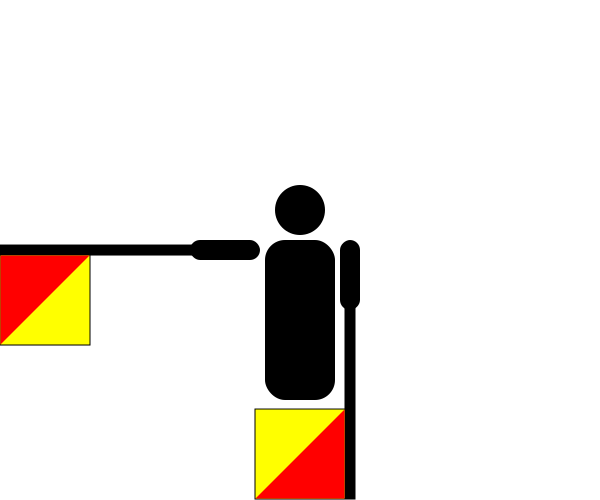
Semaphore



There are approximately 145 people named Abella in the UK. That makes it one of Britain's least common surnames. Only around two in a million people in Britain are named Abella.